



 Chat with AI
Exam 12: Contributed Capital

Exam 1: Uses of Accounting Information and the Financial Statements167 Questions
Exam 2: Analyzing Business Transactions189 Questions
Exam 3: Measuring Business Income171 Questions
Exam 4: Completing the Accounting Cycle176 Questions
Exam 5: Financial Reporting and Analysis177 Questions
Exam 6: The Operating Cycle and Merchandising Operations145 Questions
Exam 7: Internal Control117 Questions
Exam 8: Inventories154 Questions
Exam 9: Cash and Receivables177 Questions
Exam 10: Current Liabilities and Fair Value Accounting180 Questions
Exam 11: Long Term Assets241 Questions
Exam 12: Contributed Capital189 Questions
Exam 13: Long Term Liabilities194 Questions
Exam 14: The Corporate Income Statement and the Statement of Stockholders Equity176 Questions
Exam 15: The Statement of Cash Flows149 Questions
Exam 16: Financial Performance Measurement163 Questions
Exam 17: Partnerships129 Questions
Exam 18: The Changing Business Environment-A Managers Pers130 Questions
Exam 19: Cost Concepts and Cost Allocation188 Questions
Exam 20: Costing Systems: Job Order Costing88 Questions
Exam 21: Costing Systems Process Costing136 Questions
Exam 22: Activity-Based Systems-Abm and Lean152 Questions
Exam 23: Cost Behavior Analysis166 Questions
Exam 24: The Budgeting Process116 Questions
Exam 25: Performance Management and Evaluation117 Questions
Exam 26: Standard Costing and Variance Analysis120 Questions
Exam 27: Short Run Decision Analysis90 Questions
Exam 28: Capital Investment Analysis123 Questions
Select questions type


The board of directors carries out the day-to-day operations of the business.
(True/False)
4.8/5  (80)
(80) Red River Corporation has 24,000 shares of 11 percent noncumulative preferred stock and 60,000 shares of common stock outstanding. Par value for each is $10. The company paid no dividends last year. This year, a $100,000 dividend is paid. How much of the $100,000 is paid to the preferred shareholders?
(Essay)
4.9/5 (77)
(77) Indicate on the blanks below the net effect (I = increase, D = decrease, NE = no effect) of each of the following entries on total stockholders' equity.
_____ 1. To record the declaration of a cash dividend
_____ 2. To record the payment of a previously declared and recorded cash dividend
_____ 3. To close the Dividends account at the end of the accounting period
(Short Answer)
4.8/5 (83)
(83) A company purchases 400 shares of its $50 par value common stock at $55 per share. It then reissues 60 shares at $58 per share. The entry upon reissue of the stock is : 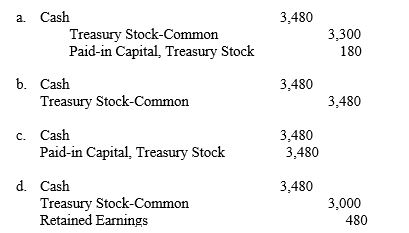
(Short Answer)
4.9/5 (76)
(76) The Additional Paid-in Capital account normally arises in the accounting records when
(Multiple Choice)
4.9/5 (76)
(76) Which of the following stock terms is least like the others?
(Multiple Choice)
4.9/5 (66)
(66) Use the following information to answer the question below.
When Calvert Corporation was formed on January 1, 2010, the corporate charter provided for 50,000 shares of $20 par value common stock. The following transactions were among those engaged in by the corporation during its first month of operation:
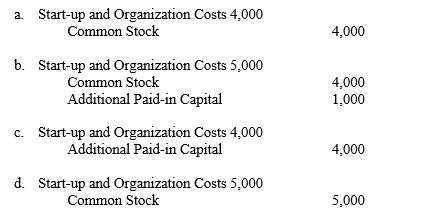
1. The corporation issued 200 shares of stock to its lawyer in full payment of the $5,000 bill for assisting the company in drawing up its articles of incorporation and filing the proper papers with the state agency.
2. The company issued 8,000 shares of stock at a price of $25 per share.
3. The company issued 7,000 shares of stock in exchange for equipment that had a fair market value of $160,000.
The entry to record transaction 1 is:
(Not Answered)
This question doesn't have any answer yet
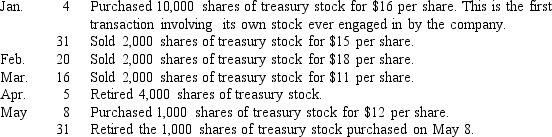
Baird Corporation had 60,000 shares of $5 par value common stock issued and outstanding on December 31, 2009. Each share was issued during 2007 at $14 per share. Prepare the entries in journal form without explanations for the following transactions occurring in 2010:
(Essay)
4.7/5 (82)
(82) Use the following information to obtain the ratios requested below. Where necessary, carry answers to one decimal place.
Dividends per share: $.76
Market price per share: $40
Net income: $64,000
Stockholders' equity, beginning of year: $500,000
Stockholders' equity, end of year: $530,000
Earnings per share: $1.75
a. Dividends yield = _____________%
b. Return on equity = _____________%
c. Price/earnings (P/E) ratio = __________ times
(Essay)
4.9/5 (75)
(75) The cost of treasury stock is deducted from total Contributed Capital and Retained Earnings in determining total stockholders' equity.
(True/False)
4.8/5 (75)
(75) Use the following information to answer the question below. The following transactions involving Lupine Corporation occurred during the year:
Apr) 1 Purchased 2,000 shares of its own preferred stock for $20, the current market price. This is the first transaction involving its own stock engaged in by the company.
May 3 Sold 400 of the shares purchased on April 1 for $25 per share.
June 5 Retired 600 of the shares purchased on April 1. The original issue price was $10. The par value of the stock is $5.
The entry to record the May 3 transaction is: 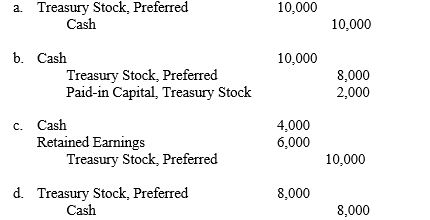
(Short Answer)
4.8/5 (72)
(72) Which of the following is the appropriate entry to record the declaration of cash dividends?
(Multiple Choice)
4.8/5 (89)
(89) The entry to record the purchase of treasury stock will cause total stockholders' equity to decrease by the amount of the cost of the treasury shares.
(True/False)
5.0/5 (91)
(91) When no-par common stock has a stated value, the stated value of the shares issued normally is considered the legal capital of the corporation.
(True/False)
5.0/5 (81)
(81) For accounting purposes, stated value is treated the same way as par value.
(True/False)
4.9/5 (78)
(78) Paloma Corporation had 5,000 shares of $100 par value, 9 percent cumulative preferred stock and 30,000 shares of $10 par value common stock outstanding during each of its first four years of operation. The following amounts of cash dividends were paid during the years indicated: 2007 , $0; 2008 , $80,000; 2009 , $220,000; 2010 , $270,000. Determine the cash dividends per share paid to the preferred and common stockholders during each of the four years.
(Essay)
4.8/5 (87)
(87) When common stock with a par value is sold for a price that exceeds par value, the Common Stock account is credited only for the par value of the shares sold.
(True/False)
4.9/5 (69)
(69) A corporation has 10,000 shares of 8 percent cumulative preferred stock and 20,000 shares of common stock outstanding. Par value for each is $100. No dividends were paid last year, but this year a $200,000 dividend is paid. How much of this $200,000 goes to the holders of common stock?
(Multiple Choice)
4.9/5 (99)
(99) 
Filters
- Essay(0)
- Multiple Choice(0)
- Short Answer(0)
- True False(0)
- Matching(0)