



 Chat with AI
Exam 20: Costing Systems: Job Order Costing

Exam 1: Uses of Accounting Information and the Financial Statements167 Questions
Exam 2: Analyzing Business Transactions189 Questions
Exam 3: Measuring Business Income171 Questions
Exam 4: Completing the Accounting Cycle176 Questions
Exam 5: Financial Reporting and Analysis177 Questions
Exam 6: The Operating Cycle and Merchandising Operations145 Questions
Exam 7: Internal Control117 Questions
Exam 8: Inventories154 Questions
Exam 9: Cash and Receivables177 Questions
Exam 10: Current Liabilities and Fair Value Accounting180 Questions
Exam 11: Long Term Assets241 Questions
Exam 12: Contributed Capital189 Questions
Exam 13: Long Term Liabilities194 Questions
Exam 14: The Corporate Income Statement and the Statement of Stockholders Equity176 Questions
Exam 15: The Statement of Cash Flows149 Questions
Exam 16: Financial Performance Measurement163 Questions
Exam 17: Partnerships129 Questions
Exam 18: The Changing Business Environment-A Managers Pers130 Questions
Exam 19: Cost Concepts and Cost Allocation188 Questions
Exam 20: Costing Systems: Job Order Costing88 Questions
Exam 21: Costing Systems Process Costing136 Questions
Exam 22: Activity-Based Systems-Abm and Lean152 Questions
Exam 23: Cost Behavior Analysis166 Questions
Exam 24: The Budgeting Process116 Questions
Exam 25: Performance Management and Evaluation117 Questions
Exam 26: Standard Costing and Variance Analysis120 Questions
Exam 27: Short Run Decision Analysis90 Questions
Exam 28: Capital Investment Analysis123 Questions
Select questions type


In a job order costing system, indirect labor costs are transferred to the Overhead account by increasing the Factory Payroll account and decreasing the Overhead account.
(True/False)
4.8/5  (91)
(91) The basic document for keeping track of costs in a job order costing system is a
(Multiple Choice)
4.8/5 (83)
(83) Job costs in a service organization end up in the Finished Goods Inventory account when a job is completed.
(True/False)
4.8/5 (91)
(91) In a service organization using a job order costing system, actual overhead will be the same as applied overhead.
(True/False)
4.8/5 (75)
(75) Which of the following is not an objective of product costing systems?
(Multiple Choice)
5.0/5 (78)
(78) The _________ provide(s) the most direct means of calculating unit costs for a job.
(Multiple Choice)
4.9/5 (86)
(86) When the amount of overhead applied differs from actual, if it is an insignificant dollar amount it is usually written off to
(Multiple Choice)
4.8/5 (84)
(84) Costs assigned to the building of a house should appear on the income statement when
(Multiple Choice)
4.8/5 (94)
(94) Quicker Company uses a job order costing system. On May 1, Quicker Company's Work in Process Inventory account shows a beginning balance of $161,000. Production activity for May was as follows: Materials costing $91,000, along with operating supplies of $18,000, were requisitioned into production. Quicker Company's total payroll was $316,000, of which $77,000 was indirect labor. Overhead is applied at a rate of 120 percent of direct labor cost. Quicker's Cost of Goods Sold for the month of May was $692,000. Finished Goods Inventory was $71,500 on May 1 and $84,000 on May 31. (Quicker does not close out overhead accounts until year-end.)
a. Calculate Quicker's cost of goods completed for May.
b. Calculate Quicker's work in process ending inventory (May 31).
c. One of the jobs that was started in May, Job 266, was completed in June. Job 266 was 200 special-order lamps. The following costs had been applied to Job 266 as of June 1: direct materials, $1,400; direct labor, $1,800; overhead, $2,160. In June, $580 in direct materials cost and $900 of direct labor cost were added to complete Job 266. What was the cost per unit for Job 266? (Show your computations.)
(Essay)
4.9/5 (81)
(81) Costs for individual jobs are maintained on job order cost cards when job order costing is in use.
(True/False)
4.8/5 (81)
(81) A basic part of a job order costing system is the set of procedures and entries used to record the costs incurred for materials, labor, and overhead.
(True/False)
4.7/5 (86)
(86) In a job order costing system, the subsidiary ledger for the Work in Process Inventory account consists of
(Multiple Choice)
4.9/5 (68)
(68) The types of computations for costs to be transferred out of Work in Process Inventory differ if the production process involves multiple departments rather than a single department.
(True/False)
4.9/5 (65)
(65) Which of the following products probably would be produced by a company using a process costing system?
(Multiple Choice)
4.9/5 (75)
(75) Which of the following products probably would be manufactured using a job order costing system?
(Multiple Choice)
4.7/5 (87)
(87) Logan Company uses a job order costing system. A predetermined overhead rate of $7 per machine hour in Department A and 220 percent per direct labor dollar in Department B has been established based upon the following information at the beginning of the year:
 Job 19 for 100 units is started in Department A and completed in Department B. Determine the total cost of Job 19 and complete the job cost card based on the following information:
Department A Department B Direct materials \ 800 \ 950 Direct labor dollars \ 490 \ 180 Direct labor hours 30 12 Machine hours 15 30
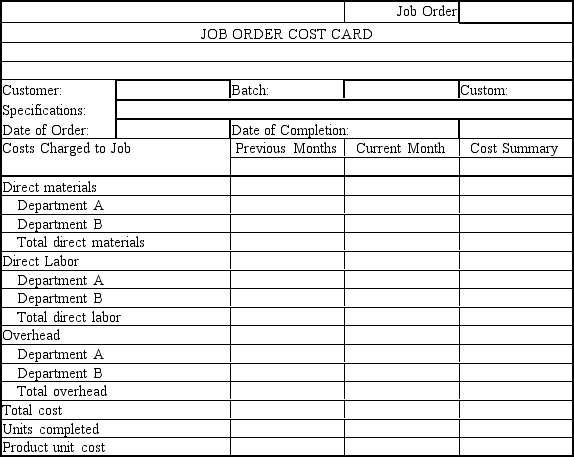
Job 19 for 100 units is started in Department A and completed in Department B. Determine the total cost of Job 19 and complete the job cost card based on the following information:
Department A Department B Direct materials \ 800 \ 950 Direct labor dollars \ 490 \ 180 Direct labor hours 30 12 Machine hours 15 30 (Essay)
4.7/5 (80)
(80) As related to a job order costing system, answer the following short questions:
a. What is a job order costing system? Identify three kinds of companies that would use such as system.
b. What is a job order?
c. What is the purpose of a job order cost card? Identify the kinds of information recorded on it.
(Essay)
4.8/5 (77)
(77) Which of the following items most likely would be manufactured using a process costing system?
(Multiple Choice)
4.9/5 (87)
(87) Regardless of the cost accounting system used, when the products are completed, they are transferred from work in process inventory to finished goods inventory.
(True/False)
4.9/5 (72)
(72) 
Filters
- Essay(0)
- Multiple Choice(0)
- Short Answer(0)
- True False(0)
- Matching(0)