



 Chat with AI
Exam 24: The Budgeting Process

Exam 1: Uses of Accounting Information and the Financial Statements167 Questions
Exam 2: Analyzing Business Transactions189 Questions
Exam 3: Measuring Business Income171 Questions
Exam 4: Completing the Accounting Cycle176 Questions
Exam 5: Financial Reporting and Analysis177 Questions
Exam 6: The Operating Cycle and Merchandising Operations145 Questions
Exam 7: Internal Control117 Questions
Exam 8: Inventories154 Questions
Exam 9: Cash and Receivables177 Questions
Exam 10: Current Liabilities and Fair Value Accounting180 Questions
Exam 11: Long Term Assets241 Questions
Exam 12: Contributed Capital189 Questions
Exam 13: Long Term Liabilities194 Questions
Exam 14: The Corporate Income Statement and the Statement of Stockholders Equity176 Questions
Exam 15: The Statement of Cash Flows149 Questions
Exam 16: Financial Performance Measurement163 Questions
Exam 17: Partnerships129 Questions
Exam 18: The Changing Business Environment-A Managers Pers130 Questions
Exam 19: Cost Concepts and Cost Allocation188 Questions
Exam 20: Costing Systems: Job Order Costing88 Questions
Exam 21: Costing Systems Process Costing136 Questions
Exam 22: Activity-Based Systems-Abm and Lean152 Questions
Exam 23: Cost Behavior Analysis166 Questions
Exam 24: The Budgeting Process116 Questions
Exam 25: Performance Management and Evaluation117 Questions
Exam 26: Standard Costing and Variance Analysis120 Questions
Exam 27: Short Run Decision Analysis90 Questions
Exam 28: Capital Investment Analysis123 Questions
Select questions type


J. J. Johnson has decided to supplement his income by selling beehives. He expects to sell 25,000 hives in 2010. He ended 2009 with 2,500 completed hives in inventory and would like to complete operations in 2010 with at least 2,800 completed hives in inventory. There is no ending work in process inventory. One beehive holds about 250 bees. The bees are purchased for $4.00 per 1,000 bees. The hives sell for $15.00 each. How many beehives would the 2010 production budget identify as needing to be produced?
(Multiple Choice)
4.7/5  (79)
(79) James International is in the construction business. In 2010, it is expected that 30 percent of a month's sales will be received in cash, with the balance being received the following month. Of the purchases, 50 percent are paid the following month, 40 percent are paid in two months, and the remaining 10 percent are paid during the month of purchase.
The sales force receives $1,500 a month base pay plus a 4 percent commission. Labor expenses are expected to be $4,000 a month. Other operating expenses are expected to run about $4,500 a month, including $500 for depreciation. The ending cash balance for 2009 was $18,000.
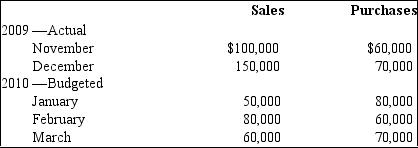 a. Prepare a cash budget and determine the projected ending cash balances for the first three months of 2010.
b. Determine the months that the company would either borrow or invest cash.
a. Prepare a cash budget and determine the projected ending cash balances for the first three months of 2010.
b. Determine the months that the company would either borrow or invest cash. (Essay)
4.9/5 (68)
(68) Static budgets are prepared on quarterly basis and require frequent change during the annual budget period.
(True/False)
4.9/5 (87)
(87) A continuous budget is a 12-month forward rolling budget that summarizes budgets for the next 12 months.
(True/False)
4.8/5 (76)
(76) Which of the following provides the catalyst for all operating budgets?
(Multiple Choice)
4.9/5 (73)
(73) Chad has been making skateboards for his friends and now has more orders than he can handle. He has decided to turn the business into a full-time venture and plans to develop the company into a Fortune 500 company. However, he does not have enough cash and has decided to apply for a Small Business Administration loan. The loan officer informed him that she will need to see projected financial statements with supporting schedules for the next 12 months of operations.
a. Identify the financial statements and supporting schedules you believe are appropriate.
b. What information will you need to include in the budgeted financial statements, and where will you get this information?
(Essay)
4.9/5 (85)
(85) If the cash budget showed a cash shortage, the company most likely would
(Multiple Choice)
4.9/5 (81)
(81) The direct materials purchases budget reflects both the quantity and cost of direct materials purchases.
(True/False)
4.8/5 (87)
(87) Describe three benefits budgeting provides to an organization's success.
(Essay)
4.7/5 (88)
(88) Mi Casa Corporation wishes to prepare a cash budget for November 2010. Sales, purchases, and expenses for October (actual) and November and December (estimated) are as follows: Sales Purchases Expenses October \ 48,000 \ 35,000 \ 14,000 November 40,000 30,000 11,000 December 45,000 22,000 9,500 Sales: All sales are on credit, and the company's experience shows that, on the average, 80 percent of sales are collected in the month of sale and the balance in the following month. A 2 percent discount is allowed on all collections in the month of sale.
Purchases: The company pays 60 percent of purchases in the month of purchase and the balance in the following month. The company is allowed an average discount of 1 percent on payments made in the month of purchase.
Expenses: The monthly expenses for November include charges for depreciation amounting to $1,000 and $100 of prepaid expenses, which will expire. All other expenses are paid as incurred.
Other: On September 1, 2010, a new machine was purchased for $5,000. A down payment of $500 was made, and it was agreed that the balance would be paid in equal installments in the following three months.
The cash receipts in November for October sales are expected to be
(Multiple Choice)
4.8/5 (78)
(78) Roger Wills & Company estimates the following for 2010:
Sales (all on account) \ 800,000 Collections of accounts receivable 700,000 Proceeds from bond issuance 500,000 Proceeds from sale of common stock 300,000 Merchandise bought on credit 650,000 Payments of accounts payable 500,000 Cash payments of expenses 70,000 Cash purchase of equipment 140,000 Depreciation of equipment 15,000 Payment on notes payable 30,000 The ending cash balance for 2009 was $200,000.
Prepare a cash budget to determine the ending cash balance for 2010.
(Essay)
5.0/5 (79)
(79) Operating budgets for the DiP Company reveal the following information: net sales, $400,000; beginning materials inventory, $23,000; materials purchased, $185,000; beginning work in process inventory, $64,700; beginning finished goods inventory, $21,600; direct labor costs, $34,000; overhead applied, $67,000; ending work in process inventory, $61,200; ending materials inventory, $18,700; and ending finished goods inventory, $16,300. Compute DiP Company's budgeted gross margin.
(Multiple Choice)
5.0/5 (77)
(77) After management has set short-term goals, the budgeting process typically starts with
(Multiple Choice)
4.9/5 (81)
(81) United Insurance Company specializes in term life insurance contracts. Cash collection experience shows that 30 percent of billed premiums are collected in the month before they are due, 60 percent are collected in the month they are due, and 6 percent are collected in the month following their due date. Four percent of the billed premiums are collected late (in the second month following their due date). Total billing notices in January were $50,000; in February, $60,000; in March, $66,000; in April, $65,000; in May, $60,000; and in June, $70,000. How much cash does the company expect to collect in May?
(Multiple Choice)
4.7/5 (94)
(94) Mi Casa Corporation wishes to prepare a cash budget for November 2010. Sales, purchases, and expenses for October (actual) and November and December (estimated) are as follows: Sales Purchases Expenses October \ 48,000 \ 35,000 \ 14,000 November 40,000 30,000 11,000 December 45,000 22,000 9,500 Sales: All sales are on credit, and the company's experience shows that, on the average, 80 percent of sales are collected in the month of sale and the balance in the following month. A 2 percent discount is allowed on all collections in the month of sale.
Purchases: The company pays 60 percent of purchases in the month of purchase and the balance in the following month. The company is allowed an average discount of 1 percent on payments made in the month of purchase.
Expenses: The monthly expenses for November include charges for depreciation amounting to $1,000 and $100 of prepaid expenses, which will expire. All other expenses are paid as incurred.
Other: On September 1, 2010, a new machine was purchased for $5,000. A down payment of $500 was made, and it was agreed that the balance would be paid in equal installments in the following three months.
The cash payments in November for expenses are expected to be
(Multiple Choice)
4.9/5 (91)
(91) Mi Casa Corporation wishes to prepare a cash budget for November 2010. Sales, purchases, and expenses for October (actual) and November and December (estimated) are as follows: Sales Purchases Expenses October \ 48,000 \ 35,000 \ 14,000 November 40,000 30,000 11,000 December 45,000 22,000 9,500 Sales: All sales are on credit, and the company's experience shows that, on the average, 80 percent of sales are collected in the month of sale and the balance in the following month. A 2 percent discount is allowed on all collections in the month of sale.
Purchases: The company pays 60 percent of purchases in the month of purchase and the balance in the following month. The company is allowed an average discount of 1 percent on payments made in the month of purchase.
Expenses: The monthly expenses for November include charges for depreciation amounting to $1,000 and $100 of prepaid expenses, which will expire. All other expenses are paid as incurred.
Other: On September 1, 2010, a new machine was purchased for $5,000. A down payment of $500 was made, and it was agreed that the balance would be paid in equal installments in the following three months.
The cash payments in November for purchases are expected to be
(Multiple Choice)
4.7/5 (64)
(64) 
Filters
- Essay(0)
- Multiple Choice(0)
- Short Answer(0)
- True False(0)
- Matching(0)