



 Chat with AI
Exam 26: Standard Costing and Variance Analysis

Exam 1: Uses of Accounting Information and the Financial Statements167 Questions
Exam 2: Analyzing Business Transactions189 Questions
Exam 3: Measuring Business Income171 Questions
Exam 4: Completing the Accounting Cycle176 Questions
Exam 5: Financial Reporting and Analysis177 Questions
Exam 6: The Operating Cycle and Merchandising Operations145 Questions
Exam 7: Internal Control117 Questions
Exam 8: Inventories154 Questions
Exam 9: Cash and Receivables177 Questions
Exam 10: Current Liabilities and Fair Value Accounting180 Questions
Exam 11: Long Term Assets241 Questions
Exam 12: Contributed Capital189 Questions
Exam 13: Long Term Liabilities194 Questions
Exam 14: The Corporate Income Statement and the Statement of Stockholders Equity176 Questions
Exam 15: The Statement of Cash Flows149 Questions
Exam 16: Financial Performance Measurement163 Questions
Exam 17: Partnerships129 Questions
Exam 18: The Changing Business Environment-A Managers Pers130 Questions
Exam 19: Cost Concepts and Cost Allocation188 Questions
Exam 20: Costing Systems: Job Order Costing88 Questions
Exam 21: Costing Systems Process Costing136 Questions
Exam 22: Activity-Based Systems-Abm and Lean152 Questions
Exam 23: Cost Behavior Analysis166 Questions
Exam 24: The Budgeting Process116 Questions
Exam 25: Performance Management and Evaluation117 Questions
Exam 26: Standard Costing and Variance Analysis120 Questions
Exam 27: Short Run Decision Analysis90 Questions
Exam 28: Capital Investment Analysis123 Questions
Select questions type


Underfoot Products uses standard costing. The following information about overhead was generated during May: Standard variable overhead rate \ 2 per machine hour Standard fixed overhead rate \ 1 per machine hour Actual variable overhead costs \ 382,000 Actual fixed overhead costs \ 175,000 Budgeted fixed overhead costs \ 190,000 Standard machine hours per unit produced 10 Good units produced 18,000 Actual machine hours 200,000 Compute the variable overhead variance.
(Multiple Choice)
4.7/5  (88)
(88) The variable overhead efficiency variance is the difference between actual total overhead costs incurred and the total overhead costs applied using the standard overhead rates.
(True/False)
4.9/5 (82)
(82) The standard overhead cost is the sum of the estimates of variable and fixed overhead costs in the next accounting period.
(True/False)
5.0/5 (77)
(77) Comparing "what did happen" with "what should have happened" aids in the performance evaluation of a company.
(True/False)
4.9/5 (68)
(68) Underfoot Products uses standard costing. The following information about overhead was generated during May: Standard variable overhead rate \ 2 per machine hour Standard fixed overhead rate \ 1 per machine hour Actual variable overhead costs \ 390,000 Actual fixed overhead costs \ 175,000 Budgeted fixed overhead costs \ 190,000 Standard machine hours per unit produced 10 Good units produced 18,000 Actual machine hours 200,000 Compute the fixed overhead variance.
(Multiple Choice)
4.8/5 (72)
(72) Ewing Corporation's controller has developed the cost and usage data listed below in preparation of standard unit cost information for the coming year. 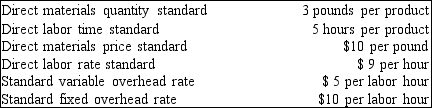 The standard unit cost for overhead is
 (Multiple Choice)
4.9/5 (82)
(82) Prepare a flexible budget for 8,000, 9,000, and 10,000 units of output, given the following data:
Variable costs: Budgeted fixed dverhead \ 90,000 Direct \ 5 Mnaterials Direct labor 4 Overhead 8
(Essay)
4.8/5 (73)
(73) The C.M. Landscaping Co. uses chicken manure to fortify the soil around trees bearing rare fruit. The price standard used is $3.50 per 10 pound sack of chicken manure. During the current year, the actual purchase price averaged $3.65 per sack, according to the company's purchasing agent. The company purchased and used 1,560 sacks of chicken manure during the year. Compute the direct materials price variance. Be sure to indicate whether it is favorable or unfavorable.
(Essay)
5.0/5 (86)
(86) The "flex" in the flexible budget formula occurs in the variable cost segment.
(True/False)
4.8/5 (93)
(93) Underfoot Products uses standard costing. The following information about overhead was generated during May: Standard variable overhead rate \ 2 per machine hour Standard fixed overhead rate \ 1 per machine hour Actual variable overhead costs \ 390,000 Actual fixed overhead costs \ 175,000 Budgeted fixed overhead costs \ 190,000 Standard machine hours per unit produced 10 Good units produced 18,000 Actual machine hours 198000 Compute the variable overhead efficiency variance.
(Multiple Choice)
4.8/5 (76)
(76) The flexible budget formula is an equation that determines unexpected costs at any level of output.
(True/False)
4.9/5 (90)
(90) Sweet Dreams manufactures candy. Its records revealed the following data: Number af urits produced 4,000 Standard direct labor hours per unit 2 Standard variable overhead rate \ 2.50 per hour Standard fixed overhead rate \ 5.00 hour Budgeted Eixed overhead costs \ 40,800 Actual variable cverhead costs \ 16,800 Actual fixed overhead costs \ 40,400 Actual labor hours 8,000 direct labor hours Total actual dverhead \ 57,200 The total overhead variance is
(Multiple Choice)
4.8/5 (74)
(74) The importance of direct labor standards and variances has been reduced.
(True/False)
4.9/5 (69)
(69) Using the standard costs of $5 per pound for a 10 pound bag of chocolate and the following actual cost and usage data, compute the direct materials quantity variance. 
(Multiple Choice)
4.9/5 (79)
(79) Krane Company has a standard costing system and keeps all its costs up to date. The company's main product is beach towels which are made in a single department. The standard variable costs for one beach towel (unit) are as follows:
 The company's normal capacity is 10,000 direct labor hours. Its budgeted fixed overhead costs for the year were $24,000. During the year, it produced and sold 22,000 beach towels and it purchased 66,250 yards of direct materials; the purchase cost was $0.99 per yard. The average labor rate was $9.10 per hour, and 10,900 direct labor hours were worked. The company's actual variable overhead costs for the year were $55,100, and its fixed costs were $24,500.
Using the data given, compute the following using formulas or diagram form:
1. Direct materials cost variances:
a. Direct materials price variance
b. Direct materials quantity variance
c. Total direct materials cost variance
2. Direct labor cost variances:
a. Direct labor rate variance
b. Direct labor efficiency variance
c. Total direct labor cost variance
3. Variable overhead variances:
a. Variable overhead spending variance
b. Variable overhead efficiency variance
c. Total variable overhead variance
4. Fixed overhead variances:
a. Fixed overhead budget variance
b. Fixed overhead volume variance
c. Total fixed overhead variance
The company's normal capacity is 10,000 direct labor hours. Its budgeted fixed overhead costs for the year were $24,000. During the year, it produced and sold 22,000 beach towels and it purchased 66,250 yards of direct materials; the purchase cost was $0.99 per yard. The average labor rate was $9.10 per hour, and 10,900 direct labor hours were worked. The company's actual variable overhead costs for the year were $55,100, and its fixed costs were $24,500.
Using the data given, compute the following using formulas or diagram form:
1. Direct materials cost variances:
a. Direct materials price variance
b. Direct materials quantity variance
c. Total direct materials cost variance
2. Direct labor cost variances:
a. Direct labor rate variance
b. Direct labor efficiency variance
c. Total direct labor cost variance
3. Variable overhead variances:
a. Variable overhead spending variance
b. Variable overhead efficiency variance
c. Total variable overhead variance
4. Fixed overhead variances:
a. Fixed overhead budget variance
b. Fixed overhead volume variance
c. Total fixed overhead variance (Essay)
4.8/5 (96)
(96) The total overhead variance is the difference between standard variable overhead costs and standard fixed overhead costs.
(True/False)
4.9/5 (74)
(74) A variance is the difference between a standard cost and a budgeted cost.
(True/False)
4.8/5 (68)
(68) Underfoot Products uses standard costing. The following information about overhead was generated during May: Standard variable overhead rate \ 2 per machine hour Standard fixed overhead rate \ 1 per machine hour Actual variable overhead costs \ 390,000 Actual fixed overhead costs \ 175,000 Budgeted fixed overhead costs \ 190,000 Standard machine hours per unit produced 10 Good units produced 18,000 Actual machine hours 200,000 Compute the fixed overhead volume variance.
(Multiple Choice)
4.9/5 (72)
(72) 
Filters
- Essay(0)
- Multiple Choice(0)
- Short Answer(0)
- True False(0)
- Matching(0)