



 Chat with AI
Exam 10: The Shapes of Molecules

Exam 1: Keys to the Study of Chemistry66 Questions
Exam 2: The Components of Matter91 Questions
Exam 3: Stoichiometry of Formulas and Equations90 Questions
Exam 4: Three Major Classes of Chemical Reactions84 Questions
Exam 5: Gases and the Kinetic-Molecular Theory93 Questions
Exam 6: Thermochemistry: Energy Flow and Chemical Change71 Questions
Exam 7: Quantum Theory and Atomic Structure72 Questions
Exam 8: Electron Configuration and Chemical Periodicity70 Questions
Exam 9: Models of Chemical Bonding60 Questions
Exam 10: The Shapes of Molecules94 Questions
Exam 11: Theories of Covalent Bonding49 Questions
Exam 12: Intermolecular Forces: Liquids,solids,and Phase Changes89 Questions
Exam 13: The Properties of Solutions73 Questions
Exam 14: The Main-Group Elements: Applying Principles of Bonding and Structure58 Questions
Exam 15: Organic Compounds and the Atomic Properties of Carbon95 Questions
Exam 16: Kinetics: Rates and Mechanisms of Chemical Reactions76 Questions
Exam 17: Equilibrium: the Extent of Chemical Reactions85 Questions
Exam 18: Acid-Base Equilibria90 Questions
Exam 19: Ionic Equilibria in Aqueous Systems96 Questions
Exam 20: Thermodynamics: Entropy, free Energy, and the Direction of Chemical Reactions84 Questions
Exam 21: Electrochemistry: Chemical Change and Electrical Work97 Questions
Exam 22: The Transition Elements and Their Coordination Compounds72 Questions
Exam 23: Nuclear Reactions and Their Applications75 Questions
Select questions type


Which one of the following Lewis structures is definitely incorrect? 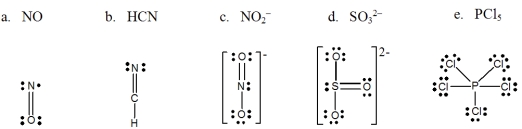
(Multiple Choice)
4.9/5  (88)
(88) Which one of the following Lewis structures is definitely incorrect? 
(Multiple Choice)
4.8/5 (78)
(78) Name and outline the concept which is introduced when more than one valid Lewis structure can be drawn for a given molecule or ion.Use appropriate diagrams of the formate ion (HCO2-,carbon is the central atom)to illustrate.
(Essay)
4.8/5 (91)
(91) Which one of the following molecules does not have a dipole moment?
(Multiple Choice)
4.8/5 (79)
(79) What is the molecular shape of XeO2F2 as predicted by the VSEPR theory? 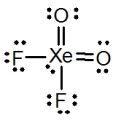
(Multiple Choice)
4.8/5 (95)
(95) Use VSEPR theory to decide which one of the following molecules and ions will have a trigonal pyramidal geometry.(The central atom is always first in the formula. )
(Multiple Choice)
4.7/5 (86)
(86) According to VSEPR theory,a molecule with the general formula AX3E2 will have a _____ molecular shape.
(Multiple Choice)
4.8/5 (78)
(78) Predict the actual bond angles in BrF3 using the VSEPR theory.
(Multiple Choice)
4.9/5 (79)
(79) In order for a non-cyclic triatomic molecule to be bent,VSEPR theory requires that there must be two lone pairs on the central atom.
(True/False)
4.8/5 (89)
(89) What is the molecular shape of NOCl as predicted by the VSEPR theory? 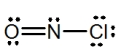
(Multiple Choice)
4.8/5 (72)
(72) Which one of the following Lewis structures is definitely incorrect? 
(Multiple Choice)
4.9/5 (82)
(82) What is the molecular shape of BeH2 as predicted by the VSEPR theory?
(Multiple Choice)
4.8/5 (77)
(77) In which one of the following is the best Lewis structure a resonance structure? (central atoms are bold)
(Multiple Choice)
4.7/5 (78)
(78) In the following Lewis structure for phosphate,phosphorus has a formal charge of ____ and an oxidation number of ____. 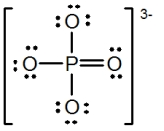
(Multiple Choice)
4.8/5 (67)
(67) Predict the ideal bond angles in AsCl3 using the molecular shape given by the VSEPR theory.
(Multiple Choice)
4.8/5 (82)
(82) What is the molecular shape of ClF4- as predicted by the VSEPR theory?
(Multiple Choice)
4.9/5 (63)
(63) In a Lewis structure for a molecule or ion,the sum of the formal charges on the atoms is equal to the charge on the molecule or ion.
(True/False)
4.9/5 (82)
(82) According to VSEPR theory,a molecule with the general formula AX2E will have a ______ molecular shape.
(Multiple Choice)
4.8/5 (87)
(87) For the chlorate ion,ClO3-,draw two different valid Lewis structures,as follows:
a.a structure in which the octet rule is obeyed
b.a structure in which formal charges are minimized
(Essay)
4.9/5 (77)
(77) Draw Lewis structures,showing all valence electrons,for the following species:
a.S2-
b.CO
c.SO2
d.CH3OH
(Essay)
4.9/5 (74)
(74) 
Filters
- Essay(0)
- Multiple Choice(0)
- Short Answer(0)
- True False(0)
- Matching(0)