



 Chat with AI
Exam 9: Models of Chemical Bonding

Exam 1: Keys to the Study of Chemistry66 Questions
Exam 2: The Components of Matter91 Questions
Exam 3: Stoichiometry of Formulas and Equations90 Questions
Exam 4: Three Major Classes of Chemical Reactions84 Questions
Exam 5: Gases and the Kinetic-Molecular Theory93 Questions
Exam 6: Thermochemistry: Energy Flow and Chemical Change71 Questions
Exam 7: Quantum Theory and Atomic Structure72 Questions
Exam 8: Electron Configuration and Chemical Periodicity70 Questions
Exam 9: Models of Chemical Bonding60 Questions
Exam 10: The Shapes of Molecules94 Questions
Exam 11: Theories of Covalent Bonding49 Questions
Exam 12: Intermolecular Forces: Liquids,solids,and Phase Changes89 Questions
Exam 13: The Properties of Solutions73 Questions
Exam 14: The Main-Group Elements: Applying Principles of Bonding and Structure58 Questions
Exam 15: Organic Compounds and the Atomic Properties of Carbon95 Questions
Exam 16: Kinetics: Rates and Mechanisms of Chemical Reactions76 Questions
Exam 17: Equilibrium: the Extent of Chemical Reactions85 Questions
Exam 18: Acid-Base Equilibria90 Questions
Exam 19: Ionic Equilibria in Aqueous Systems96 Questions
Exam 20: Thermodynamics: Entropy, free Energy, and the Direction of Chemical Reactions84 Questions
Exam 21: Electrochemistry: Chemical Change and Electrical Work97 Questions
Exam 22: The Transition Elements and Their Coordination Compounds72 Questions
Exam 23: Nuclear Reactions and Their Applications75 Questions
Select questions type


Which one of the following properties is least characteristic of typical ionic compounds?
(Multiple Choice)
5.0/5  (86)
(86) A single covalent bond consists of a single delocalized electron pair.
(True/False)
4.9/5 (72)
(72) Which one of the following properties is least characteristic of substances composed of small,covalently-bonded molecules?
(Multiple Choice)
5.0/5 (65)
(65) A hypothetical ionic substance will not form merely because it has a high lattice energy.Explain why,using energy-based arguments.
(Essay)
4.8/5 (83)
(83) Select the correct formula for a compound formed from calcium and chlorine.
(Multiple Choice)
4.8/5 (80)
(80) In not more than three sentences,describe the electron arrangement responsible for bonding in solid SrCl2.
(Essay)
4.8/5 (80)
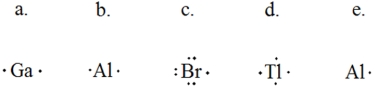
(80) 
Covalent bonding typically occurs when a ______________ bonds with a ______________.
(Short Answer)
4.8/5 (76)
(76) The lattice energy is the energy released when separated ions in the gas phase combine to form ionic molecules in the gas phase.
(True/False)
5.0/5 (80)
(80) Describe,with appropriate explanations,the key factors which affect the magnitude of the lattice energy of an ionic substance.
(Essay)
4.9/5 (60)
(60) Hydrogenation of double and triple bonds is an important industrial process.Calculate (in kJ)the standard enthalpy change H° for the hydrogenation of ethyne (acetylene)to ethane.
 Bond:
C-C
C C
C-H
H-H

Bond:
C-C
C C
C-H
H-H
(Multiple Choice)
4.9/5 (81)
(81) Ethanol is sometimes used as an additive in oxygenated gasoline.Calculate its enthalpy of combustion using the bond energies given. 

(Short Answer)
4.9/5 (84)
(84) The lattice energy for ionic crystals increases as the charge on the ions _____________ and the size of the ions __________________.
(Multiple Choice)
5.0/5 (76)
(76) Using appropriate,real examples to illustrate your answer,describe the correlation between bond energy and bond length for a series of single bonds.
(Essay)
4.8/5 (78)
(78) For which of the following elements (in their normal,stable forms)would it be correct to describe the bonding as involving "electron pooling"?
(Multiple Choice)
4.9/5 (91)
(91) Electronegativities on Pauling's scale are calculated from ionization energies and electron affinities.
(True/False)
4.9/5 (64)
(64) 
Filters
- Essay(0)
- Multiple Choice(0)
- Short Answer(0)
- True False(0)
- Matching(0)