



 Chat with AI
Exam 18: Spoilage, rework, and Scrap

Exam 1: The Manager and Management Accounting195 Questions
Exam 2: An Introduction to Cost Terms and Purposes224 Questions
Exam 3: Cost-Volume-Profit Analysis209 Questions
Exam 4: Job Costing203 Questions
Exam 5: Activity-Based Costing and Activity-Based Management176 Questions
Exam 6: Master Budget and Responsibility Accounting226 Questions
Exam 7: Flexible Budgets,direct-Cost Variances,and Management Control181 Questions
Exam 8: Flexible Budgets, overhead Cost Variances, and Management Control171 Questions
Exam 9: Inventory Costing and Capacity Analysis207 Questions
Exam 10: Determining How Costs Behave192 Questions
Exam 11: Decision Making and Relevant Information218 Questions
Exam 12: Strategy,balanced Scorecard,and Strategic Profitability Analysis172 Questions
Exam 13: Pricing Decisions and Cost Management209 Questions
Exam 14: Cost Allocation, customer-Profitability Analysis, and Sales-Variance Analysis167 Questions
Exam 15: Allocation of Support-Department Costs, common Costs, and Revenues150 Questions
Exam 16: Cost Allocation: Joint Products and Byproducts150 Questions
Exam 17: Process Costing149 Questions
Exam 18: Spoilage, rework, and Scrap153 Questions
Exam 19: Balanced Scorecard: Quality and Time150 Questions
Exam 20: Inventory Management, just-In-Time, and Simplified Costing Methods150 Questions
Exam 21: Capital Budgeting and Cost Analysis151 Questions
Exam 22: Management Control Systems, transfer Pricing, and Multinational Considerations150 Questions
Exam 23: Performance Measurement, compensation, and Multinational Considerations150 Questions
Select questions type


Spoilage always occurs at beginning stages of a production process and can be detected only at the end of process.
(True/False)
4.7/5  (68)
(68) Firms often conduct multiple inspections to avoid instances of undetected spoiled units at later stages of the process.
(True/False)
4.8/5 (75)
(75) Under efficient operating conditions,all spoilage is considered to be abnormal spoilage.
(True/False)
4.9/5 (91)
(91) Spoilage and rework costs are thoroughly captured in the accounting system.
(True/False)
4.9/5 (91)
(91) Rework is finished production that is NOT in accordance with customer desires.The product is redone and sold as finished goods.
(True/False)
4.8/5 (93)
(93) Companies calculate the units of abnormal spoilage and record the cost in the Loss from Abnormal Spoilage account,which appears as a separate line item in an income statement.
(True/False)
4.8/5 (72)
(72) To simplify calculations under FIFO,spoiled units are accounted for as if they were started in the current period.
(True/False)
4.9/5 (88)
(88) Normal spoilage costs are usually deducted from the costs of good units.
(True/False)
4.8/5 (75)
(75) Which of the following sentences is true of classification of spoilage as normal or abnormal when inventories are present?
(Multiple Choice)
4.7/5 (82)
(82) Units spoiled due to machine breakdowns and operator errors are normal spoilage.
(True/False)
4.9/5 (84)
(84) Under the FIFO method,all spoilage costs are assumed to be related to the units completed during this period using the unit costs of the current period.
(True/False)
4.8/5 (81)
(81) Costs of abnormal spoilage are usually accounted for as ________.
(Multiple Choice)
4.9/5 (71)
(71) Fish Fillet Incorporated obtains fish and then processes them into frozen fillets and then prepares the frozen fish fillets for distribution to its retail sales department.Direct materials are added at the initiation of the cycle.Conversion costs are incurred evenly throughout the production cycle.Before inspection,some fillets are spoiled due to undetectable defects.Spoiled fillets generally constitute 4% of the good fillets.Data for April 2017 are as follows:
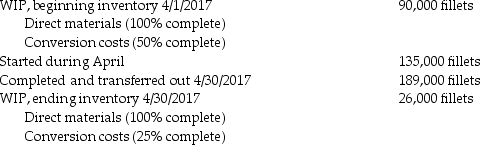 Costs for April:
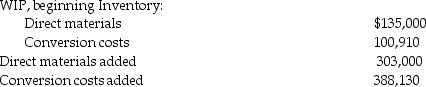 What is the amount of direct materials and conversion costs assigned to ending work in process using the weighted-average process-costing method? (Round any cost per unit calculations to the nearest cent. )
Costs for April:
What is the amount of direct materials and conversion costs assigned to ending work in process using the weighted-average process-costing method? (Round any cost per unit calculations to the nearest cent. ) (Multiple Choice)
5.0/5 (69)
(69) Excluding spoiled units in the equivalent-unit calculation results in ________.
(Multiple Choice)
4.7/5 (79)
(79) Recognizing the value of scrap in the accounting records is always done at the time the scrap is produced.
(True/False)
4.9/5 (83)
(83) Costs of abnormal spoilage are separately accounted for as losses of the period.
(True/False)
4.8/5 (90)
(90) When the amount of scrap is material and the scrap is sold immediately after it is produced,which of the following is the journal entry if the scrap attributable to a specific job is sold on account?
(Multiple Choice)
4.7/5 (86)
(86) Spoilage that is not inherent in a particular production process and would not arise under efficient operating conditions is referred to as ________.
(Multiple Choice)
4.8/5 (75)
(75) 
Filters
- Essay(0)
- Multiple Choice(0)
- Short Answer(0)
- True False(0)
- Matching(0)