



 Chat with AI
Exam 12: The Respiratory System

Exam 1: Introduction to Physiology and Homeostasis111 Questions
Exam 2: Cell Physiology181 Questions
Exam 3: The Plasma Membrane and Membrane Potential214 Questions
Exam 4: Principles of Neural and Hormonal Communication230 Questions
Exam 5: The Central Nervous System250 Questions
Exam 6: The Peripheral Nervous System: Afferent Division and Special Senses244 Questions
Exam 7: The Peripheral Nervous System: Efferent Division150 Questions
Exam 8: Muscle Physiology333 Questions
Exam 9: Cardiac Physiology284 Questions
Exam 10: The Blood Vessels and Blood Pressure204 Questions
Exam 11: The Blood and Body Defenses247 Questions
Exam 12: The Respiratory System203 Questions
Exam 13: The Urinary System258 Questions
Exam 14: Fluid and Acid-Base Balance182 Questions
Exam 15: The Digestive System304 Questions
Exam 16: Energy Balance and Temperature Regulation168 Questions
Exam 17: The Endocrine System335 Questions
Exam 18: The Reproductive System302 Questions
Select questions type


 The following questions refer to the accompanying diagram of a normal spirogram. The wave labels have been removed and replaced with letters A-H. Match the letter with list of missing terms below to complete the diagram.
-inspiratory reserve volume
The following questions refer to the accompanying diagram of a normal spirogram. The wave labels have been removed and replaced with letters A-H. Match the letter with list of missing terms below to complete the diagram.
-inspiratory reserve volume (Short Answer)
4.7/5  (87)
(87) In the absence of pulmonary surfactant, smaller alveoli display a larger inward-directed pressure than do larger alveoli.
(True/False)
4.9/5 (70)
(70) Approximately what percentage of oxygen is transported in the blood bound to Hb?
(Multiple Choice)
4.8/5 (92)
(92) Which of the following statements concerning the dorsal respiratory group (DRG) is correct?
(Multiple Choice)
5.0/5 (82)
(82) At the end of a normal expiration when outward air flow has ceased,
(Multiple Choice)
4.8/5 (66)
(66) An increase in airway resistance and an increase in alveolar surface tension both increase the work of breathing.
(True/False)
5.0/5 (85)
(85) 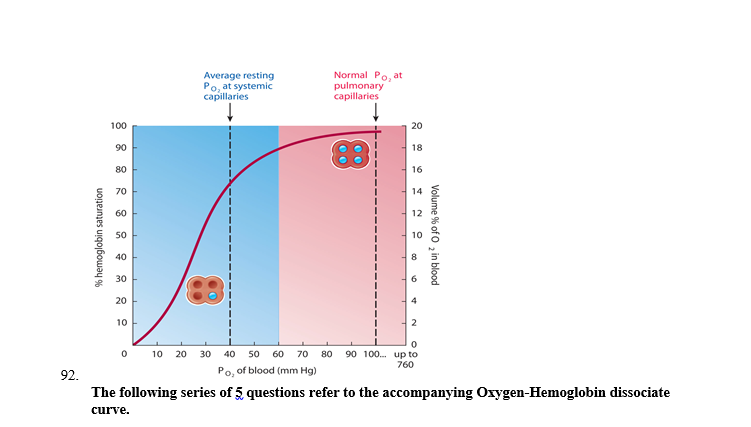 -At a PO2 of 40 mm Hg, how many ml of oxygen (per 100 ml of blood) remain in the blood?
 (Multiple Choice)
4.9/5 (66)
(66) The volume occupied by the conducting airways is known as the ____________________.
(Short Answer)
4.8/5 (72)
(72) A person with asthma has more difficulty expiring than inspiring, giving rise to the characteristic "wheeze" as air is forced out through the narrowed airways.
(True/False)
5.0/5 (73)
(73)
The following questions refer to the accompanying diagram of a normal spirogram. The wave labels have been removed and replaced with letters A-H. Match the letter with list of missing terms below to complete the diagram.
-vital capacity
The following questions refer to the accompanying diagram of a normal spirogram. The wave labels have been removed and replaced with letters A-H. Match the letter with list of missing terms below to complete the diagram.
-vital capacity (Short Answer)
4.8/5 (82)
(82) A transmural pressure gradient exists across the lung wall because the ____ pressure is less than the ____ pressure.
(Multiple Choice)
4.9/5 (74)
(74) If 20% of the air is composed of O2, the partial pressure of oxygen at sea level where atmospheric pressure is 760 mm Hg is
(Multiple Choice)
4.8/5 (81)
(81) The vocal folds are found in the ____________________ among the respiratory passages.
(Short Answer)
4.9/5 (90)
(90) 
Filters
- Essay(0)
- Multiple Choice(0)
- Short Answer(0)
- True False(0)
- Matching(0)