



 Chat with AI
Exam 4: Principles of Neural and Hormonal Communication

Exam 1: Introduction to Physiology and Homeostasis111 Questions
Exam 2: Cell Physiology181 Questions
Exam 3: The Plasma Membrane and Membrane Potential214 Questions
Exam 4: Principles of Neural and Hormonal Communication230 Questions
Exam 5: The Central Nervous System250 Questions
Exam 6: The Peripheral Nervous System: Afferent Division and Special Senses244 Questions
Exam 7: The Peripheral Nervous System: Efferent Division150 Questions
Exam 8: Muscle Physiology333 Questions
Exam 9: Cardiac Physiology284 Questions
Exam 10: The Blood Vessels and Blood Pressure204 Questions
Exam 11: The Blood and Body Defenses247 Questions
Exam 12: The Respiratory System203 Questions
Exam 13: The Urinary System258 Questions
Exam 14: Fluid and Acid-Base Balance182 Questions
Exam 15: The Digestive System304 Questions
Exam 16: Energy Balance and Temperature Regulation168 Questions
Exam 17: The Endocrine System335 Questions
Exam 18: The Reproductive System302 Questions
Select questions type


Which of the classes of hormones is derived from large preprohormones?
(Multiple Choice)
4.7/5  (87)
(87) At the end of repolarization, the newly opened channels for ____________________ ions close.
(Short Answer)
4.9/5 (80)
(80) Indicate whether the characteristics below apply to the endocrine system or the nervous system by writing the appropriate letter in the blank using the following answer code:
-Controls activities that require longer duration rather than speed.
(Multiple Choice)
4.9/5 (89)
(89) Axon terminal possess ____________________ voltage-gated channels that when operational induce neurotransmitter release.
(Short Answer)
4.9/5 (64)
(64) Describe the electrical events that occur during the rising and falling phase of an action potential.
(Essay)
4.8/5 (82)
(82) Hydrophilic hormones exert their effects primarily by activating second-messenger systems within their target cells.
(True/False)
4.8/5 (79)
(79) Indicate the solubility characteristics of each of the classes of hormones by writing the appropriate letter in the blank using the following answer code:
-catecholamines
(Multiple Choice)
4.9/5 (71)
(71) MATCHING: ART
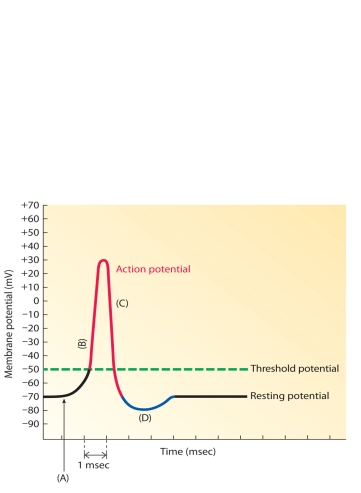 The following questions refer to the accompanying diagram of an action potential.
Segments of the action potential are labeled A-D. Match the letters to the corresponding statements below.
-Slow depolarization to threshold due to stimulus
The following questions refer to the accompanying diagram of an action potential.
Segments of the action potential are labeled A-D. Match the letters to the corresponding statements below.
-Slow depolarization to threshold due to stimulus (Short Answer)
4.8/5 (81)
(81) Indicate whether the characteristics below apply to the endocrine system or the nervous system by writing the appropriate letter in the blank using the following answer code:
-Releases factors such as CRF.
(Multiple Choice)
4.8/5 (79)
(79) Indicate which characteristic applies to classical neurotransmitters and neuropeptides using the following answer code:
-released into the blood for delivery to site of action
(Multiple Choice)
4.8/5 (83)
(83) MATCHING: ART
The following questions refer to the accompanying diagram of an action potential.
Segments of the action potential are labeled A-D. Match the letters to the corresponding statements below.
-Potassium moving through voltage-gated channels
The following questions refer to the accompanying diagram of an action potential.
Segments of the action potential are labeled A-D. Match the letters to the corresponding statements below.
-Potassium moving through voltage-gated channels (Short Answer)
4.9/5 (80)
(80) Endocrine responses occur more slowly and last longer than neural responses.
(True/False)
4.8/5 (85)
(85) The nodes of Ranvier are formed by the open patches of axon when oligodendrocytes wrap themselves "jelly roll fashion" around the axon.
(True/False)
4.8/5 (72)
(72) Peptide hormones cause changes in solute permeability or alter intracellular protein activity at their targets.
(True/False)
4.9/5 (92)
(92) The most common second messenger used by hydrophilic hormones is
(Multiple Choice)
4.8/5 (74)
(74) Which of the following is responsible for the falling phase of an action potential?
(Multiple Choice)
4.8/5 (89)
(89) 
Filters
- Essay(0)
- Multiple Choice(0)
- Short Answer(0)
- True False(0)
- Matching(0)