



 Chat with AI
Exam 7: Fiscal Policy

Exam 1: The Economic Problem156 Questions
Exam 2: Demand and Supply: an Introduction184 Questions
Exam 3: Measuring the Economy 1: GDP and Economic Growth209 Questions
Exam 4: Measuring the Economy 2: Unemployment and Inflation184 Questions
Exam 5: Aggregate Demand and Supply183 Questions
Exam 6: Aggregate Expenditures196 Questions
Exam 7: Fiscal Policy147 Questions
Exam 8: Money and Banking159 Questions
Exam 9: The Money Market and Monetary Policy156 Questions
Exam 10: International Trade167 Questions
Exam 11: Exchange Rates and the Balance of Payments146 Questions
Exam 12: Macroeconomic Policy Revisited63 Questions
Exam 13: A Walk Through the Twentieth Century and Beyond85 Questions
Select questions type


Below is some data for a hypothetical economy:
 -Refer to the information above to answer this question.Suppose the economy is presently in equilibrium.If the government increases its spending by the amount of its current surplus/deficit,what will be the result?
 (Multiple Choice)
4.7/5  (87)
(87) Which of the following is not part of a cyclically-balanced-budget fiscal policy?
(Multiple Choice)
4.8/5 (67)
(67) Below is some information about the state of the budget and the economy.
1.A budget deficit and a recessionary gap.
2.A budget deficit and an inflationary gap.
3.A budget surplus and a recessionary gap.
4.A budget surplus and an inflationary gap.
-Refer to the information above to answer this question.When would a balanced-budget fiscal policy be counter-cyclical?
(Multiple Choice)
5.0/5 (91)
(91) Which of the following is a legitimate concern over the national debt?
(Multiple Choice)
4.7/5 (78)
(78) Counter-cyclical fiscal policy aimed at closing an inflationary gap is illustrated graphically by the aggregate demand curve shifting to the left.
(True/False)
4.7/5 (76)
(76) Suppose the government Daikai balances its budget over a five-year period.Autonomous taxes are $50 and the marginal tax rate is 25%.The following table shows the level of GDP and government expenditure in each of the first 5 years:
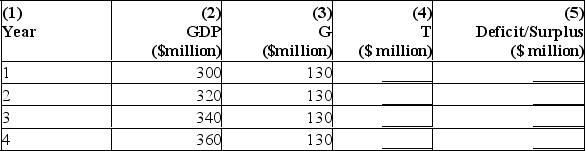 a)Fill in column (4)and (5).Suppose the level of GDP for Year 5 is $380 million.
b)What level of government spending in Year 5 will balance the budget over the five-year cycle?
c)What level of autonomous taxes in Year 5 will balance the budget over the five-year cycle?
a)
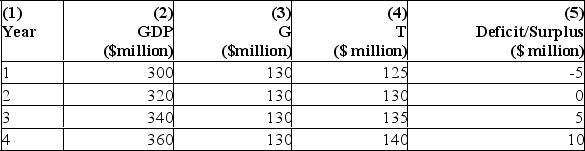
a)Fill in column (4)and (5).Suppose the level of GDP for Year 5 is $380 million.
b)What level of government spending in Year 5 will balance the budget over the five-year cycle?
c)What level of autonomous taxes in Year 5 will balance the budget over the five-year cycle?
a)
(Short Answer)
4.9/5 (84)
(84) Below is some data for a hypothetical economy:
 -Refer to the information above to answer this question.If government decreased both its spending and taxes by $45,how would equilibrium GDP change?
 (Multiple Choice)
4.9/5 (67)
(67) Which of the following is true if the government attempts to balance its budget when the economy is in a recession and the government is running a budget deficit?
(Multiple Choice)
4.9/5 (67)
(67) All of the following,except one,are arguments against the use of counter-cyclical fiscal policy to close a recessionary gap.Which is the exception?
(Multiple Choice)
4.9/5 (81)
(81) If the government used counter-cyclical policy to eliminate an inflationary gap,what should it do?
(Multiple Choice)
4.9/5 (94)
(94) All of the following,except one,are outlays categories in the federal government's budget plan.Which is the exception?
(Multiple Choice)
4.8/5 (65)
(65) A decrease in government spending on goods and services will shift the budget line up.
(True/False)
4.8/5 (73)
(73) Below is some data for a hypothetical economy:
-Refer to the information above to answer this question.What is the value of equilibrium income?
-Refer to the information above to answer this question.What is the value of equilibrium income? (Multiple Choice)
4.7/5 (82)
(82) What effect will an expansionary fiscal policy have on interest rates and the exchange rate?
(Essay)
4.9/5 (73)
(73) 
Filters
- Essay(0)
- Multiple Choice(0)
- Short Answer(0)
- True False(0)
- Matching(0)