



 Chat with AI
Exam 5: Gross Income: Exclusions

Exam 1: An Introduction to Taxation and Understanding the Federal Tax Law195 Questions
Exam 2: Working With the Tax Law86 Questions
Exam 3: Computing the Tax187 Questions
Exam 4: Gross Income: Concepts and Inclusions124 Questions
Exam 5: Gross Income: Exclusions113 Questions
Exam 6: Deductions and Losses: in General146 Questions
Exam 7: Deductions and Losses: Certain Business Expenses and Losses95 Questions
Exam 8: Depreciation, cost Recovery, amortization, and Depletion103 Questions
Exam 9: Deductions: Employee and Self-Employed-Related Expenses181 Questions
Exam 10: Deductions and Losses: Certain Itemized Deductions105 Questions
Exam 11: Investor Losses111 Questions
Exam 12: Tax Credits and Payments118 Questions
Exam 13: Property Transactions: Determination of Gain or Loss, basis Considerations, and Nontaxable Exchanges280 Questions
Exam 14: Property Transactions, capital Gains and Losses, sec1231, and Recapture Provisions145 Questions
Exam 15: Alternative Minimum Tax132 Questions
Exam 16: Accounting Periods and Methods91 Questions
Exam 17: Corporations: Introduction and Operating Rules112 Questions
Exam 18: Corporations: Organization and Capital Structure93 Questions
Exam 19: Corporations: Distributions Not in Complete Liquidation192 Questions
Exam 20: Corporations: Distributions in Complete Liquidation and an Overview of Reorganization72 Questions
Exam 21: Partnerships163 Questions
Exam 22: S Corporations145 Questions
Exam 23: Exempt Entities141 Questions
Exam 24: Multistate Corporate Taxation196 Questions
Exam 25: Taxation of International Transactions164 Questions
Exam 26: Tax Practice and Ethics183 Questions
Exam 27: The Federal Gift and Estate Taxes167 Questions
Exam 28: Income Taxation of Trusts and Estates167 Questions
Select questions type


For a person who is in the 35% marginal tax bracket,$1,000 of tax-exempt income is equivalent to $1,350 of income that is subject to tax.
(True/False)
4.9/5  (80)
(80) Sonja is a United States citizen who has worked in Spain for the past 10 months.She received $8,000 a month as compensation.Her employer has offered to extend Sonja's contract to work in Spain for another 6 months at the same rate of pay.If she rejects the offer,she can return to the United States and receive a salary of $10,000 per month.While working in Spain,she is subject to the Spain income tax,which is approximately 11% of her gross pay.The marginal tax rate on her income taxed in the United States is 25%.Compare Sonja's after-tax income assuming she remains in Spain with her after-tax income if she returns to the United States.
(Essay)
4.7/5 (81)
(81) Matilda works for a company with 1,000 employees.The company has a hospitalization insurance plan that covers all employees.However,the employee must pay the first $3,000 of his or her medical expenses each year.Each year,the employer contributes $1,500 to each employee's health savings account (HSA).Matilda's employer made the contributions in 2016 and 2017,and the account earned $100 interest in 2017.At the end of 2017,Matilda withdrew $3,100 from the account to pay the deductible portion of her medical expenses for the year and other medical expenses not covered by the hospitalization insurance policy.As a result,Matilda must include in her 2017 gross income:
(Multiple Choice)
4.7/5 (80)
(80) Brooke works part-time as a waitress in a restaurant.For groups of 7 or more customers,the customer is charged 15% of the bill for Brooke's services.For parties of less than 7,the tips are voluntary.Brooke received $11,000 from the groups of 7 or more and $7,000 in voluntary tips from all other customers.Using the customary 15% rate,her voluntary tips would have been only $6,000.Brooke must include $18,000 ($11,000 + $7,000) in gross income.
(True/False)
4.8/5 (87)
(87) The CEO of Cirtronics Inc.,discovered that the company's competitor had adopted a cafeteria plan for its employees.The CEO is concerned about retaining his talented employees and would like you to provide a brief explanation as to why a cafeteria plan may be attractive to the company's employees.
(Essay)
4.9/5 (79)
(79) Zack was the beneficiary of a life insurance policy on his wife.Zack had paid $20,000 in premiums on the policy.He collected $50,000 on the policy when his wife died from a terminal illness.Because it took several months to process the claim,the insurance company paid Zack $53,000,the face amount of the policy plus $3,000 interest.Zack must include $23,000 in his gross income.
(True/False)
4.8/5 (78)
(78) Fresh Bakery often has unsold donuts at the end of the day.The bakery allows employees to take the leftovers home.The employees are not required to recognize gross income because the bakery does not incur any additional cost.
(True/False)
4.7/5 (76)
(76) Nicole's employer pays her $150 per month towards the cost of parking near a railway station where Nicole catches the train to work.The employer also pays the cost of the rail pass,$75 per month.Nicole can exclude both of these payments from her gross income.
(True/False)
5.0/5 (77)
(77) When Betty was diagnosed as having a terminal illness,she sold her life insurance policy to Insurance Purchase,Inc.,a company that is licensed to invest in these types of contracts.Betty sold the policy for $32,000 and Insurance Purchase,Inc.,became the beneficiary.She had paid total premiums of $19,000.Betty died 8 months after the sale.Insurance Purchase,Inc.,collected $50,000 on the policy.The company had paid additional premiums of $4,000 on the policy.Betty is not required to recognize a $13,000 gain from the sale of her life insurance policy and Insurance Purchase,Inc.,is required to recognize a $14,000 gain from the insurance policy.
(True/False)
4.9/5 (74)
(74) Zork Corporation was very profitable and had accumulated excess cash.The company decided to repurchase some of its bonds that had been issued for $1,000,000.Because of an increase in market interest rates,Zork was able to retire the bonds for $900,000.The company is not required to recognize $100,000 of income from the discharge of its indebtedness but must reduce the basis in its assets.
(True/False)
4.9/5 (72)
(72) Ron,age 19,is a full-time graduate student at City University.During 2017,he received the following payments:
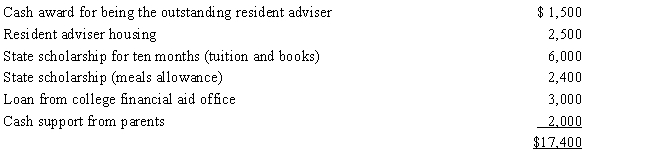 Ron served as a resident adviser in a dormitory and,therefore,the university waived the $2,500 charge for the room he occupied.What is Ron's adjusted gross income for 2017?
 (Multiple Choice)
4.7/5 (75)
(75) Hazel,a solvent individual but a recovering alcoholic,embezzled $6,000 from her employer.In the same year that she embezzled the funds,her employer discovered the theft.Her employer did not fire her and told her she did not have to repay the $6,000 if she would attend Alcoholics Anonymous.Hazel met the conditions and her employer canceled the debt.
(Multiple Choice)
4.9/5 (68)
(68) All employees of United Company are covered by a group hospitalization insurance plan,but the employees must pay the premiums ($8,000 for each employee).None of the employees has sufficient medical expenses to deduct the premiums.Instead of giving raises next year,United is considering paying the employee's hospitalization insurance premiums.If the change is made,the employee's after-tax and insurance pay will:
(Multiple Choice)
4.7/5 (83)
(83) A cash basis taxpayer took an itemized deduction of $5,500 for state income tax paid in 2017.His total itemized deductions in 2017 were $18,000.In 2018,he received a $900 refund of his 2017 state income tax.The taxpayer must include the $900 refund in his 2018 Federal gross income in accordance with the tax benefit rule.
(True/False)
4.9/5 (68)
(68) The exclusion for health insurance premiums paid by the employer applies to:
(Multiple Choice)
4.8/5 (94)
(94) Mauve Company permits employees to occasionally use the copying machine for personal purposes.The copying machine is located in the office where the higher paid executives work,so they occasionally use the machine.However,the machine is not convenient for use by the lower paid warehouse employees and,thus,they never use the copier.The use of the copy machine may not be excluded from gross income because the benefit is discriminatory.
(True/False)
4.9/5 (61)
(61) In December 2017,Emily,a cash basis taxpayer,received a $2,500 cash scholarship for the Spring semester of 2018.However,she did not use the funds to pay the tuition until January 2018.Emily can exclude the $2,500 from her gross income in 2017.
(True/False)
4.8/5 (70)
(70) Employees of the Valley Country Club are allowed to use the golf course without charge before and after working hours on Mondays,when the number of players on the course is at its lowest.Tom,an employee of the country club played 40 rounds of golf during the year at no charge when the non-employee charge was $20 per round.
(Multiple Choice)
4.9/5 (65)
(65) James,a cash basis taxpayer,received the following compensation and fringe benefits in the current year:
 His actual salary was $72,000.He received only $66,000 because his salary was garnished and the employer paid $6,000 on James's credit card debt he owed.The wage continuation insurance is available to all employees and pays the employee three-fourths of the regular salary if the employee is sick or disabled.The long-term care insurance is available to all employees and pays $150 per day towards a nursing home or similar facility.What is James's gross income from the above?
 (Multiple Choice)
4.9/5 (91)
(91) 
Filters
- Essay(0)
- Multiple Choice(0)
- Short Answer(0)
- True False(0)
- Matching(0)