



 Chat with AI
Exam 18: Pediatric Dosages

Exam 1: Fractions6 Questions
Exam 2: Decimals12 Questions
Exam 3: Percents12 Questions
Exam 4: Ratios12 Questions
Exam 5: Proportions10 Questions
Exam 6: Metric and Household Measurements20 Questions
Exam 7: Calculations Used in Patient Assessments44 Questions
Exam 11: Oral Dosages105 Questions
Exam 12: Parenteral Dosages51 Questions
Exam 13: Dosages Measured in Units30 Questions
Exam 14: Reconstitution of Medications10 Questions
Exam 15: Intravenous Flow Rates75 Questions
Exam 16: Intravenous Flow Rates for Dosages Measured in Units10 Questions
Exam 17: Critical Care Intravenous Flow Rates39 Questions
Exam 18: Pediatric Dosages20 Questions
Exam 19: Obstetric Dosages18 Questions
Select questions type


Insert the correct responses. Do not round doses.
-Maintenance Rate Table
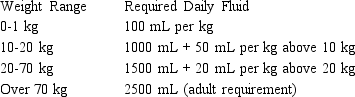 A child is to receive IV fluids at maintenance rate. The child weighs 75 lb.
a. What is the child's weight in kilograms? _____________
b. Calculate the 24-hour fluid requirements for this patient. ___________________
c. How many milliliters per hour are needed to deliver the maintenance fluids? _______________
A child is to receive IV fluids at maintenance rate. The child weighs 75 lb.
a. What is the child's weight in kilograms? _____________
b. Calculate the 24-hour fluid requirements for this patient. ___________________
c. How many milliliters per hour are needed to deliver the maintenance fluids? _______________
Free
(Essay)
4.9/5  (84)
(84) Correct Answer: Verified
a. 34.1 kg
b. 1782 mL
c. 74.3 mL/h
Insert the correct responses. Do not round doses.
-Maintenance Rate Table
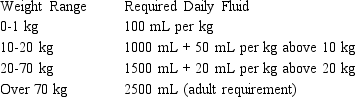 A child is to receive IV fluids at maintenance rate. The child weighs 32 lb.
a. What is the child's weight in kilograms? ________________
b. Calculate the 24-hour fluid requirements for this patient. _________________
c. How many milliliters per hour are needed to deliver the maintenance fluids? _________________
A child is to receive IV fluids at maintenance rate. The child weighs 32 lb.
a. What is the child's weight in kilograms? ________________
b. Calculate the 24-hour fluid requirements for this patient. _________________
c. How many milliliters per hour are needed to deliver the maintenance fluids? _________________Free
(Essay)
4.7/5 (76)
(76) Correct Answer:Verified
Verifieda. 14.5 kg
b. 1225 mL
c. 51 mL/h
Insert the correct responses. Do not round doses.
-The recommended safe dosage of erythromycin for a child is 20 mg/kg/day in four equal doses. The child's weight is 33 lb. The medication is supplied in 125 mg/mL.
a. What is the child's weight in kilograms? _____________
b. Calculate the safe dose for this child. ____________________
c. How many milliliters will be administered for each dose? ____________________
Free
(Essay)
5.0/5 (85)
(85) Correct Answer:Verified
Verifieda. 15 kg
b. 75 mg/dose
c. 0.6 mL/dose
Insert the correct responses. Do not round doses.
-A health care provider orders 500 mL of D50.45% NS to infuse at 50 mL/h. The tubing drop factor is 60 gtt/mL. Calculate the rate in drops per minute. ____________________
(Essay)
4.8/5 (87)
(87)
Insert the correct responses. Do not round doses.
-The recommended dosage of morphine IV for a child is 0.6 mg/kg/h. The child weighs 99 lb. The medication is supplied in 30 mg/30 mL.
a. What is the child's weight in kilograms? _____________
b. Calculate the dose for this child. ____________________
c. Calculate the rate in milliliters per hour for this IV. ____________________
(Essay)
4.7/5 (72)
(72)
Insert the correct responses. Do not round doses.
-The physician orders Ancef 500 mg IV every 8 hours for a child weighing 30 lb. The Ancef is available in a 330 mg/mL concentration. The recommended dose is 100 mg/kg/24 h divided in three doses.
a. What is the child's weight in kilograms? ___________
b. How many milligrams per kilogram per 24 hours is the patient receiving? ___________
c. Is the order safe? _____________
d. If yes, how many milliliters are needed for each dose? ______
(Essay)
4.8/5 (73)
(73)
Insert the correct responses. Do not round doses.
-The physician orders vancomycin 400 mg oral every 6 hours for a child weighing 90 lb. The vancomycin is available in a 250 mg/5 mL concentration. The recommended dose is 40 mg/kg/24 h divided in four divided doses.
a. What is the child's weight in kilograms? _____________
b. How many milligrams per kilogram per 24 hours is the patient receiving? ______________
c. Is the order safe? ___________________
d. If yes, how many milliliters are needed for each dose? ______________
(Essay)
4.8/5 (72)
(72)
Insert the correct responses. Do not round doses.
-The recommended dosage of gentamicin IVPB for a child is 6 mg/kg/day in two equal doses. The child's weight is 44 lb. The tubing drop factor is 60 gtt/mL. The medication is supplied in 60 mg/100 mL to infuse over 90 minutes.
a. What is the child's weight in kilograms? _____________
b. Calculate the dose for this child. ____________________
c. Calculate the rate in milliliters per hour for this IV. ____________________
d. Calculate the drops per minute. ____________________
(Essay)
4.9/5 (74)
(74)
Insert the correct responses. Do not round doses.
-The physician orders Keflex 250 mg oral every 6 hours for a child weighing 40 lb. The Keflex is available in a 250 mg/5 mL concentration. The recommended dose is 50 to 100 mg/kg/24 h divided in four doses.
a. What is the child's weight in kilograms? _____________
b. How many milligrams per kilogram per 24 hours is the patient receiving? ___________
c. Is the order safe? ________________
d. If yes, how many milliliters are needed for each dose? ________________
(Essay)
4.8/5 (75)
(75)
Insert the correct responses. Do not round doses.
-The recommended dosage of Zinacef IVPB for a child is 75 mg/kg/day in three equal doses. The child weighs 66 lb. The tubing drop factor is 60 gtt/mL. The medication is supplied in 750 mg/50 mL to infuse over 30 minutes.
a. What is the child's weight in kilograms? _____________
b. Calculate the dose for this child. ____________________
c. Calculate the rate in milliliters per hour for this IV. ____________________
d. Calculate the drops per minute. ____________________
(Essay)
4.9/5 (72)
(72)
Insert the correct responses. Do not round doses.
-The physician orders prednisone 10 mg oral every 12 hours for a child weighing 22 lb. The prednisone syrup is available in a 5 mg/5 mL concentration. The recommended dose is 0.5 to 2 mg/kg/24 h.
a. What is the child's weight in kilograms? _____________
b. How many milligrams per kilogram per 24 hours is the patient receiving? ___________
c. Is the order safe? _______________
d. If yes, how many milliliters are needed for each dose? _________________
(Essay)
4.8/5 (79)
(79)
Insert the correct responses. Do not round doses.
-Maintenance Rate Table
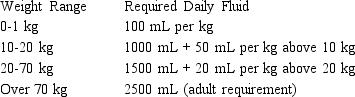 A child is to receive IV fluids at maintenance rate. The child weighs 60 lb.
a. What is the child's weight in kilograms? _____________
b. Calculate the 24-hour fluid requirements for this patient. ____________
c. How many milliliters per hour are needed to deliver the maintenance fluids? _______________
A child is to receive IV fluids at maintenance rate. The child weighs 60 lb.
a. What is the child's weight in kilograms? _____________
b. Calculate the 24-hour fluid requirements for this patient. ____________
c. How many milliliters per hour are needed to deliver the maintenance fluids? _______________ (Essay)
4.8/5 (78)
(78)
Insert the correct responses. Do not round doses.
-The recommended dosage of amoxicillin is 20 to 40 mg/kg/day divided in equal doses q8 h. The medication is supplied as 50 mg/mL oral suspension. The child weighs 72.6 lb.
a. What is the child's weight in kilograms? _____________
b. Calculate the safe dosage range for this child per day. ____________________
c. Calculate the safe dose range for each 8-hour dose. _______________________
d. How many milliliters will be administered for a single dose if the child is receiving the 20 mg/kg/day dosage? ____________________
(Essay)
4.8/5 (80)
(80)
Insert the correct responses. Do not round doses.
-Maintenance Rate Table
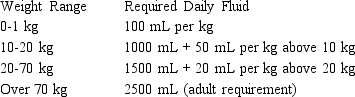 A child is to receive IV fluids at maintenance rate. The child weighs 14 lb.
a. What is the child's weight in kilograms? _____________
b. Calculate the 24-hour fluid requirements for this patient. _______________
c. How many milliliters per hour are needed to deliver the maintenance fluids? _______________
A child is to receive IV fluids at maintenance rate. The child weighs 14 lb.
a. What is the child's weight in kilograms? _____________
b. Calculate the 24-hour fluid requirements for this patient. _______________
c. How many milliliters per hour are needed to deliver the maintenance fluids? _______________ (Essay)
4.8/5 (74)
(74)
Insert the correct responses. Do not round doses.
-The recommended dosage of oxacillin for a child is 50 mg/kg/day in four equal doses. The child's weight is 66 lb. The medication is supplied in 250 mg/5 mL.
a. What is the child's weight in kilograms? _____________
b. Calculate the safe dose for this child. ____________________
c. How many milliliters will be administered for each dose? ____________________
(Essay)
4.9/5 (64)
(64)
Insert the correct responses. Do not round doses.
-The recommended dose of Lasix for a child is 1 mg/kg/dose. The child's weight is 77 lb. The medication is supplied in 10 mg/mL.
a. What is the child's weight in kilograms? _____________
b. Calculate the safe dose for this child. ____________________
c. How many milliliters will be administered for each dose? ____________________
(Essay)
4.9/5 (86)
(86)
Insert the correct responses. Do not round doses.
-Maintenance Rate Table
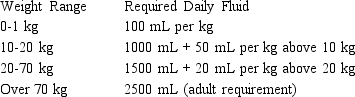 A child is to receive IV fluids at maintenance rate. The child weighs 28 lb.
a. What is the child's weight in kilograms? _____________
b. Calculate the 24-hour fluid requirements for this patient. __________________
c. How many milliliters per hour are needed to deliver the maintenance fluids? _______________
A child is to receive IV fluids at maintenance rate. The child weighs 28 lb.
a. What is the child's weight in kilograms? _____________
b. Calculate the 24-hour fluid requirements for this patient. __________________
c. How many milliliters per hour are needed to deliver the maintenance fluids? _______________ (Essay)
4.8/5 (75)
(75)
Insert the correct responses. Do not round doses.
-The recommended safe dose of rifampin for a child is 5 mg/kg/dose. The child's weight is 11 lb. The medication is supplied in 10 mg/mL.
a. What is the child's weight in kilograms? _____________
b. Calculate the safe dose for this child. ____________________
c. How many milliliters will be administered for each dose? ____________________
(Essay)
4.9/5 (84)
(84)
Insert the correct responses. Do not round doses.
-The physician orders ibuprofen 200 mg oral every 6 hours for a child weighing 60 lb. The ibuprofen is available in a 100 mg/5 mL concentration. The recommended dose is 5 to 10 mg/kg/dose.
a. What is the child's weight in kilograms? _______________
b. How many milligrams per kilogram per 24 hours is the patient receiving? ___________
c. Is the order safe? _______________
d. If yes, how many milliliters are needed for each dose? __________________
(Essay)
4.9/5 (85)
(85)
Insert the correct responses. Do not round doses.
-The recommended dosage of Dilantin for a child is 7 mg/kg/24 h given q12 h. The child's weight is 55 lb. The medication is supplied in 125 mg/5 mL.
a. What is the child's weight in kilograms? _____________
b. Calculate the safe dose for this child. ____________________
c. How many milliliters will be administered for each dose? ____________________
(Essay)
4.8/5 (89)
(89) 
Filters
- Essay(0)
- Multiple Choice(0)
- Short Answer(0)
- True False(0)
- Matching(0)