



 Chat with AI
Exam 17: Economic Growth: Resources, technology, ideas, and Institutions

Exam 1: What Economics Is About159 Questions
Exam 2: Production Possibilities Frontier Framework132 Questions
Exam 3: Supply and Demand: Theory197 Questions
Exam 4: Prices: Free, controlled, and Relative95 Questions
Exam 5: Supply,demand,and Price: Applications66 Questions
Exam 6: Macroeconomic Measurements, part I: Prices and Unemployment103 Questions
Exam 7: Macroeconomic Measurements, part II: GDP and Real GDP115 Questions
Exam 8: Aggregate Demand and Aggregate Supply203 Questions
Exam 9: Classical Macroeconomics and the Self-Regulating Economy159 Questions
Exam 10: Keynesian Macroeconomics and Economic Instability: a Critique of the Self-Regulating Economy183 Questions
Exam 11: Fiscal Policy and the Federal Budget162 Questions
Exam 12: Money,banking,and the Financial System121 Questions
Exam 13: The Federal Reserve System178 Questions
Exam 14: Money and the Economy123 Questions
Exam 15: Monetary Policy174 Questions
Exam 16: Expectations Theory and the Economy132 Questions
Exam 17: Economic Growth: Resources, technology, ideas, and Institutions79 Questions
Exam 18: The Financial Crisis of 2007-200971 Questions
Exam 19: Debates in Macroeconomics Over the Role and Effects of Government119 Questions
Exam 20: Public Choice and Special-Interest-Group Politics56 Questions
Exam 21: Building Theories to Explain Everyday Life: From Observations to Questions to Theories to Predictions120 Questions
Exam 22: International Trade121 Questions
Exam 23: International Finance137 Questions
Exam 24: Globalization and International Impacts on the Economy77 Questions
Exam 25: The Economic Case for and Against Government: Five Topics Considered92 Questions
Exam 26: Stocks, bonds, futures, and Options149 Questions
Select questions type


Exhibit 17-3 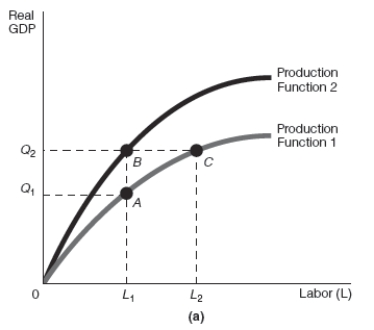
 -Refer to Exhibit 17-3 Assume that the starting point on the production function is point A.After an increase in the technology coefficient,there would be a ______________________ which would shift the LRAS curve from LRAS1 to _______________ resulting in _______________..
 (Multiple Choice)
4.8/5  (70)
(70) Per-capita real economic growth refers to an increase from one period to the next in
(Multiple Choice)
4.8/5 (76)
(76) __________ rights refer to the range of laws,rules,and regulations that define rights for the use and transfer of resources.
(Multiple Choice)
4.8/5 (73)
(73) Neoclassical growth theory emphasized how __________ contribute to growth.
(Multiple Choice)
4.8/5 (76)
(76) Exhibit 17-2 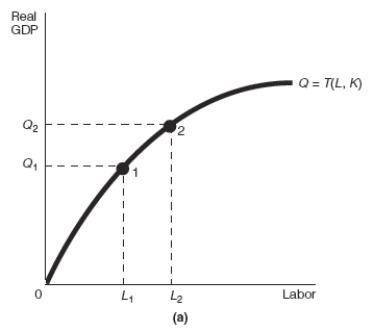
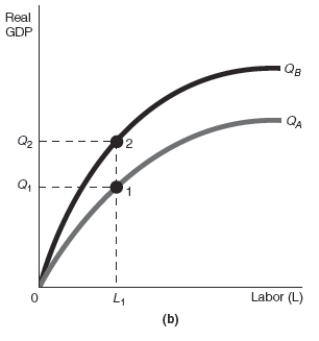 -Refer to Exhibit 17-2.Assume that the starting point is always point 1.Which of the production function graphs shown, (a)or (b),represents an increase in the quantity of labor,and which represents an increase in the quantity of capital,respectively?
 (Multiple Choice)
4.9/5 (93)
(93) In the production function Real GDP = T (L,K),the T represents the _____________ coefficient,the L represents ________________ and the K represents _______________.
(Multiple Choice)
4.9/5 (83)
(83) Country X experiences an increase in Real GDP and an increase in per-capita Real GDP.It follows that
(Multiple Choice)
4.9/5 (79)
(79) Exhibit 17-3
-Refer to Exhibit 17-3 Assume that the starting point on the production function is point A.After an increase in the quantity of capital,there would be a ______________________ which would shift the LRAS curve from LRAS1 to _______________ resulting in _______________..
-Refer to Exhibit 17-3 Assume that the starting point on the production function is point A.After an increase in the quantity of capital,there would be a ______________________ which would shift the LRAS curve from LRAS1 to _______________ resulting in _______________.. (Multiple Choice)
4.8/5 (73)
(73) If Real GDP is $6 billion and the population is 300,000,per-capita Real GDP is
(Multiple Choice)
4.8/5 (69)
(69) If a country's economic growth rate is 4 percent a year,approximately how many years will it take to double its Real GDP?
(Multiple Choice)
4.9/5 (87)
(87) In the production function Real GDP = T (L,K),the T represents the tax coefficient.
(True/False)
4.7/5 (60)
(60) Real GDP in a small country is worth $8 billion.The population of the country is 200,000.What is per capita Real GDP?
(Multiple Choice)
4.7/5 (75)
(75) An economy doubles in size every 35 years if it maintains a steady annual growth rate of about __________ percent.
(Multiple Choice)
4.9/5 (79)
(79) Compare a property rights system in which people are allowed to keep one-third of the monetary rewards of their labor with a system in which they keep two-thirds.We should expect more entrepreneurship under the __________ system and faster real economic growth under the __________ system.
(Multiple Choice)
4.9/5 (81)
(81) Exhibit 17-4 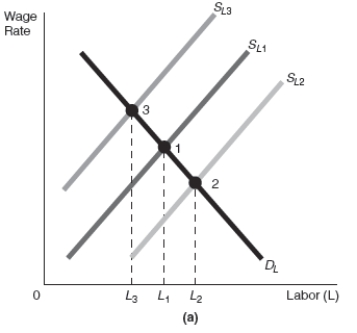

 -Refer to Exhibit 17-4 Assume that the starting point in graphs (a)and (b)in Exhibit 17-4 is point 1.After a decrease in income taxes,there would be a ______________________ which would cause a movement along the production function from point 1 to point ______________.The result would be a shift of the LRAS curve from LRAS1 to _______________ resulting in _______________..
 (Multiple Choice)
4.9/5 (83)
(83) When interest rates in a given economy are reduced,it causes firms to employ __________ capital goods.In terms of the production function (graphed with labor on the horizontal axis and Real GDP on the vertical axis),this then causes ____________________ .
(Multiple Choice)
5.0/5 (88)
(88) When taxes on the return to capital in a given economy are reduced,it causes firms to employ __________ capital goods.In terms of the production function (graphed with labor on the horizontal axis and Real GDP on the vertical axis),this then causes ____________________ which makes the LRAS curve shift ____________ resulting in ______________________.
(Multiple Choice)
4.9/5 (76)
(76) A production function specifies the relation between ____________ and the ___________ to ____________________.
(Multiple Choice)
4.9/5 (75)
(75) Compare a property rights system in which people are allowed to keep one-third of the monetary rewards of their labor with a system in which they keep two-thirds.We should expect harder work under the __________ system and less risk taking under the __________ system.
(Multiple Choice)
4.9/5 (66)
(66) According to new growth theory,technological advances can be promoted
(Multiple Choice)
4.9/5 (81)
(81) 
Filters
- Essay(0)
- Multiple Choice(0)
- Short Answer(0)
- True False(0)
- Matching(0)