



 Chat with AI
Exam 11: Fiscal Policy and the Federal Budget

Exam 1: What Economics Is About159 Questions
Exam 2: Production Possibilities Frontier Framework132 Questions
Exam 3: Supply and Demand: Theory197 Questions
Exam 4: Prices: Free, controlled, and Relative95 Questions
Exam 5: Supply,demand,and Price: Applications66 Questions
Exam 6: Macroeconomic Measurements, part I: Prices and Unemployment103 Questions
Exam 7: Macroeconomic Measurements, part II: GDP and Real GDP115 Questions
Exam 8: Aggregate Demand and Aggregate Supply203 Questions
Exam 9: Classical Macroeconomics and the Self-Regulating Economy159 Questions
Exam 10: Keynesian Macroeconomics and Economic Instability: a Critique of the Self-Regulating Economy183 Questions
Exam 11: Fiscal Policy and the Federal Budget162 Questions
Exam 12: Money,banking,and the Financial System121 Questions
Exam 13: The Federal Reserve System178 Questions
Exam 14: Money and the Economy123 Questions
Exam 15: Monetary Policy174 Questions
Exam 16: Expectations Theory and the Economy132 Questions
Exam 17: Economic Growth: Resources, technology, ideas, and Institutions79 Questions
Exam 18: The Financial Crisis of 2007-200971 Questions
Exam 19: Debates in Macroeconomics Over the Role and Effects of Government119 Questions
Exam 20: Public Choice and Special-Interest-Group Politics56 Questions
Exam 21: Building Theories to Explain Everyday Life: From Observations to Questions to Theories to Predictions120 Questions
Exam 22: International Trade121 Questions
Exam 23: International Finance137 Questions
Exam 24: Globalization and International Impacts on the Economy77 Questions
Exam 25: The Economic Case for and Against Government: Five Topics Considered92 Questions
Exam 26: Stocks, bonds, futures, and Options149 Questions
Select questions type


If an economist recommends that the government reduce the tax rate in order to increase tax revenues (based on the Laffer curve),she is implicitly assuming that the economy is currently operating at a point
(Multiple Choice)
4.8/5  (71)
(71) The lag between an increase in government spending and the impact of this increased spending on the economy is called the __________ lag.
(Multiple Choice)
4.9/5 (69)
(69) To identify whether fiscal policy is expansionary or contractionary,one should focus on the cyclical deficit.
(True/False)
4.8/5 (90)
(90) With complete crowding out,an increase in government spending
(Multiple Choice)
4.9/5 (65)
(65) Complete crowding out implies that as government increases purchases by $1,
(Multiple Choice)
4.8/5 (77)
(77) Exhibit 11-1  -Refer to Exhibit 11-1.The economy is currently at point 1.In this situation,supply-side economists would most likely propose _______________ to make the price level ______________ and Real GDP ___________.
 (Multiple Choice)
4.9/5 (57)
(57) Exhibit 11-2 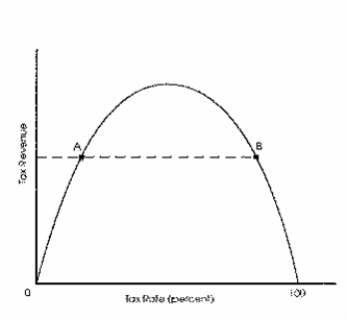 -Refer to Exhibit 11-2.At point B,if we cut tax rates slightly,tax revenues will
 (Multiple Choice)
4.9/5 (83)
(83) Over the past 50 years in the United States,tax revenues as a percentage of GDP have tended to be in the __________________ percent range.
(Multiple Choice)
4.9/5 (75)
(75) Explain how tax cuts can impact both aggregate demand and aggregate supply.Give an example of each.
(Essay)
4.8/5 (81)
(81) Suppose the government increases spending on public education by $700 million and individual spending on private education drops by $700 million.This is an example of
(Multiple Choice)
4.8/5 (81)
(81) Suppose the economy's current AD and SRAS curves intersect to the right of Natural Real GDP.Keynesians might advise a policy of tax __________ to shift __________.
(Multiple Choice)
4.9/5 (65)
(65) If the economy is on the downward-sloping portion of the Laffer curve,a(an)__________ in tax rates will __________ tax revenues.
(Multiple Choice)
4.8/5 (93)
(93) Exhibit 11-1
-Refer to Exhibit 11-1.The economy is currently at point 1.Suppose the federal government increases purchases and there is complete crowding out.As a result,the aggregate demand (AD)curve in the exhibit
-Refer to Exhibit 11-1.The economy is currently at point 1.Suppose the federal government increases purchases and there is complete crowding out.As a result,the aggregate demand (AD)curve in the exhibit (Multiple Choice)
4.9/5 (82)
(82) Buchanan and Wagner assert that there is a political bias toward contractionary fiscal policy and not expansionary fiscal policy.
(True/False)
4.8/5 (84)
(84) At a taxable income of $80,000 Adam's income tax is $18,400.When his taxable income rises to $90,000 his income tax is $21,000.Based on this information,Adam's marginal tax rate is _____________ percent and his new average tax rate is ____________ percent.
(Multiple Choice)
4.8/5 (85)
(85) 
Filters
- Essay(0)
- Multiple Choice(0)
- Short Answer(0)
- True False(0)
- Matching(0)