



 Chat with AI
Exam 14: Capital Budgeting and Strategic Investment Decisions

Exam 1: The Role of Accounting Information in Management Decision Making81 Questions
Exam 2: Cost Concepts, Behaviour and Estimation88 Questions
Exam 3: A Costing Framework and Cost Allocation45 Questions
Exam 4: Cost-Volume-Profit Cvp Analysis93 Questions
Exam 5: Job Costing Systems45 Questions
Exam 6: Process Costing Systems93 Questions
Exam 7: Absorption, Variable and Throughput Costing102 Questions
Exam 8: Activity Analysis: Costing and Management96 Questions
Exam 9: Relevant Costs for Decision Making122 Questions
Exam 10: Standard Costs, Flexible Budgets and Variance Analysis104 Questions
Exam 11: Operational Budgets87 Questions
Exam 12: Strategy and Control35 Questions
Exam 13: Planning and Budgeting for Strategic Success45 Questions
Exam 14: Capital Budgeting and Strategic Investment Decisions93 Questions
Exam 15: The Strategic Management of Costs and Revenues109 Questions
Exam 16: Strategic Management Control: a Lean Perspective46 Questions
Exam 17: Responsibility Accounting, Performance Evaluation and Transfer Pricing63 Questions
Exam 18: The Balanced Scorecard and Strategy Maps83 Questions
Exam 19: Rewards, Incentives and Risk Management45 Questions
Exam 20: Sustainability Management Accounting45 Questions
Select questions type


Sebastian is presenting a capital budgeting project to Tamara, his division manager. Which one of the following is likely to have the least amount of bias when evaluating this project?
(Multiple Choice)
4.9/5  (78)
(78) Bailey Pty Ltd is considering modernising its production by purchasing a new machine and selling an old machine. The following data have been collected on this investment: The income tax rate is 40%, and the required rate of return is 16%. Depreciation is $5,000 per year for the old machine. The new machine would be depreciated $7,600 in 2008, $5,700 in 2009, $3,800 in 2010, and $1,900 in 2011. Assume Bailey would purchase the new machine in December 2007 and dispose of the old machine in January 2008.
The net cash flow associated with selling the old machine in January 2008 (i.e., the value of the sale and any tax consequences) would be
(Multiple Choice)
4.7/5 (84)
(84) Which of the following statements regarding NPV analysis is true?
(Multiple Choice)
4.8/5 (68)
(68) In a capital budgeting analysis, nominal cash flow is generally calculated as
(Multiple Choice)
4.8/5 (77)
(77) Which of the following factors are subject to uncertainty in an NPV analysis? 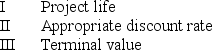
(Multiple Choice)
4.9/5 (65)
(65) DBR is considering the purchase and implementation of an enterprise-wide information system. Which of the following would be the least biased source of qualitative information about the project?
(Multiple Choice)
4.9/5 (89)
(89) Which of the following is the best example of a capital budgeting decision?
(Multiple Choice)
4.8/5 (95)
(95) Uniform cash flows from a capital project are necessary for which of the following calculations? 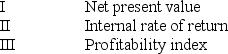
(Multiple Choice)
4.8/5 (66)
(66) Which of the following is not a step in the process for addressing capital budgeting decisions?
(Multiple Choice)
4.8/5 (83)
(83) Arnold is acquiring a new machine with a life of 5 years for use on its production line. The following data relate to this purchase: 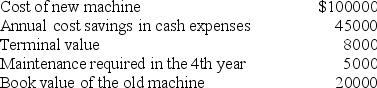 The new machine would replace an old fully-depreciated machine. The old machine can be sold for $15,000 at the time the new equipment is acquired. The income tax rate is 30%, and the discount rate is 12%. Arnold uses the straight-line method for depreciation on all machines (ignore the half-year convention).
The present value of the terminal cash flows is
The new machine would replace an old fully-depreciated machine. The old machine can be sold for $15,000 at the time the new equipment is acquired. The income tax rate is 30%, and the discount rate is 12%. Arnold uses the straight-line method for depreciation on all machines (ignore the half-year convention).
The present value of the terminal cash flows is (Multiple Choice)
4.8/5 (69)
(69) Rams Ltd has invested in a machine with a cost of $37,164 and annual cost savings of $6,000. The discount rate is 8%, and the machine's internal rate of return is 12%. Ignore income taxes. The estimated life of the machine is
(Multiple Choice)
4.9/5 (65)
(65) Phoxco would like to automate its calligraphy operation. The equipment will cost $150,000 plus freight, installation, and testing costs of $5,500. The expected life of the project is 8 years, with annual cost savings of $20,000. The minimum rate of return is 12% and estimated terminal value is $3,000. Ignore income taxes. The profitability index of the project is
(Multiple Choice)
4.9/5 (65)
(65) 
Filters
- Essay(0)
- Multiple Choice(0)
- Short Answer(0)
- True False(0)
- Matching(0)