



 Chat with AI
Exam 18: The Balanced Scorecard and Strategy Maps

Exam 1: The Role of Accounting Information in Management Decision Making81 Questions
Exam 2: Cost Concepts, Behaviour and Estimation88 Questions
Exam 3: A Costing Framework and Cost Allocation45 Questions
Exam 4: Cost-Volume-Profit Cvp Analysis93 Questions
Exam 5: Job Costing Systems45 Questions
Exam 6: Process Costing Systems93 Questions
Exam 7: Absorption, Variable and Throughput Costing102 Questions
Exam 8: Activity Analysis: Costing and Management96 Questions
Exam 9: Relevant Costs for Decision Making122 Questions
Exam 10: Standard Costs, Flexible Budgets and Variance Analysis104 Questions
Exam 11: Operational Budgets87 Questions
Exam 12: Strategy and Control35 Questions
Exam 13: Planning and Budgeting for Strategic Success45 Questions
Exam 14: Capital Budgeting and Strategic Investment Decisions93 Questions
Exam 15: The Strategic Management of Costs and Revenues109 Questions
Exam 16: Strategic Management Control: a Lean Perspective46 Questions
Exam 17: Responsibility Accounting, Performance Evaluation and Transfer Pricing63 Questions
Exam 18: The Balanced Scorecard and Strategy Maps83 Questions
Exam 19: Rewards, Incentives and Risk Management45 Questions
Exam 20: Sustainability Management Accounting45 Questions
Select questions type




The purpose of a balanced scorecard is to translate organisational vision and strategies into performance objectives that can be monitored over time.
(True/False)
4.9/5  (93)
(93) Once balanced scorecard measures have been chosen, they should not be changed for at least five years.
(True/False)
4.9/5 (74)
(74) The perspectives in a typical balanced scorecard include all of the following except
(Multiple Choice)
4.9/5 (80)
(80) National Bank of Victoria (NBOV) is the fourth largest commercial bank in Australia. NBOV assets total $46.1 billion, loans of $26 billion, and total deposits of $35.5 billion. It provides online, telephone, and traditional banking and investment services to both individuals and businesses in Australia. NBOV's mission is to create an exceptional customer experience internationally by providing solutions through leading technologies, offering a wide selection of financial products and services, and leveraging experience to meet customers' needs. NBOV could develop a balanced scorecard for 
(Multiple Choice)
4.8/5 (82)
(82) An organisational vision is concerned with creating value for stakeholders, including 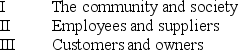
(Multiple Choice)
4.8/5 (75)
(75) Strengths of the balanced scorecard related to communication and linkages include 
(Multiple Choice)
4.8/5 (80)
(80) The basis of a balanced scorecard is continuous strategic analysis from as many perspectives as possible.
(True/False)
4.9/5 (87)
(87) Strengths of the balanced scorecard can typically be summarised in three groups. Which of the following is not one of them?
(Multiple Choice)
4.8/5 (89)
(89) A balanced scorecard usually contains four perspectives: customer, financial, internal business process, and learning and growth.
(True/False)
4.9/5 (80)
(80) Steps in the post-sales service cycle of the value chain include
(Multiple Choice)
4.9/5 (80)
(80) Non-financial measures are typically not objective enough to serve as effective performance measures.
(True/False)
4.9/5 (88)
(88) The balanced scorecard approach has been criticised for not capturing core values related to
(Multiple Choice)
5.0/5 (82)
(82) An organisation's core competencies can include productivity, reputation, and regulatory advantages.
(True/False)
4.8/5 (96)
(96) Which of the following is a synonym for an organisation's vision?
(Multiple Choice)
4.9/5 (76)
(76) The steps and cycles in the value chain are most closely associated with which balanced scorecard perspective?
(Multiple Choice)
4.9/5 (80)
(80) 
Filters
- Essay(0)
- Multiple Choice(0)
- Short Answer(0)
- True False(0)
- Matching(0)