



 Chat with AI
Exam 28: Plant Reproduction and Development

Exam 1: Invitation to Biology101 Questions
Exam 2: Molecules of Life159 Questions
Exam 3: Cell Structure103 Questions
Exam 4: Energy and Metabolism107 Questions
Exam 5: Capturing and Releasing Energy150 Questions
Exam 6: DNA Structure and Function109 Questions
Exam 7: Gene Expression and Control135 Questions
Exam 8: How Cells Reproduce160 Questions
Exam 9: Patterns of Inheritance155 Questions
Exam 10: Biotechnology103 Questions
Exam 11: Evidence of Evolution117 Questions
Exam 12: Processes of Evolution136 Questions
Exam 13: Early Life Forms and the Viruses147 Questions
Exam 14: Plants and Fungi139 Questions
Exam 15: Animal Evolution170 Questions
Exam 16: Population Ecology111 Questions
Exam 17: Communities and Ecosystems118 Questions
Exam 18: The Biosphere and Human Effects111 Questions
Exam 19: Animal Tissues and Organs134 Questions
Exam 20: How Animals Move125 Questions
Exam 21: Circulation and Respiration152 Questions
Exam 22: Immunity132 Questions
Exam 23: Digestion and Excretion146 Questions
Exam 24: Neural Control and the Senses173 Questions
Exam 25: Endocrine Control142 Questions
Exam 26: Reproduction and Development160 Questions
Exam 27: Plant Form and Function187 Questions
Exam 28: Plant Reproduction and Development157 Questions
Select questions type


Choose the one most appropriate answer for each.
a.haploid cells in the anther
b.reduction of chromosome number by one-half
c.after fertilization,ripens into fruit tissue
d.two nuclei in the ovule that unite with a single sperm
e.after fertilization,will form a seed
f.modified leaf with pigments and fragrance-producing cells
g.mature microspore
h.female reproductive organ
i.landing platform for pollen
j.pollen-bearing structure
k.haploid cells in the ovule
l.outermost whorl of flower parts on a receptacle
m.female gametophyte
-sepal
(Essay)
4.9/5  (68)
(68) The aging of a plant from the time of full maturity is known as
(Multiple Choice)
4.8/5 (94)
(94) Choose the one most appropriate answer for each.
a.haploid cells in the anther
b.reduction of chromosome number by one-half
c.after fertilization,ripens into fruit tissue
d.two nuclei in the ovule that unite with a single sperm
e.after fertilization,will form a seed
f.modified leaf with pigments and fragrance-producing cells
g.mature microspore
h.female reproductive organ
i.landing platform for pollen
j.pollen-bearing structure
k.haploid cells in the ovule
l.outermost whorl of flower parts on a receptacle
m.female gametophyte
-microspores
(Essay)
4.9/5 (68)
(68) 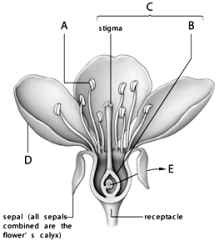 -The seeds will form in the structure at letter _____.
Phytochrome is converted from the inactive to the active form by being exposed to light of what color?
(Multiple Choice)
4.7/5 (81)
(81) Which of the following chemicals is used to induce polyploidy?
(Multiple Choice)
4.8/5 (61)
(61) Four of the five answers listed below are haploid.Select the EXCEPTION.
(Multiple Choice)
4.7/5 (91)
(91) Four of the five answers listed below are related by being plant gender specific.Select the EXCEPTION.
(Multiple Choice)
4.9/5 (82)
(82) The seeds of colorful,fleshy fruits are most likely to be spread by
(Multiple Choice)
4.9/5 (87)
(87) The process of inducing a cutting from one plant to fuse with the tissues of another plant is called
(Multiple Choice)
4.8/5 (75)
(75) Counting the number of seeds in a fruit will give a firm indication of the number of ___ in the flower.
(Multiple Choice)
4.9/5 (71)
(71) 
Filters
- Essay(0)
- Multiple Choice(0)
- Short Answer(0)
- True False(0)
- Matching(0)