



 Chat with AI
Exam 16: Population Ecology

Exam 1: Invitation to Biology101 Questions
Exam 2: Molecules of Life159 Questions
Exam 3: Cell Structure103 Questions
Exam 4: Energy and Metabolism107 Questions
Exam 5: Capturing and Releasing Energy150 Questions
Exam 6: DNA Structure and Function109 Questions
Exam 7: Gene Expression and Control135 Questions
Exam 8: How Cells Reproduce160 Questions
Exam 9: Patterns of Inheritance155 Questions
Exam 10: Biotechnology103 Questions
Exam 11: Evidence of Evolution117 Questions
Exam 12: Processes of Evolution136 Questions
Exam 13: Early Life Forms and the Viruses147 Questions
Exam 14: Plants and Fungi139 Questions
Exam 15: Animal Evolution170 Questions
Exam 16: Population Ecology111 Questions
Exam 17: Communities and Ecosystems118 Questions
Exam 18: The Biosphere and Human Effects111 Questions
Exam 19: Animal Tissues and Organs134 Questions
Exam 20: How Animals Move125 Questions
Exam 21: Circulation and Respiration152 Questions
Exam 22: Immunity132 Questions
Exam 23: Digestion and Excretion146 Questions
Exam 24: Neural Control and the Senses173 Questions
Exam 25: Endocrine Control142 Questions
Exam 26: Reproduction and Development160 Questions
Exam 27: Plant Form and Function187 Questions
Exam 28: Plant Reproduction and Development157 Questions
Select questions type


Which of the following is NOT a reason for the rapid explosion of the human population?
(Multiple Choice)
4.8/5  (87)
(87) In a population of 100 Douglas squirrels,the birth rate is 10 per year and the death rate is 20 per year.The per capita growth rate of Douglas squirrels is ___ per squirrel per year.
(Multiple Choice)
4.9/5 (67)
(67) In which type of population distribution would plot sampling be most accurate?
(Multiple Choice)
4.8/5 (84)
(84) 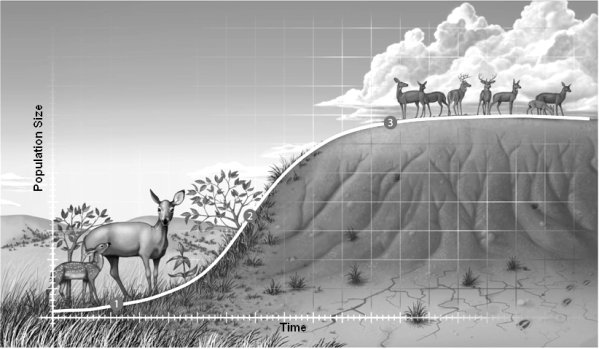 Examine the figure above and answer the following question(s).
-During phase "1",the size of the population of deer grow slowly because
Examine the figure above and answer the following question(s).
-During phase "1",the size of the population of deer grow slowly because (Multiple Choice)
4.7/5 (77)
(77) ____ is the study of interactions among organisms and between organisms and their environment.
(Multiple Choice)
4.7/5 (81)
(81) E.coli is an intestinal bacterium that reproduces at a rate of every 20 minutes.E.coli is representative of a ___ species.
(Multiple Choice)
4.7/5 (86)
(86) Four of the five answers listed below follow a type I survivorship curve.Select the EXCEPTION.
(Multiple Choice)
4.9/5 (73)
(73) Four of the five answers listed below are density-independent factors.Select the EXCEPTION.
(Multiple Choice)
4.9/5 (98)
(98) Which of the following countries has the smallest ecological footprint?
(Multiple Choice)
4.8/5 (79)
(79)
Examine the figure above and answer the following question(s).
-During the second phase "2",the growth is ____ as long as resources are plentiful.
Examine the figure above and answer the following question(s).
-During the second phase "2",the growth is ____ as long as resources are plentiful. (Multiple Choice)
4.8/5 (76)
(76) Classification.Answer the questions in reference to the seven terms listed below that are used by ecologists.
a.density-dependent factor
b.demographic transitional stage
c.type I survivorship
d.r-selected species
e.biotic potential
f.density-independent factor
g.logistic growth
-This describes a population that grows slowly at first then increases rapidly until it reaches carrying capacity.
(Essay)
4.9/5 (74)
(74) Four of the five answers listed below are limits to achieving a population's full biotic potential.Select the EXCEPTION.
(Multiple Choice)
4.9/5 (80)
(80) Which of the following factors is NOT a density-independent factor?
(Multiple Choice)
4.9/5 (93)
(93) The countries of ___ and ___ have the world's highest human populations.
(Multiple Choice)
4.8/5 (81)
(81) Match the following letters with the number with which they best correspond.
a.population density
b.population growth rate
c.carrying capacity
d.limiting factor
e.age structure
f.ecological footprint
-the amount of the Earth's surface needed to sustain a population's life habits
(Essay)
4.9/5 (80)
(80) 
Filters
- Essay(0)
- Multiple Choice(0)
- Short Answer(0)
- True False(0)
- Matching(0)