



 Chat with AI
Exam 15: Animal Evolution

Exam 1: Invitation to Biology101 Questions
Exam 2: Molecules of Life159 Questions
Exam 3: Cell Structure103 Questions
Exam 4: Energy and Metabolism107 Questions
Exam 5: Capturing and Releasing Energy150 Questions
Exam 6: DNA Structure and Function109 Questions
Exam 7: Gene Expression and Control135 Questions
Exam 8: How Cells Reproduce160 Questions
Exam 9: Patterns of Inheritance155 Questions
Exam 10: Biotechnology103 Questions
Exam 11: Evidence of Evolution117 Questions
Exam 12: Processes of Evolution136 Questions
Exam 13: Early Life Forms and the Viruses147 Questions
Exam 14: Plants and Fungi139 Questions
Exam 15: Animal Evolution170 Questions
Exam 16: Population Ecology111 Questions
Exam 17: Communities and Ecosystems118 Questions
Exam 18: The Biosphere and Human Effects111 Questions
Exam 19: Animal Tissues and Organs134 Questions
Exam 20: How Animals Move125 Questions
Exam 21: Circulation and Respiration152 Questions
Exam 22: Immunity132 Questions
Exam 23: Digestion and Excretion146 Questions
Exam 24: Neural Control and the Senses173 Questions
Exam 25: Endocrine Control142 Questions
Exam 26: Reproduction and Development160 Questions
Exam 27: Plant Form and Function187 Questions
Exam 28: Plant Reproduction and Development157 Questions
Select questions type


Which aspect of their lives prevents amphibians from becoming fully terrestrial?
(Multiple Choice)
4.9/5  (80)
(80) Four of the five answers listed below possess some type of coelom.Select the EXCEPTION.
(Multiple Choice)
4.7/5 (79)
(79) Classification.Answer the questions in reference to the groups listed below.
a.jawless fish
b.cartilage fish
c.bony fish
d.amphibians
e.reptiles
-Members of this class are fully terrestrial except for reproduction.
(Essay)
4.8/5 (64)
(64) MATCHING
Examine the figure below and match the options with the number which best corresponds.
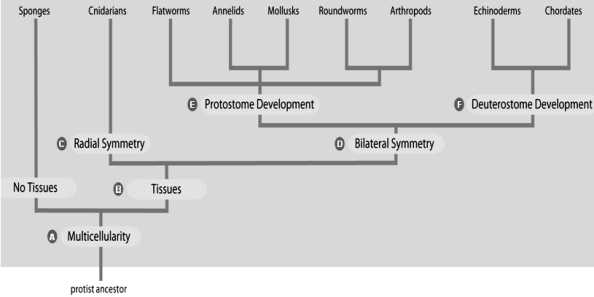 -first opening of the embryo becomes a mouth,and the second becomes an anus.
 (Essay)
4.9/5 (90)
(90) MATCHING
Examine the figure below and match the options with the number which best corresponds.
-having right and left halves with similar parts,and a front and back that differ
-having right and left halves with similar parts,and a front and back that differ (Essay)
5.0/5 (95)
(95) As an adult,which of the following typical chordate embryonic traits do adult tunicates retain?
(Multiple Choice)
4.9/5 (81)
(81) Which of the following invertebrates is most closely related to vertebrates?
(Multiple Choice)
4.9/5 (75)
(75) Four of the five answers listed below are features found in sponges.Select the EXCEPTION.
(Multiple Choice)
5.0/5 (80)
(80) What is one clue that snakes evolved from ancestral lizards?
(Multiple Choice)
4.9/5 (82)
(82) MATCHING
Examine the figure below and match the options with the number which best corresponds.
-first opening of the embryo becomes an anus,and the second becomes a mouth
-first opening of the embryo becomes an anus,and the second becomes a mouth (Essay)
4.9/5 (71)
(71) 
Filters
- Essay(0)
- Multiple Choice(0)
- Short Answer(0)
- True False(0)
- Matching(0)