



 Chat with AI
Exam 13: Accounting for Corporations

Exam 1: Accounting in Business298 Questions
Exam 2: Analyzing and Recording Transactions253 Questions
Exam 3: Adjusting Accounts and Preparing Financial Statements247 Questions
Exam 4: Completing the Accounting Cycle186 Questions
Exam 5: Accounting for Merchandising Operations258 Questions
Exam 6: Inventories and Cost of Sales232 Questions
Exam 7: Accounting Information Systems177 Questions
Exam 8: Cash and Internal Controls220 Questions
Exam 9: Accounting for Receivables217 Questions
Exam 10: Plant Assets Natural Resoures and Intangibles245 Questions
Exam 11: Current Liabilities and Payroll Accounting210 Questions
Exam 12: Accounting for Partnerships172 Questions
Exam 13: Accounting for Corporations228 Questions
Exam 14: Long-Term Liabilities234 Questions
Exam 15: Investments220 Questions
Exam 16: Reporting the Statement of Cash Flows237 Questions
Exam 17: Analysis of Financial Statements235 Questions
Exam 18: Managerial Accounting Concepts and Principles246 Questions
Exam 19: Job Order Costing213 Questions
Exam 20: Process Costing230 Questions
Exam 21: Cost-Volume-Profit Analysis244 Questions
Exam 22: Master Budgets and Planning216 Questions
Exam 23: Flexible Budgets and Standard Costs223 Questions
Exam 24: Performance Measurement and Responsibility Accounting208 Questions
Exam 25: Capital Budgeting and Managerial Decisions190 Questions
Exam 26: Present and Future Values in Accounting84 Questions
Exam 27: Activity-Based Costing70 Questions
Select questions type


Explain how to compute book value per common share and discuss how it can be used to analyze the financial condition of a corporation.
(Essay)
4.8/5  (76)
(76) If a corporation receives assets other than cash in exchange for stock, it records the assets received at their market value as of the date of the transaction.
(True/False)
4.9/5 (75)
(75) Djarleen Company has 10,000 shares of $10 par preferred stock, which were issued at par. It also has 250,000 shares of common stock outstanding, and its total stockholders' equity equals $4,000,000. The book value per common share is:
(Multiple Choice)
4.9/5 (85)
(85) A corporation issued 2,500 shares of its no par common stock at a cash price of $11 per share. The entry to record this transaction would be:
(Multiple Choice)
4.8/5 (69)
(69) In many states, the minimum amount that stockholders must contribute to the corporation, and which is intended to protect the creditors of the corporation, is called the:
(Multiple Choice)
4.8/5 (90)
(90) A large stock dividend only occurs when a distribution of more than 50% of previously outstanding shares is issued.
(True/False)
4.9/5 (78)
(78) The stockholders' equity section of a corporation's balance sheet follows:
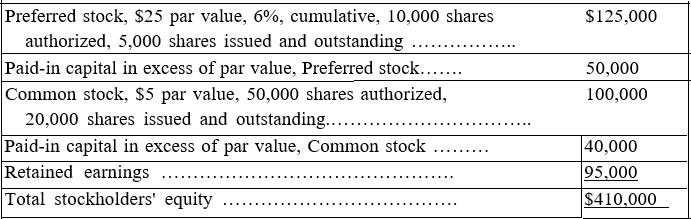 (1) Assuming that no dividends are in arrears, compute the book values per preferred share and per common share.
(2) Assuming that one year of cumulative preferred dividends is in arrears, compute the book values per preferred share and per common share.
(1) Assuming that no dividends are in arrears, compute the book values per preferred share and per common share.
(2) Assuming that one year of cumulative preferred dividends is in arrears, compute the book values per preferred share and per common share. (Essay)
4.9/5 (88)
(88) A company issued 60 shares of $100 par value common stock for $7,000 cash. The total amount of paid-in capital in excess of par is:
(Multiple Choice)
5.0/5 (88)
(88) Stock not assigned a value per share by the corporate charter, allowing it to be issued at any price without the possibility of a minimum legal capital deficiency, is called___________ .
(Short Answer)
4.9/5 (90)
(90) Sweet Company's outstanding stock consists of 1,000 shares of cumulative 5% preferred stock with a $100 par value and 10,000 shares of common stock with a $10 par value. During the first three years of operation, the corporation declared and paid the following total cash dividends. Dividend Declared \ year 1 \ 2,000 year 2 \ 6,000 year 3 \ 32,000
-
The total amount of dividends paid to preferred and common shareholders over the three-year period is:
(Multiple Choice)
4.9/5 (84)
(84) A stock split is the distribution of additional shares of stock to stockholders according to their percent of ownership.
(True/False)
5.0/5 (65)
(65) The price-earnings ratio is computed by dividing earnings per share by the market price per share.
(True/False)
4.8/5 (71)
(71) On September 20, Fletcher Corporation issued 25,000 shares of no-par common stock for equipment having a market value of $85,000. Prepare the general journal entry to record this transaction.
(Essay)
4.9/5 (74)
(74) On July 1, a corporation issued 15,000 shares of no-par common stock with a stated value of $3 per share in exchange for a tract of land having a market value of $215,000. Prepare the general journal entry to record this transaction.
(Essay)
4.9/5 (65)
(65) If a company resells treasury stock below the acquisition cost, a loss from the sale of treasury stock is recorded.
(True/False)
4.8/5 (82)
(82) Explain how to compute dividend yield and discuss how it is used in analysis of a company's financial condition.
(Essay)
4.7/5 (83)
(83) A company issued 70 shares of $30 par value preferred stock for $4,000 cash. The journal entry to record the issuance is:
(Multiple Choice)
4.9/5 (83)
(83) Retained earnings generally consist of a company's cumulative net income less any net losses and dividends declared since its inception.
(True/False)
5.0/5 (91)
(91) 
Filters
- Essay(0)
- Multiple Choice(0)
- Short Answer(0)
- True False(0)
- Matching(0)