



 Chat with AI
Exam 23: Flexible Budgets and Standard Costs

Exam 1: Accounting in Business298 Questions
Exam 2: Analyzing and Recording Transactions253 Questions
Exam 3: Adjusting Accounts and Preparing Financial Statements247 Questions
Exam 4: Completing the Accounting Cycle186 Questions
Exam 5: Accounting for Merchandising Operations258 Questions
Exam 6: Inventories and Cost of Sales232 Questions
Exam 7: Accounting Information Systems177 Questions
Exam 8: Cash and Internal Controls220 Questions
Exam 9: Accounting for Receivables217 Questions
Exam 10: Plant Assets Natural Resoures and Intangibles245 Questions
Exam 11: Current Liabilities and Payroll Accounting210 Questions
Exam 12: Accounting for Partnerships172 Questions
Exam 13: Accounting for Corporations228 Questions
Exam 14: Long-Term Liabilities234 Questions
Exam 15: Investments220 Questions
Exam 16: Reporting the Statement of Cash Flows237 Questions
Exam 17: Analysis of Financial Statements235 Questions
Exam 18: Managerial Accounting Concepts and Principles246 Questions
Exam 19: Job Order Costing213 Questions
Exam 20: Process Costing230 Questions
Exam 21: Cost-Volume-Profit Analysis244 Questions
Exam 22: Master Budgets and Planning216 Questions
Exam 23: Flexible Budgets and Standard Costs223 Questions
Exam 24: Performance Measurement and Responsibility Accounting208 Questions
Exam 25: Capital Budgeting and Managerial Decisions190 Questions
Exam 26: Present and Future Values in Accounting84 Questions
Exam 27: Activity-Based Costing70 Questions
Select questions type


Use the following data to find the direct labor rate variance if the company produced 3,500 units during the period. Direct labor standard (4 hrs. @ $7/hr.) $ 28 per unit Actual hours worked 12,250
Actual rate per hour $ 7.50
(Multiple Choice)
4.7/5  (83)
(83) An unfavorable variance is recorded with a debit because it reflects additional costs higher than the standard cost.
(True/False)
4.7/5 (79)
(79) Fletcher Company collected the following data regarding production of one of its products. Compute the direct labor rate variance. Direct labor standard (2 hrs. @ \1 2.75/hr.) \2 5.50 per finished unit Actual direct labor hours 81,500 hrs. Actual finished units produced 40,000 units Actual cost of direct labor \1 ,100,250
(Multiple Choice)
4.9/5 (79)
(79) Fletcher Company collected the following data regarding production of one of its products. Compute the direct materials price variance. Direct materrals standard (6 lbs. @ \2 /1b.) \1 2 per finished unit Actual direct materials used 243,000 Ibs. Actual finished units produced 40,000 units Actual cost of direct materials used \4 83,570
(Multiple Choice)
5.0/5 (67)
(67) Ransom, Inc. budgets direct materials cost at $1.10/liter and each product requires 4 liters per unit of finished product. April's activities show usage of 832 liters to complete 196 units at a cost of
$798.72. Compute the direct materials price and quantity variances. Indicate if the variance is favorable or unfavorable.
(Essay)
4.9/5 (74)
(74) The following information relating to a company's overhead costs is available. Actual total variable overhead \ 73,000 Actual total fixed overhead \ 17,000 Budgeted variable overhead rate per machine hour \ 2.50 Budgeted total fixed overhead \ 15,000 Budgeted machine hours allowed for actual output 30,000
Based on this information, the total variable overhead variance is:
(Multiple Choice)
4.8/5 (84)
(84) A company uses the following standard costs to produce a single unit of output. Direct materials 6 pounds at \ 0.90 per pound =\ 5.40 Direct labor 0.5 hour at \ 12.00 per hour =\ 6.00 Manufactuning overhead 0.5 hour at \ 4.80 per hour =\ 2.40 During the latest month, the company purchased and used 58,000 pounds of direct materials at a price of $1.00 per pound to produce 10,000 units of output. Direct labor costs for the month totaled
$56,350 based on 4,900 direct labor hours worked. Variable manufacturing overhead costs incurred totaled $15,000 and fixed manufacturing overhead incurred was $10,400. Based on this information, the direct materials price variance for the month was:
(Multiple Choice)
4.8/5 (83)
(83) A fixed budget is based on a single predicted amount of sales or other activity measure.
(True/False)
5.0/5 (86)
(86) The usefulness of a flexible budget depends on the valid classification of variable and fixed costs.
(True/False)
4.9/5 (75)
(75) When computing a price variance, the quantity is held constant.
(True/False)
4.9/5 (83)
(83) Based on predicted production of 25,000 units, FreshCo. anticipates $175,000 of fixed costs and
$137,500 of variable costs. What are the flexible budget amounts of total costs for 20,000 and 30,000 units?
(Essay)
4.8/5 (92)
(92) Summerlin Company budgeted 4,000 pounds of material costing $5.00 per pound to produce 2,000 units. The company actually used 4,500 pounds that cost $5.10 per pound to produce 2,000 units. What is the direct materials quantity variance?
(Multiple Choice)
4.9/5 (73)
(73) One possible explanation for direct labor rate and efficiency variances is the use of workers with different skill levels.
(True/False)
4.7/5 (77)
(77) In the analysis of variances, management commonly focuses on four categories of production costs:
________ cost, ________ cost; ________ cost; and ________ cost.
(Short Answer)
4.9/5 (76)
(76) Regent, Inc. uses the following standard to produce a single unit of its product: overhead $6 (2 hrs. @ $3/hr.). The flexible budget for overhead is $100,000 plus $1 per direct labor hour. Actual data for the month show overhead costs of $150,000, and 24,000 units produced. The overhead volume variance is:
(Multiple Choice)
4.8/5 (83)
(83) Gleason Company has developed the following standard cost data based on 60,000 direct labor hours, which is 75% of capacity. Fixed overhead is $360,000 and variable overhead is $180,000 at this level of activity.
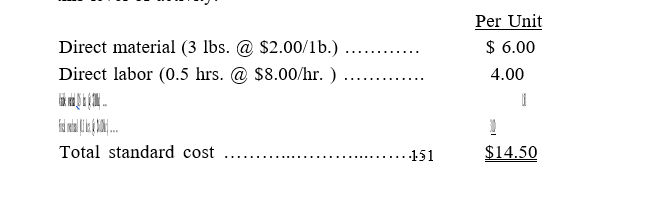 During the current period, the company operated at 80% of capacity and produced 128,000 units. Actual costs were:
Direct material (380,000.)\ldots\ldots\ldots\ldots\ldots \ 779,000 Direct labor (63,000.)\ldots\ldots\ldots\ldots\ldots\ldots\ldots 507,150 Fixed overhead \ldots\ldots\ldots\ldots\ldots\ldots\ldots\ldots\ldots\ldots 365,000 Variable overhe ad \ldots\ldots\ldots\ldots\ldots\ldots\ldots\ldots\ldots 220,000 Calculate the variable overhead spending and efficiency variance and the fixed overhead spending
and volume variances. Indicate whether each is favorable or unfavorable.
During the current period, the company operated at 80% of capacity and produced 128,000 units. Actual costs were:
Direct material (380,000.)\ldots\ldots\ldots\ldots\ldots \ 779,000 Direct labor (63,000.)\ldots\ldots\ldots\ldots\ldots\ldots\ldots 507,150 Fixed overhead \ldots\ldots\ldots\ldots\ldots\ldots\ldots\ldots\ldots\ldots 365,000 Variable overhe ad \ldots\ldots\ldots\ldots\ldots\ldots\ldots\ldots\ldots 220,000 Calculate the variable overhead spending and efficiency variance and the fixed overhead spending
and volume variances. Indicate whether each is favorable or unfavorable. (Essay)
4.9/5 (72)
(72) An internal report that helps management analyze the difference between actual performance and budgeted performance based on the actual sales volume (or other level of activity) is called a(n):
(Multiple Choice)
4.7/5 (77)
(77) A job was budgeted to require 3 hours of labor per unit at $8.00 per hour. The job consisted of 8,000 units and was completed in 22,000 hours at a total labor cost of $198,000.
-What is the direct labor efficiency variance?
(Multiple Choice)
4.7/5 (73)
(73) A job was budgeted to require 3 hours of labor per unit at $8.00 per hour. The job consisted of 8,000 units and was completed in 22,000 hours at a total labor cost of $198,000.
-What is the direct labor rate variance?
(Multiple Choice)
4.8/5 (76)
(76) 
Filters
- Essay(0)
- Multiple Choice(0)
- Short Answer(0)
- True False(0)
- Matching(0)