



 Chat with AI
Exam 25: Capital Budgeting and Managerial Decisions

Exam 1: Accounting in Business298 Questions
Exam 2: Analyzing and Recording Transactions253 Questions
Exam 3: Adjusting Accounts and Preparing Financial Statements247 Questions
Exam 4: Completing the Accounting Cycle186 Questions
Exam 5: Accounting for Merchandising Operations258 Questions
Exam 6: Inventories and Cost of Sales232 Questions
Exam 7: Accounting Information Systems177 Questions
Exam 8: Cash and Internal Controls220 Questions
Exam 9: Accounting for Receivables217 Questions
Exam 10: Plant Assets Natural Resoures and Intangibles245 Questions
Exam 11: Current Liabilities and Payroll Accounting210 Questions
Exam 12: Accounting for Partnerships172 Questions
Exam 13: Accounting for Corporations228 Questions
Exam 14: Long-Term Liabilities234 Questions
Exam 15: Investments220 Questions
Exam 16: Reporting the Statement of Cash Flows237 Questions
Exam 17: Analysis of Financial Statements235 Questions
Exam 18: Managerial Accounting Concepts and Principles246 Questions
Exam 19: Job Order Costing213 Questions
Exam 20: Process Costing230 Questions
Exam 21: Cost-Volume-Profit Analysis244 Questions
Exam 22: Master Budgets and Planning216 Questions
Exam 23: Flexible Budgets and Standard Costs223 Questions
Exam 24: Performance Measurement and Responsibility Accounting208 Questions
Exam 25: Capital Budgeting and Managerial Decisions190 Questions
Exam 26: Present and Future Values in Accounting84 Questions
Exam 27: Activity-Based Costing70 Questions
Select questions type


The payback period method, unlike the net present value method, does not ignore cash flows after the point of cost recovery.
(True/False)
4.9/5  (81)
(81) The minimum acceptable rate of return on an investment, often the company's cost of capital, is called the ________.
(Short Answer)
4.8/5 (81)
(81) Chang Industries has 2,000 defective units of product that have already cost $14 each to produce. A salvage company will purchase the defective units as they are for $5 each. Chang's production manager reports that the defects can be corrected for $6 per unit, enabling them to be sold at their regular market price of $21.
- The incremental income or loss on reworking the units is:
(Multiple Choice)
4.7/5 (81)
(81) Alfarsi Industries uses the net present value method to make investment decisions and requires a 15% annual return on all investments. The company is considering two different investments. Each require an initial investment of $15,000 and will produce cash flows as follows: End of Investment Year A B 1 \ 8,000 \ 0 2 8,000 0 3 8,000 24,000
The present value factors of each year at are:
1 0.8696 2 0.7561 3 0.6575
- The present value of an annuity of $1 for 3 years at 15% is 2.2832
The net present value of Investment B is:
(Multiple Choice)
4.7/5 (83)
(83) Bluebird Mfg. has received a special one-time order for 15,000 bird feeders at $3 per unit. Bluebird currently produces and sells 75,000 units at $7.00 each. This level represents 80% of its capacity. These bird feeders would be marketed under the wholesaler's name and would not affect Bluebird's sales through its normal channels. Production costs for these units are $3.50 per unit, which includes $2.25 variable cost and $1.25 fixed cost.
- If Bluebird accepts this additional business, the incremental revenue will be:
(Multiple Choice)
5.0/5 (80)
(80) A machine costs $180,000 and will have an eight-year life, a $20,000 salvage value, and straight-line depreciation is used. Management estimates the machine will yield an after-tax net income of $12,500 each year. Compute the accounting rate of return for the investment.
(Multiple Choice)
4.8/5 (84)
(84) A disadvantage of using the payback period to compare investment alternatives is that:
(Multiple Choice)
5.0/5 (97)
(97) Porter Co. is analyzing two projects for the future. Assume that only one project can be selected. Project X Project Y Cost of machine \ 68,000 \ 60,000 Net cash flow: Year 1 24,000 4,000 Year 2 24,000 26,000 Year 3 24,000 26,000 Year 4 0 20,000
- The payback period in years for Project X is:
(Multiple Choice)
4.9/5 (88)
(88) When computing payback period, the year in which a capital investment is made is year 1.
(True/False)
4.9/5 (93)
(93) Briefly describe both the payback period method and the net present value method of comparing investment alternatives.
(Essay)
4.9/5 (86)
(86) The payback period method of evaluating an investment fails to consider cash inflows after the point where an investment's costs are fully recovered.
(True/False)
4.9/5 (76)
(76) Two investments with exactly the same payback periods are not equally valuable to an investor because the timing of net cash flows may be different.
(True/False)
4.9/5 (76)
(76) For each of the capital budgeting methods listed below, place an X in the correct column, indicating the measurement basis of each, the ability to make comparison among projects, and whether each method reflects or ignores the time value of money.
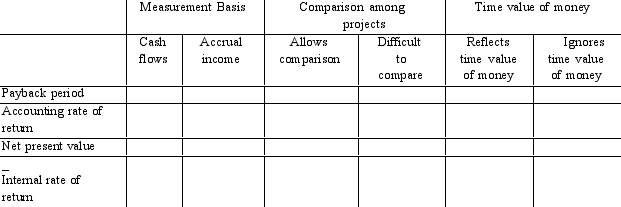
(Essay)
4.8/5 (79)
(79) A company is trying to decide which of two new product lines to introduce in the coming year. The predicted revenue and cost data for each product line follows:
Product A Product B Sales \ 80,000 \ 96,000 Direct materials 3,000 6,000 Direct labor 30,000 45,000 Other cash operating expenses 7,500 9,000 New equipment costs 75,000 100,000 Estimated useful life (no salvage) 5 years 5 years
The company has a 30% tax rate, it uses the straight-line depreciation method, and it predicts that cash flows will be spread evenly throughout each year. Calculate each product's payback period. If the company requires a payback period of three years or less, which, if either, product should be chosen?
(Essay)
4.7/5 (72)
(72) Granfield Company has a piece of manufacturing equipment with a book value of $40,000 and a remaining useful life of four years. At the end of the four years the equipment will have a zero salvage value. The market value of the equipment is currently $22,000. Granfield can purchase a new machine for $120,000 and receive $22,000 in return for trading in its old machine. The new machine will reduce variable manufacturing costs by $19,000 per year over the four-year life of the new machine. The total increase or decrease in net income by replacing the current machine with the new machine (ignoring the time value of money) is:
(Multiple Choice)
4.8/5 (78)
(78) A company puts four products through a common production process. This process costs $100,000 each year. The four products can be sold when they emerge from this process at the "split-off point", or processed further and then sold. Data about the four products for the coming period are:
Unit Sales Unit Sales Price per Price per urnit at unit after Additional Split-Off Further Processing Product Volume Point Processing Costs Stroller 20,000. \ 28.00 \ 42.00 \ 400,000 Walker 10,000. 7.00 28.00 144.000 Jogger 5,000 36.00 58.00 120.000 Runner 5,000 18.00 22.00 40.000 Determine which products should be sold at the split-off point and which should be processed further.
(Essay)
4.7/5 (75)
(75) The accounting rate of return is based on cash flows rather than net income in its calculation.
(True/False)
4.7/5 (91)
(91) Which of the following cash flows is not considered when using the net present value method?
(Multiple Choice)
4.9/5 (69)
(69) 
Filters
- Essay(0)
- Multiple Choice(0)
- Short Answer(0)
- True False(0)
- Matching(0)