



 Chat with AI
Exam 28: Atomic Physics

Exam 1: Introduction32 Questions
Exam 2: Kinematics: Motion in One Dimension162 Questions
Exam 3: Newtonian Mechanics54 Questions
Exam 4: Applying Newtons Laws178 Questions
Exam 5: Circular Motion119 Questions
Exam 6: Impulse and Linear Momentum82 Questions
Exam 7: Work and Energy191 Questions
Exam 8: Extended Bodies at Rest59 Questions
Exam 9: Rotational Motion124 Questions
Exam 10: Gases84 Questions
Exam 11: Static Fluids65 Questions
Exam 12: Fluids in Motion30 Questions
Exam 13: First Law of Thermodynamics119 Questions
Exam 14: Second Law of Thermodynamics70 Questions
Exam 15: Electric Charge force and Energy78 Questions
Exam 16: The Electric Field151 Questions
Exam 17: Dc Circuits225 Questions
Exam 18: Magnetism136 Questions
Exam 19: Electromagnetic Induction99 Questions
Exam 20: Vibrational Motion94 Questions
Exam 21: Mechanical Waves155 Questions
Exam 22: Reflection and Refraction36 Questions
Exam 23: Mirrors and Lenses221 Questions
Exam 24: Wave Optics135 Questions
Exam 25: Electromagnetic Waves79 Questions
Exam 26: Special Relativity124 Questions
Exam 27: Quantum Optics100 Questions
Exam 28: Atomic Physics141 Questions
Exam 29: Nuclear Physics155 Questions
Exam 30: Particle Physics21 Questions
Select questions type


A proton that is moving freely has a wavelength of 0.600 pm.(mproton = 1.67 × 10⁻²⁷ kg,e = 1.60 × 10⁻¹⁹ C,h = 6.626 × 10⁻³⁴ J ∙ s)
(a)What is its momentum?
(b)What is its speed?
(c)What potential difference would it have been accelerated through,starting from rest,to reach this speed?
(Short Answer)
4.9/5  (82)
(82) For an electron in the M (n = 3)shell,find (a)the largest possible orbital angular momentum it can have,and (b)the smallest possible orbital angular momentum it can have.Express your answers in SI units,and for each case indicate the subshell (s,p,d,...)of the electron.(h = 6.626 × 10⁻³⁴ J ∙ s)
(Short Answer)
4.9/5 (85)
(85) Atoms in crystals are typically separated by distances of 0.10 nm.What kinetic energy must a nonrelativistic electron have,in electron-volts,in order to have a wavelength of 0.10 nm? (melectron = 9.11 × 10⁻³¹ kg,1 eV = 1.60 × 10⁻¹⁹ J,h = 6.626 × 10⁻³⁴ J ∙ s)
(Short Answer)
4.9/5 (83)
(83) If the wavelength of a photon in vacuum is the same as the de Broglie wavelength of an electron,which one is traveling faster through space?
(Multiple Choice)
4.7/5 (93)
(93) What is the energy required to remove the electron from a hydrogen atom in the n = 11 state?
(Multiple Choice)
4.9/5 (85)
(85) The elements in the periodic table that have completely filled shells or subshells are referred to as
(Multiple Choice)
4.8/5 (89)
(89) If the de Broglie wavelength of an electron is 380 nm,what is the speed of this electron? (melectron = 9.11 × 10⁻³¹ kg,h = 6.626 × 10⁻³⁴ J ∙ s)
(Multiple Choice)
4.9/5 (80)
(80) What is the electron configuration for Li,which has 3 electrons?
(Multiple Choice)
4.7/5 (71)
(71) If the maximum possible accuracy in measuring the energy of a particle increases,the maximum possible accuracy in measuring its lifetime will
(Multiple Choice)
4.8/5 (80)
(80) The figure shows part of the energy level diagram of a certain atom.The energy spacing between levels 1 and 2 is twice that between 2 and 3.If an electron makes a transition from level 3 to level 2,the radiation of wavelength λ is emitted.What possible radiation wavelengths might be produced by other transitions between the three energy levels? 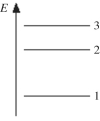
(Multiple Choice)
4.7/5 (88)
(88) According to the quantum mechanical model of the hydrogen atom,if the orbital angular momentum quantum number is ℓ,there will be how many permitted magnetic quantum numbers?
(Multiple Choice)
4.9/5 (81)
(81) Which of the following actions will increase the de Broglie wavelength of a speck of dust? (There could be more than one correct choice.)
(Multiple Choice)
4.8/5 (78)
(78) An electron is moving with the speed of 1780 m/s.What is its de Broglie wavelength? (melectron = 9.11 × 10⁻³¹ kg,h = 6.626 × 10⁻³⁴ J ∙ s)
(Multiple Choice)
4.7/5 (86)
(86) The wavelength of the emitted photon when a hydrogen atom makes a transition from the n = 2 state to the ground state is closest to which of the following values? (c = 3.0 × 10⁸ m/s,h = 6.626 × 10⁻³⁴ J ∙ s,1 eV = 1.60 × 10⁻¹⁹ J)
(Multiple Choice)
5.0/5 (82)
(82) An electron is accelerated from rest through a potential difference.After acceleration the electron has a wavelength of 880 nm.What is the potential difference responsible for the acceleration of the electron? (h = 6.626 × 10⁻³⁴ J ∙ s,melectron = 9.11 × 10⁻³¹ kg,e = 1.6 10-19 C)
(Multiple Choice)
4.9/5 (76)
(76) If light excites atomic hydrogen from its lowest energy level to the n = 12 level,what is the energy of the photons of this light?
(Multiple Choice)
4.8/5 (80)
(80) For the ground state of the hydrogen atom,which of the following numbers represents the correct value of the orbital angular momentum quantum number?
(Multiple Choice)
4.8/5 (82)
(82) Light shines through atomic hydrogen gas that was initially in its ground state.You observe that after awhile much of the hydrogen gas has been excited to its n = 5 state.What wavelength of light entering the gas caused this excitation? (c = 3.00 × 10⁸ m/s,h = 6.626 × 10⁻³⁴ J ∙ s,1 eV = 1.60 × 10⁻¹⁹ J)
(Multiple Choice)
4.9/5 (84)
(84) The orbital angular momentum quantum number ℓ can have any integer value ranging from
(Multiple Choice)
4.8/5 (75)
(75) 
Filters
- Essay(0)
- Multiple Choice(0)
- Short Answer(0)
- True False(0)
- Matching(0)