



 Chat with AI
Exam 15: Electric Charge force and Energy

Exam 1: Introduction32 Questions
Exam 2: Kinematics: Motion in One Dimension162 Questions
Exam 3: Newtonian Mechanics54 Questions
Exam 4: Applying Newtons Laws178 Questions
Exam 5: Circular Motion119 Questions
Exam 6: Impulse and Linear Momentum82 Questions
Exam 7: Work and Energy191 Questions
Exam 8: Extended Bodies at Rest59 Questions
Exam 9: Rotational Motion124 Questions
Exam 10: Gases84 Questions
Exam 11: Static Fluids65 Questions
Exam 12: Fluids in Motion30 Questions
Exam 13: First Law of Thermodynamics119 Questions
Exam 14: Second Law of Thermodynamics70 Questions
Exam 15: Electric Charge force and Energy78 Questions
Exam 16: The Electric Field151 Questions
Exam 17: Dc Circuits225 Questions
Exam 18: Magnetism136 Questions
Exam 19: Electromagnetic Induction99 Questions
Exam 20: Vibrational Motion94 Questions
Exam 21: Mechanical Waves155 Questions
Exam 22: Reflection and Refraction36 Questions
Exam 23: Mirrors and Lenses221 Questions
Exam 24: Wave Optics135 Questions
Exam 25: Electromagnetic Waves79 Questions
Exam 26: Special Relativity124 Questions
Exam 27: Quantum Optics100 Questions
Exam 28: Atomic Physics141 Questions
Exam 29: Nuclear Physics155 Questions
Exam 30: Particle Physics21 Questions
Select questions type


Four point charges of varying magnitude and sign are arranged on the corners of the square of side d as shown in the figure.Which one of the arrows shown represents the sum of the forces exerted on the point charge with a charge +Q? 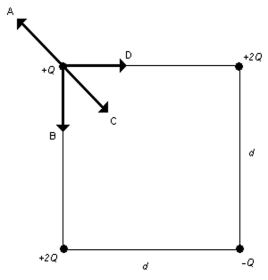
(Multiple Choice)
4.9/5  (70)
(70) Two uncharged metal spheres,#1 and #2,are mounted on insulating support rods.A third metal sphere,carrying a positive charge,is then placed near #2.Now a copper wire is momentarily connected between #1 and #2 and then removed.Finally,sphere #3 is removed.In this final state
(Multiple Choice)
4.9/5 (84)
(84) An electron and a proton are released simultaneously from rest and start moving toward each other due to their electrostatic attraction,with no other forces present.Which of the following statements are true just before they are about to collide? (There could be more than one correct choice.)
(Multiple Choice)
4.8/5 (69)
(69) An electron is released from rest at a distance of 9.00 cm from a fixed proton.How fast will the electron be moving when it is 3.00 cm from the proton? (k = 1/4πε0 = 8.99 × 10⁹ N ∙ m2/C2,e = 1.60 × 10⁻¹⁹ C,melectron = 9.11 × 10⁻³¹ kg,mproton = 1.67 × 10⁻²⁷ kg)
(Multiple Choice)
4.8/5 (72)
(72) A small 4.0-µC charge and a small 1.5-µC charge are initially very far apart.How much work does it take to bring them to a final configuration in which the 4.0-µC charge is at the point x = 1.0 mm,y = 1.0 mm,and the 1.5-µC charge is at the point x = 1.0 mm,y = 3.0 mm? (k = 1/4πε0 = 8.99 × 10⁹ N ∙ m2/C2)
(Multiple Choice)
4.9/5 (77)
(77) As shown in the figure,three charges are at the vertices of an equilateral triangle.The charge Q is 6.7 nC,and all the other quantities are accurate to two significant figures.What is the magnitude of the net electric force exerted on the charge Q by the other two charges? (k = 1/4πε0 = 9.0 × 10⁹ N ∙ m2/C2) 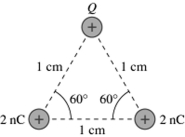
(Multiple Choice)
5.0/5 (85)
(85) Two very small plastic balls of equal mass are released from rest.One of them carries +10 µC of excess charge and the other one carries +1µC of charge.No other charges or fields are present.Which of the following statements are true about them as they move away from each other? (There may be more than one correct choice.)
(Multiple Choice)
4.8/5 (85)
(85) Two tiny grains of sand having charges of 4.0 μC and -4.0 μC are situated along the x-axis at x1 = 2.0 m and x2 = -2.0 m.What is electric potential energy of the system of these grains assuming that at infinity the energy of the system is zero? (k = 1/4πε0 = 9.0 × 10⁹ N ∙ m2/C2)
(Multiple Choice)
4.9/5 (83)
(83) In the figure,+4.0-μC and -4.0-μC point charges are located as shown.Now an additional +2.00-µC point charge is placed at point A.What is the electric potential energy of this system of three charges,relative to infinity? (k = 1/4πε0 = 8.99 × 10⁹ N ∙ m2/C2) 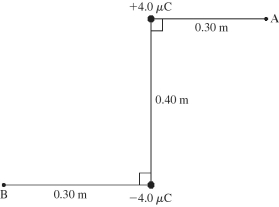
(Multiple Choice)
4.7/5 (88)
(88) A hydrogen nucleus,which has a charge +e,is situated to the left of a carbon nucleus,which has a charge +6e.Which statement is true?
(Multiple Choice)
4.8/5 (79)
(79) The figure shows two tiny 5.0-g spheres suspended from very light 1.0-m-long threads.The spheres repel each other after each one is given the same positive charge and hang at rest when θ = 4.1°.What is the charge on each sphere? (k = 1/4πε0 = 9.0 × 10⁹ N ∙ m2/C2) 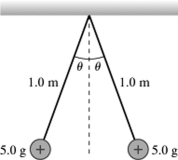
(Multiple Choice)
5.0/5 (88)
(88) Two point charges,Q1 and Q2,are separated by a distance R.If the magnitudes of both charges are doubled and their separation is also doubled,what happens to the electrical force that each charge exerts on the other one?
(Multiple Choice)
4.9/5 (95)
(95) Suppose you wanted to hold up an electron against the gravitational force by the attraction of a fixed proton some distance above it.How far above the electron would the proton have to be? (k = 1/4πε0 = 9.0 × 10⁹ N ∙ m2/C2,e = 1.6 × 10⁻¹⁹ C,mproton = 1.67 × 10⁻²⁷ kg,melectron = 9.11 × 10⁻³¹ kg)
(Multiple Choice)
4.8/5 (70)
(70) A proton is located at the point (x = 1.0 nm,y = 0.0 nm)and an electron is located at the point Find the magnitude of the electrostatic force that each one exerts on the other.(k = 1/4πε0 = 9.0 × 10⁹ N ∙ m2/C2,e = 1.6 × 10⁻¹⁹ C)
(Multiple Choice)
4.9/5 (77)
(77) A +3.0-µC point charge is initially extremely far from a positive point charge Q.You find that it takes 41 J of work to bring the +3.0-µC charge to the point x = 3.0 mm,y = 0.0 mm and the point charge Q to the point x = -3.0 mm,y = 0.00 mm.What is Q? (k = …)
(Multiple Choice)
4.8/5 (84)
(84) The figure shows a group of three particles,all of which have charge Q = 8.8 nC.How much work did it take to assemble this group of charges if they all started out extremely far from each other? (k = 1/4πε0 = 9.0 × 10⁹ N ∙ m2/C2) 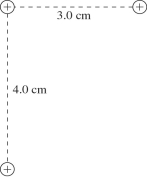
(Multiple Choice)
4.9/5 (85)
(85) A hydrogen atom consists of a proton and an electron.If the orbital radius of the electron increases,the electric potential energy of the electron-proton system
(Multiple Choice)
4.7/5 (78)
(78) As shown in the figure,charge q1 = 2.2 x C is placed at the origin and charge is placed on the at Where along the x-axis can a third charge Q = -8.30 × 10⁻⁶ C be placed so that the resultant force exerted on Q is zero? 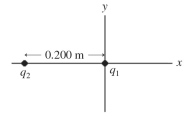
(Short Answer)
4.8/5 (88)
(88) 
Filters
- Essay(0)
- Multiple Choice(0)
- Short Answer(0)
- True False(0)
- Matching(0)