



 Chat with AI
Exam 14: Second Law of Thermodynamics

Exam 1: Introduction32 Questions
Exam 2: Kinematics: Motion in One Dimension162 Questions
Exam 3: Newtonian Mechanics54 Questions
Exam 4: Applying Newtons Laws178 Questions
Exam 5: Circular Motion119 Questions
Exam 6: Impulse and Linear Momentum82 Questions
Exam 7: Work and Energy191 Questions
Exam 8: Extended Bodies at Rest59 Questions
Exam 9: Rotational Motion124 Questions
Exam 10: Gases84 Questions
Exam 11: Static Fluids65 Questions
Exam 12: Fluids in Motion30 Questions
Exam 13: First Law of Thermodynamics119 Questions
Exam 14: Second Law of Thermodynamics70 Questions
Exam 15: Electric Charge force and Energy78 Questions
Exam 16: The Electric Field151 Questions
Exam 17: Dc Circuits225 Questions
Exam 18: Magnetism136 Questions
Exam 19: Electromagnetic Induction99 Questions
Exam 20: Vibrational Motion94 Questions
Exam 21: Mechanical Waves155 Questions
Exam 22: Reflection and Refraction36 Questions
Exam 23: Mirrors and Lenses221 Questions
Exam 24: Wave Optics135 Questions
Exam 25: Electromagnetic Waves79 Questions
Exam 26: Special Relativity124 Questions
Exam 27: Quantum Optics100 Questions
Exam 28: Atomic Physics141 Questions
Exam 29: Nuclear Physics155 Questions
Exam 30: Particle Physics21 Questions
Select questions type


The figure shows a pV diagram for a cycle of a thermodynamic engine for which QH = 59 J.What is the thermal efficiency of the engine? 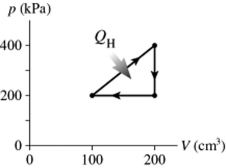
(Multiple Choice)
4.7/5  (93)
(93) If the efficiency of a Carnot engine were to be 100%,the cool reservoirs would have to be
(Multiple Choice)
4.9/5 (92)
(92) An ideal Carnot engine operating between a warm reservoir of unknown temperature and a cold reservoir at has an efficiency of What is the temperature of the warm reservoir?
(Multiple Choice)
4.8/5 (78)
(78) A thermodynamic engine has an efficiency of 35.0% and receives 150 J of energy per cycle.
(a)How much work does it do in each cycle?
(b)How much thermal energy does it "waste" in each cycle?
(Short Answer)
4.8/5 (95)
(95) A gas follows the pV trajectory shown in Figure 16.2.How much work is done per cycle by the gas if the gas in a thermodynamic engine follows the cycle shown in the pV diagram.How much work does this engine do each cycle if p0 = 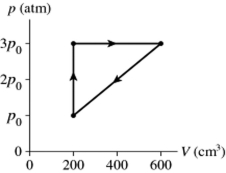
(Multiple Choice)
4.9/5 (83)
(83) On a cold winter day,the outside temperature is -20°C and the inside temperature is maintained at 20°C.There is a net thermal energy flow to the outside through the walls,roof,etc.,of 25 kW.What is the rate of increase of the entropy of the universe as a result of this energy flow?
(Multiple Choice)
4.8/5 (66)
(66) An ideal Carnot engine operates between a high temperature reservoir at and a river with water at If it absorbs of energy each cycle,how much work per cycle does it perform?
(Multiple Choice)
4.9/5 (76)
(76) An ideal Carnot engine extracts 529 J of energy from a high-temperature reservoir during each cycle,and rejects of energy to a low-temperature reservoir during the same cycle.What is the efficiency of the engine?
(Multiple Choice)
5.0/5 (81)
(81) For a certain ideal Carnot engine,the hot reservoir is 35 C° higher than the cold reservoir.If this engine is to have an efficiency of 20%,what must be the temperature of the hot reservoir?
(Multiple Choice)
4.8/5 (80)
(80) An ideal Carnot engine operating between a warm reservoir of unknown temperature and a cold reservoir at has an efficiency of What is the temperature of the warm reservoir?
(Multiple Choice)
4.9/5 (73)
(73) A real (non-Carnot)thermodynamic engine,operating between thermal energy reservoirs at temperatures of 450 K and 270 K,performs 3.3 kJ of net work,and rejects 8.2 kJ of energy in a single cycle.
(a)What is the thermal efficiency of this thermodynamic engine?
(b)What is the maximum efficiency it could possibly have?
(Short Answer)
4.8/5 (85)
(85) A container of ideal gas at STP undergoes an isothermal expansion and its entropy changes by 3.7 J/K.How much work does it do?
(Multiple Choice)
4.8/5 (87)
(87) An ideal gas undergoes an isothermal expansion.During this process,its entropy
(Multiple Choice)
4.9/5 (81)
(81) A 15.0-kg block of ice at 0.00°C falls into Lake Superior,which is a fresh water lake.The lake water is at 10.0°C,and the latent heat of fusion for ice is 3.34 × 10⁵ J/kg.Find the change in entropy due to the melting of the ice (a)of the block of ice,(b)of the lake,and (c)of the system consisting of the lake and the ice.(d)Is your answer to part (c)consistent with the reversibility or irreversibility of the melting process?
(Short Answer)
4.9/5 (96)
(96) A thermodynamic pump absorbs thermal energy from the atmosphere at a rate of 30 kW.If work is being done to run this thermodynamic pump at a rate of 7.7 kW,what is the coefficient of performance (COP)of the thermodynamic pump?
(Multiple Choice)
4.7/5 (88)
(88) When 0.50 kg of water at 0°C freezes,what is the change in entropy of the water? The latent heat of fusion of water is 33,400 J/kg.
(Multiple Choice)
4.8/5 (74)
(74) A refrigerator has a coefficient of performance equal to 4.2.How much work must be done on the operating gas in the refrigerator in order to remove 250 J of energy from the interior compartment?
(Multiple Choice)
4.9/5 (84)
(84) An ideal Carnot engine is operated as an air conditioner to cool a house in the summer.The air conditioner removes of thermal energy per second from the house,and maintains the inside temperature at while the outside temperature is The power required to run the air conditioner under these operating conditions is closest to
(Multiple Choice)
4.9/5 (62)
(62) An ideal Carnot engine has an efficiency of 83.0% and performs 4500 J of work every cycle.How much energy is discharged to the lower temperature reservoir every cycle?
(Multiple Choice)
4.7/5 (78)
(78) 
Filters
- Essay(0)
- Multiple Choice(0)
- Short Answer(0)
- True False(0)
- Matching(0)