



 Chat with AI
Exam 7: Work and Energy

Exam 1: Introduction32 Questions
Exam 2: Kinematics: Motion in One Dimension162 Questions
Exam 3: Newtonian Mechanics54 Questions
Exam 4: Applying Newtons Laws178 Questions
Exam 5: Circular Motion119 Questions
Exam 6: Impulse and Linear Momentum82 Questions
Exam 7: Work and Energy191 Questions
Exam 8: Extended Bodies at Rest59 Questions
Exam 9: Rotational Motion124 Questions
Exam 10: Gases84 Questions
Exam 11: Static Fluids65 Questions
Exam 12: Fluids in Motion30 Questions
Exam 13: First Law of Thermodynamics119 Questions
Exam 14: Second Law of Thermodynamics70 Questions
Exam 15: Electric Charge force and Energy78 Questions
Exam 16: The Electric Field151 Questions
Exam 17: Dc Circuits225 Questions
Exam 18: Magnetism136 Questions
Exam 19: Electromagnetic Induction99 Questions
Exam 20: Vibrational Motion94 Questions
Exam 21: Mechanical Waves155 Questions
Exam 22: Reflection and Refraction36 Questions
Exam 23: Mirrors and Lenses221 Questions
Exam 24: Wave Optics135 Questions
Exam 25: Electromagnetic Waves79 Questions
Exam 26: Special Relativity124 Questions
Exam 27: Quantum Optics100 Questions
Exam 28: Atomic Physics141 Questions
Exam 29: Nuclear Physics155 Questions
Exam 30: Particle Physics21 Questions
Select questions type


When you drop a pebble from height H,it reaches the ground with speed V assuming there is no air resistance.From what height should you drop it so it will reach the ground with twice speed?
(Multiple Choice)
4.8/5  (90)
(90) At what minimum rate is a 60.0-kg boy converting his internal energy when,in 8.00 s,he runs up a flight of stairs that is 10.0-m high?
(Multiple Choice)
4.9/5 (86)
(86) If you want to double the momentum of a gas molecule,by what factor must you increase its kinetic energy?
(Multiple Choice)
4.8/5 (70)
(70) Planet W-70 has a radius of 2.48 × 10⁷ m and an escape velocity of 23,300 m/s.What is the mass of W-70? (G = 6.67 × 10⁻¹¹ N ∙ m2/kg2)
(Multiple Choice)
4.8/5 (75)
(75) What is the minimum energy needed to change the speed of a 1600-kg sport utility vehicle from 15.0 m/s to 40.0 m/s?
(Multiple Choice)
4.8/5 (92)
(92) A block of mass m = 3.6 kg,moving on a frictionless surface with a speed makes a sudden perfectly elastic collision with a stationary block of mass M,as shown in the figure.Just after the collision,the 3.6-kg block recoils with a speed of What is the speed V of the other block? 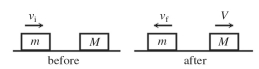
(Multiple Choice)
4.9/5 (79)
(79) A heavy sled and a light sled,both moving horizontally with the same speed,suddenly slide onto a rough patch of snow and eventually come to a stop.The coefficient of kinetic friction between the sleds and the rough snow is the same for both of them.Which of the following statements about these sleds are correct? (There could be more than one correct choice.)
(Multiple Choice)
4.9/5 (85)
(85) A stone (the system)with a mass of 1.0 kg is tied to the end of a light string which keeps it moving in a circle with a constant speed of 4.0 m/s on a perfectly smooth horizontal tabletop.The radius of the path is 0.60 m.How much work does the force exerted by the string do on the stone as it makes one-half of a complete circle?
(Multiple Choice)
4.8/5 (87)
(87) In the past,Earth has been hit by many asteroids,some very large.Suppose one such asteroid approached Earth so that when it was very far away it was traveling at 6500 m/s along a line that would miss the center of Earth by 8,500,000 m.Because of the gravitational attraction of Earth,it departed from this straight line and curved towards Earth,colliding with it.What was the speed of this asteroid when it hit Earth if we ignore the effect of the sun? The mass of Earth is 5.97 × 1024 kg,its radius is 6.38 × 10⁶ m,and G = 6.67 × 10⁻¹¹ N ∙ m2/kg2.
(Multiple Choice)
4.8/5 (80)
(80) On a frictionless horizontal surface,a 1.50-kg mass traveling at 3.50 m/s suddenly collides with and sticks to a 3.00-kg mass that is initially at rest,as shown in the figure.This system then runs into an ideal spring of force constant (spring constant)50.0 N/cm.
(a)What will be the maximum compression distance of the spring?
(b)How much mechanical energy is lost during this process? During which parts of the process (the collision and compression of the spring)is this energy lost? 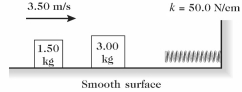
(Short Answer)
4.7/5 (77)
(77) How high a hill would a 75-kg hiker have to climb to increase her gravitational potential energy by 10,000 J?
(Short Answer)
4.8/5 (72)
(72) 
Filters
- Essay(0)
- Multiple Choice(0)
- Short Answer(0)
- True False(0)
- Matching(0)