



 Chat with AI
Exam 15: Accounting for Colleges and Universities

Exam 1: Introduction to Accounting and Financial Reporting for Governmental and Not-For-Profit Entities48 Questions
Exam 2: Principles of Accounting and Financial Reporting for State and Local Governments50 Questions
Exam 3: Governmental Operating Statement Accounts; Budgetary Accounting67 Questions
Exam 4: Accounting for Governmental Operating Activitiesillustrative Transactions and Financial Statements85 Questions
Exam 5: Accounting for General Capital Assets and Capital Projects87 Questions
Exam 6: Accounting for General Long-Term Liabilities and Debt Service82 Questions
Exam 7: Accounting for the Business-Type Activities of State and Local Governments85 Questions
Exam 8: Accounting for Fiduciary Activities Agency and Trust Funds56 Questions
Exam 9: Financial Reporting of State and Local Governments50 Questions
Exam 10: Analysis of Governmental Financial Performance48 Questions
Exam 11: Auditing of Governmental and Not-For-Profit Organizations51 Questions
Exam 12: Budgeting and Performance Measurement58 Questions
Exam 13: Accounting for Not-For-Profit Organizations65 Questions
Exam 14: Not-For-Profit Organizations Regulatory, taxation, and Performance Issues56 Questions
Exam 15: Accounting for Colleges and Universities41 Questions
Exam 16: Accounting for Health Care Organizations46 Questions
Exam 17: Accounting and Reporting for the Federal Government52 Questions
Select questions type


A tax-exempt organization that receives its support primarily from a large number of individuals or corporations and a relatively small amount from investment income is called a
(Multiple Choice)
4.9/5  (82)
(82) The unrelated business income tax could be a significant cost and therefore should be of concern to tax-exempt organizations.
(True/False)
4.8/5 (76)
(76) The term that means information skewed toward a particular belief with a tendency to have little or no factual basis is
(Multiple Choice)
4.8/5 (74)
(74) Why do states and the federal government exercise oversight responsibility over not-for-profit,tax-exempt corporations? How do states and the federal government differ in the way they exercise this responsibility?
(Essay)
4.8/5 (91)
(91) The following are key terms in Chapter 15 that relate to regulatory and taxation issues of not-for-profit organizations:
A.Unrelated business income
B.Public charity
C.Gifts in kind
D.Lobbying
E.Debt financed income
F.Private foundation
G.Expenditure responsibility
H.Propaganda
For each of the following definitions,indicate the key term from the list above that best matches by placing the appropriate letter in the blank space next to the definition 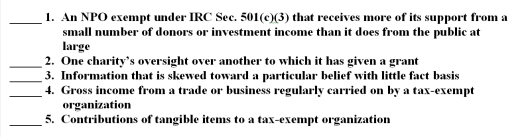
(Short Answer)
4.9/5 (88)
(88) Which of the following not-for-profit organizations is most likely to be tax-exempt under IRC Sec.501(c)(3)?
(Multiple Choice)
4.7/5 (86)
(86) Describe the process for becoming a tax-exempt organization.Why is it important for an accountant to understand this process?
(Essay)
4.8/5 (99)
(99) The Internal Revenue Service may impose intermediate sanctions on all of the following transactions between a not-for-profit organization and its executive officer except
(Multiple Choice)
4.9/5 (80)
(80) "Excess benefit transactions" are those in which persons who have substantial influence over the not-for-profit organization engage in transactions that result in economic benefits to them that are excessive,such as unreasonable compensation,sale of assets at bargain prices,and lease arrangements.
(True/False)
4.9/5 (76)
(76) A good measure of whether a not-for-profit organization is "liquid" and can meet its short-term obligations is
(Multiple Choice)
4.8/5 (79)
(79) Describe the difficulty in comparing the financial performance of a not-for-profit organization to other similar organizations.What benchmarks are available to assist in this task?
(Essay)
5.0/5 (74)
(74) All officers of a not-for-profit organization have the same responsibilities to the organization and its constituents.
(True/False)
4.8/5 (82)
(82) Public disclosure rules require that a tax-exempt not-for-profit organization
(Multiple Choice)
5.0/5 (81)
(81) The following are types of ratios described in Chapter 15 that can be used to assess the financial performance of not-for-profit organizations:
A.Liquidity
B.Going concern
C.Capital structure
D.Program effectiveness
E.Efficiency
F.Leverage and debt coverage
G.Fund-raising efficiency
H.Investment performance
For each of the following performance indicators,indicate the type of ratio from the list above that best matches by placing the appropriate letter in the blank space next to the phrase. 
(Short Answer)
4.8/5 (69)
(69) The ratio unrestricted net assets as a percent of operating expenses is helpful in determining if the not-for-profit organization can cover its debt service expense.
(True/False)
4.9/5 (65)
(65) If a tax-exempt organization dissolves and goes out of business,it must distribute its assets to another tax-exempt organization.
(True/False)
4.7/5 (84)
(84) Not-for-profit corporations cannot lobby or attempt to influence legislation or politicians.
(True/False)
4.8/5 (86)
(86) The federal government's primary objective in regulating not-for-profit organizations through the income tax laws is to limit the number of exempt organizations that operate at any one point in time.
(True/False)
4.9/5 (89)
(89) Not-for-profit organizations risk loss of their tax-exempt status if they engage in any political activity.
(True/False)
5.0/5 (85)
(85) Which of the following is a not a true statement about tax-exempt organizations?
(Multiple Choice)
4.8/5 (87)
(87) 
Filters
- Essay(0)
- Multiple Choice(0)
- Short Answer(0)
- True False(0)
- Matching(0)