



 Chat with AI
Exam 27: Relativity

Exam 1: Representing Motion113 Questions
Exam 2: Motion in One Dimension174 Questions
Exam 3: Vectors and Motion in Two Dimensions183 Questions
Exam 4: Forces and Newtons Laws of Motion64 Questions
Exam 5: Applying Newtons Laws82 Questions
Exam 6: Gravity96 Questions
Exam 7: Rotational Motion95 Questions
Exam 8: Equilibrium Ad Elasticity73 Questions
Exam 9: Momentum103 Questions
Exam 10: Energy and Work223 Questions
Exam 11: Using Energy106 Questions
Exam 12: Thermal Properties of Matter220 Questions
Exam 13: Fluids115 Questions
Exam 14: Oscillations105 Questions
Exam 15: Traveling Waves and Sound94 Questions
Exam 16: Superposition and Standing Waves66 Questions
Exam 17: Wave Optics129 Questions
Exam 18: Ray Optics155 Questions
Exam 19: Optical Instruments137 Questions
Exam 20: Electric Fields and Forces95 Questions
Exam 21: Electric Potential144 Questions
Exam 22: Current and Resistance125 Questions
Exam 23: Circuits157 Questions
Exam 24: Magnetic Fields and Forces168 Questions
Exam 25: EM Induction and Em Waves185 Questions
Exam 26: AC Electricity122 Questions
Exam 27: Relativity126 Questions
Exam 28: Quantum Physics86 Questions
Exam 29: Atoms and Molecules105 Questions
Exam 30: Nuclear Physics175 Questions
Select questions type


A proton, which has a mass of 1.67 × 10⁻²⁷, is moving at 0.80c relative to the laboratory. What does a physicist in that lab measure for its momentum? (c = 3.0 × 10⁸ m/s)
(Multiple Choice)
4.9/5  (83)
(83) The figure shows a right-angled construction frame ABC. When measured at rest, it has dimensions as follows: AB = 18.9 m, AC = 10.0 m, and BC = 16.0 m. This frame is now given a new velocity of 0.420c, relative to Earth, in a direction parallel to AC. How long is part BC of this frame with the new velocity as measured by Earth-based engineers? 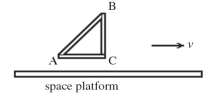
(Multiple Choice)
4.8/5 (87)
(87) A spaceship approaches Earth with a speed 0.50c. A passenger in the spaceship measures his heartbeat as 70 beats per minute. What is his heartbeat rate according to an observer that is at rest relative to Earth?
(Multiple Choice)
4.9/5 (77)
(77) How fast must a meter stick move, relative to the frame of the observer making the measurement, so its length will be measured to be 0.60 m?
(Multiple Choice)
4.9/5 (73)
(73) Astronaut Rachel leaves Earth in a spaceship at a speed of 0.960c relative to an observer on Earth. Rachel's destination is a star system 14.4 light-years away (one light-year is the distance light travels in one year). According to Rachel, how long does the trip take?
(Multiple Choice)
4.8/5 (82)
(82) When a proton is traveling at 0.80c, what is the ratio of its kinetic energy to its rest energy?
(Multiple Choice)
4.8/5 (74)
(74) A spaceship with a constant speed of 0.800c relative to Earth travels to a star that is 4.30 light-years from Earth. How much time for this trip would elapse on a clock on board the spaceship?
(Multiple Choice)
4.9/5 (80)
(80) A set of twins, Andrea and Courtney, are initially 10 years old. While Courtney remains on Earth, Andrea rides on a spaceship that travels away from Earth at a speed of 0.60c for 10 years (as measured by Courtney). At the end of the trip, Courtney is 20 years old. How old is Andrea?
(Multiple Choice)
4.7/5 (95)
(95) One of the first atomic bombs released energy equivalent to that of 20,000 tons of TNT explosive. How much mass was converted to energy by this explosion, given that 1000 tons of TNT produce 4.3 × 10¹² J of energy. Incidentally, modern H-bombs have energy yields 1000 times as much! (c = 3.0 × 10⁸ m/s)
(Short Answer)
4.8/5 (84)
(84) A satellite, initially at rest in deep space, separates into two pieces, which move away from each other. One piece has a rest mass of 190 kg and moves away with a speed 0.500c, and the second piece has a rest mass of 250 kg and moves in the opposite direction. What is the speed of the second piece?
(Multiple Choice)
4.9/5 (87)
(87) An electron has a relativistic momentum of 1.1 × 10⁻²¹ kg ∙ m/s. What percent of its total energy is its kinetic energy? (melectron = 9.11 ×10⁻³¹ kg, c = 3.0 × 10⁸ m/s)
(Short Answer)
4.8/5 (89)
(89) How much work must be done to accelerate a particle of mass from a speed of to a speed of (c = 3.0 × 10⁸ m/s)
(Short Answer)
4.9/5 (79)
(79) Consider a student whose mass is 70 kg. If all his mass were converted to electrical energy, for how many years could he keep a 100-W light bulb burning? (c = 3.0 × 10⁸ m/s)
(Short Answer)
4.8/5 (77)
(77) Two satellites with equal rest masses of 100 kg are traveling toward each other in deep space. One is traveling at 0.650c and the other at 0.850c. The satellites collide and somehow manage to stick together. What is the rest mass of the combined object after the collision?
(Multiple Choice)
4.8/5 (88)
(88) An astronaut on a spaceship moving at 0.927c says that the trip between two stationary stars took How long does this journey appear to take to someone in the rest frame of the two stars?
(Multiple Choice)
4.9/5 (76)
(76) A muon at rest decays in 2.2 μs. Moving at 99.00% the speed of light, it would be seen to "live" for how long?
(Short Answer)
4.7/5 (80)
(80) The figure shows a right-angled construction frame ABC. When measured at rest, it has dimensions as follows: AB = 26.0 m, AC = 10.0 m, and BC = 24.0 m. This frame is now given a new velocity of 0.760c, relative to Earth, in a direction parallel to AC. How long is part AC of this frame with the new velocity as measured by Earth-based engineers? 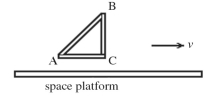
(Multiple Choice)
4.9/5 (73)
(73) As an electron slows down from 0.9980c to 0.5000c, how much momentum does it lose? (c = 3.0 × 10⁸ m/s, melectron = 9.11 × 10⁻³¹ kg)
(Short Answer)
4.8/5 (87)
(87) How much energy would be released if 2.0 kg of material was lost during a reaction? (c = 3.0 × 10⁸ m/s)
(Multiple Choice)
4.9/5 (89)
(89) 
Filters
- Essay(0)
- Multiple Choice(0)
- Short Answer(0)
- True False(0)
- Matching(0)