



 Chat with AI
Exam 25: EM Induction and Em Waves

Exam 1: Representing Motion113 Questions
Exam 2: Motion in One Dimension174 Questions
Exam 3: Vectors and Motion in Two Dimensions183 Questions
Exam 4: Forces and Newtons Laws of Motion64 Questions
Exam 5: Applying Newtons Laws82 Questions
Exam 6: Gravity96 Questions
Exam 7: Rotational Motion95 Questions
Exam 8: Equilibrium Ad Elasticity73 Questions
Exam 9: Momentum103 Questions
Exam 10: Energy and Work223 Questions
Exam 11: Using Energy106 Questions
Exam 12: Thermal Properties of Matter220 Questions
Exam 13: Fluids115 Questions
Exam 14: Oscillations105 Questions
Exam 15: Traveling Waves and Sound94 Questions
Exam 16: Superposition and Standing Waves66 Questions
Exam 17: Wave Optics129 Questions
Exam 18: Ray Optics155 Questions
Exam 19: Optical Instruments137 Questions
Exam 20: Electric Fields and Forces95 Questions
Exam 21: Electric Potential144 Questions
Exam 22: Current and Resistance125 Questions
Exam 23: Circuits157 Questions
Exam 24: Magnetic Fields and Forces168 Questions
Exam 25: EM Induction and Em Waves185 Questions
Exam 26: AC Electricity122 Questions
Exam 27: Relativity126 Questions
Exam 28: Quantum Physics86 Questions
Exam 29: Atoms and Molecules105 Questions
Exam 30: Nuclear Physics175 Questions
Select questions type


By what primary heat transfer mechanism does the sun warm the earth?
(Multiple Choice)
4.8/5  (82)
(82) How far does a beam of light travel in 2.0 ms? (c = 3.0 × 10⁸ m/s)
(Multiple Choice)
4.9/5 (79)
(79) What is the wavelength used by a radio station that broadcasts at a frequency of 920 kHz? (c = 3.00 × 10⁸ m/s)
(Multiple Choice)
4.9/5 (75)
(75) A giant star radiates energy at the rate of 3.0 × 1030 W, and its surface temperature has been measured to be 3000 K. Assuming that it is a perfect emitter, what is the radius of this star?(σ = 5.67 × 10⁻⁸ W/m2 ∙ K4)
(Multiple Choice)
4.8/5 (76)
(76) The following items are positioned in sequence: A source of a beam of natural light of intensity I0, three ideal polarizers A, B, and C; and an observer. Polarizer axis angles are measured clockwise from the vertical, as viewed by the observer. The axis angle of polarizer A is set at 0° (vertical), and the axis angle of polarizer C is set at 50°. Polarizer B is set so that the beam intensity at the observer is a maximum. What is the axis angle settings of polarizer B?
(Multiple Choice)
4.7/5 (69)
(69) A airplane having a metal surface and a wingspan of 25.0 m flies horizontally at 200. m/s where the earth's magnetic field is vertical with magnitude 45.0 μT.
(a) What emf is induced across the wings?
(b) What wingspan would the plane need to produce 1.00-V emf across its wings?
(c) The plane now reverses direction. Does the polarity of the wingtip emf change? That is, if the left wing was positive before, does it now become negative?
(Short Answer)
4.9/5 (75)
(75) What is the surface temperature of a star, if its radiation peak occurs at a frequency of 1.06 × 10¹⁵ Hz? (c = 3.00 × 10⁸ m/s, and the constant in Wien's law is 0.00290 m ∙ K)
(Multiple Choice)
4.8/5 (78)
(78) A conducting rod whose length is ℓ = 1.60 m is placed on frictionless U-shaped metal rails that is connected to a lightbulb having a resistance of 4.00 Ω as shown in the figure. The rails and the rod are in the plane of the page. A constant uniform magnetic field of strength 2.20 T is applied perpendicular to and out of the paper. An external applied force moves the rod to the right with a constant speed of 6.00 m/s. At what rate is energy dissipated in the lightbulb? 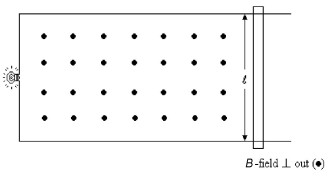
(Multiple Choice)
4.8/5 (75)
(75) As shown in the figure, a metal bar is in contact with a pair of parallel rails and is in motion with an upward velocity of magnitude ν. A uniform magnetic field is present, directed downward as shown. The direction of the induced current through the resistor R is 
(Multiple Choice)
4.9/5 (82)
(82) About 1350 W/m2 of electromagnetic energy reaches the upper atmosphere of the earth from the sun, which is 1.5 × 10¹¹ m away. Use this information to estimate the average power output of the sun.
(Multiple Choice)
4.9/5 (72)
(72) A radiometer has two square vanes (1.0 cm by 1.0 cm), attached to a light horizontal cross arm, and pivoted about a vertical axis through the center, as shown in the figure. The center of each vane is 6.0 cm from the axis. One vane is silvered and it reflects all radiant energy that falls upon it. The other vane is blackened and it absorbs all incident radiant energy. Radiant energy, having an intensity of 300 W/m2, is incident normally upon the front surfaces of both vanes. What is the radiant power absorbed by the blackened vane? 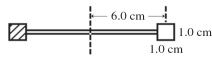
(Multiple Choice)
4.9/5 (90)
(90) A conducting rod with a length ℓ = 25 cm is placed on a U-shaped metal wire that is connected to a lightbulb having a resistance of 8.0 Ω as shown in the figure. The wire and the rod are in the plane of the page. A constant uniform magnetic field of strength 0.40 T is applied perpendicular to and into the paper. An external applied force moves the rod to the right with a constant speed of 6.0 m/s. What are the magnitude and direction of the induced current in the circuit? 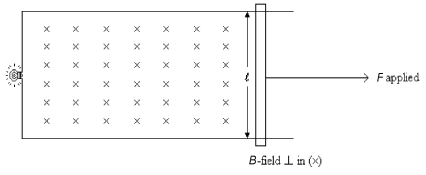
(Multiple Choice)
4.9/5 (77)
(77) A bar magnet is oriented above a copper ring, as shown in the figure. If the magnet is kept fixed while the ring is dropped, what is the direction of the current induced in the ring, as viewed from below the ring? 
(Multiple Choice)
4.8/5 (92)
(92) In an electromagnetic wave in free space, the electric and magnetic fields are
(Multiple Choice)
4.8/5 (77)
(77) An 800-kHz sinusoidal radio signal is detected at a point 2.1 km distant from a transmitter tower. The electric field amplitude of the signal at that point is 0.80 V/m. Assume that the signal power is radiated uniformly in all directions and that radio waves incident upon the ground are completely absorbed. What is the intensity of the radio signal at that point? (ε0 = 8.85 × 10⁻¹² C2/N ∙ m2, μ0 = 4π × 10-7 T ∙ m/A, c = 3.0 × 10⁸ m/s)
(Multiple Choice)
4.9/5 (73)
(73) A long vertical wire carries a steady 70 A current. As shown in the figure, a pair of horizontal rails are 0.20 m apart. A 20-Ω resistor connects points a and b, at the end of the rails. A bar is in contact with the rails, and is moved by an external force with a constant horizontal velocity of 0.90 m/s to the right, as shown. The bar and the rails have negligible resistance. At the instant that the bar is 0.20 m from the wire, what are the induced current in the resistor and its direction through the resistor? (μ0 = 4π × 10-7 T ∙ m/A) 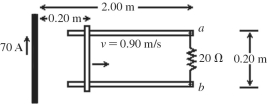
(Multiple Choice)
4.7/5 (75)
(75) An ideal polarizer with its transmission axis rotated 30° to the vertical is placed in a beam of unpolarized light of intensity 10 W/m2. After passing through the polarizer, what is intensity of the beam?
(Multiple Choice)
4.8/5 (62)
(62) Each photon in a beam of light has an energy of 4.20 eV. What is the wavelength of this light? (c = 3.00 × 10⁸ m/s, h = 6.626 × 10⁻³⁴ J ∙ s, 1 eV = 1.60 × 10⁻¹⁹ J)
(Multiple Choice)
4.9/5 (80)
(80) A blacksmith is flattening a steel plate having dimensions 10 cm × 15 cm × 1 mm. He has heated the plate to 900 K. If the emissivity of the plate is 0.75, at what rate does it lose energy by radiation? Ignore any heat exchange with the surroundings.
(σ = 5.67 × 10⁻⁸ W/m2 ∙ K4)
(Multiple Choice)
4.9/5 (76)
(76) If the surface of our bodies is at 37°C, at what wavelength does the radiation that we emit peak if we behave like a blackbody? The constant in Wien's law is 0.0029 m ∙ K.
(Short Answer)
4.8/5 (85)
(85) 
Filters
- Essay(0)
- Multiple Choice(0)
- Short Answer(0)
- True False(0)
- Matching(0)