



 Chat with AI
Exam 20: Electric Fields and Forces

Exam 1: Representing Motion113 Questions
Exam 2: Motion in One Dimension174 Questions
Exam 3: Vectors and Motion in Two Dimensions183 Questions
Exam 4: Forces and Newtons Laws of Motion64 Questions
Exam 5: Applying Newtons Laws82 Questions
Exam 6: Gravity96 Questions
Exam 7: Rotational Motion95 Questions
Exam 8: Equilibrium Ad Elasticity73 Questions
Exam 9: Momentum103 Questions
Exam 10: Energy and Work223 Questions
Exam 11: Using Energy106 Questions
Exam 12: Thermal Properties of Matter220 Questions
Exam 13: Fluids115 Questions
Exam 14: Oscillations105 Questions
Exam 15: Traveling Waves and Sound94 Questions
Exam 16: Superposition and Standing Waves66 Questions
Exam 17: Wave Optics129 Questions
Exam 18: Ray Optics155 Questions
Exam 19: Optical Instruments137 Questions
Exam 20: Electric Fields and Forces95 Questions
Exam 21: Electric Potential144 Questions
Exam 22: Current and Resistance125 Questions
Exam 23: Circuits157 Questions
Exam 24: Magnetic Fields and Forces168 Questions
Exam 25: EM Induction and Em Waves185 Questions
Exam 26: AC Electricity122 Questions
Exam 27: Relativity126 Questions
Exam 28: Quantum Physics86 Questions
Exam 29: Atoms and Molecules105 Questions
Exam 30: Nuclear Physics175 Questions
Select questions type


A conductor is placed in a steady external electric field. Which of the following statements are correct for this situation? (There could be more than one correct choice.)
(Multiple Choice)
4.8/5  (87)
(87) An electron is projected with an initial velocity v0 = 8.4 × m/s along the y-axis, which is the centerline between a pair of charged plates, as shown in the figure. The plates are 1.0 m long and are separated by 0.10 m. A uniform electric field of magnitude E in the +x-direction is present between the plates. If the magnitude of the acceleration of the electron is measured to be what is the magnitude of the electric field between the plates? (e = 1.6 × 10⁻¹⁹ C, melectron = 9.11 × 10⁻³¹ kg) 
(Multiple Choice)
4.8/5 (79)
(79) Two point charges each experience a 1-N electrostatic force when they are 2 cm apart. If they are moved to a new separation of 8 cm, what is the magnitude of the electric force on each of them?
(Multiple Choice)
4.7/5 (77)
(77) Three equal-magnitude point charges of varying signs are placed at three of the corners of a square of side d as shown in the figure. Which one of the arrows shown represents the direction of the net electric field at the vacant corner of the square? 
(Multiple Choice)
4.9/5 (90)
(90) Two tiny beads, each of mass 3.2 g, carry equal-magnitude charges. When they are placed 6.4 cm apart and released in outer space, they begin to accelerate toward each other at 538 m/s2. What is the magnitude of the charge on each bead? (k = 1/4πε0 = 9.0 × 10⁹ N ∙ m2/C2)
(Multiple Choice)
4.9/5 (76)
(76) A negatively-charged plastic rod is brought close to (but does not touch) a neutral metal sphere that is connected to ground. After waiting a few seconds, the ground connection is removed (without touching the sphere), and after that the rod is also removed. The sphere is now
(Multiple Choice)
4.9/5 (79)
(79) A +5.0-μC point charge is placed at the 0 cm mark of a meter stick and a -4.0-μC charge is placed at the 50 cm mark. What is the net electric field at the 30 cm mark? (k = 1/4πε0 = 8.99 × 10⁹ N ∙ m2/C2)
(Multiple Choice)
4.8/5 (70)
(70) The figure shows electric field lines arising from two small charged particles P and Q. Consider the following two statements: (i) The charge on P is smaller than the charge on Q.
(ii) The electrostatic force on P is smaller than the force on Q.
Which of the above statements are true? 
(Multiple Choice)
4.8/5 (72)
(72) Two large closely-spaced parallel metal plates are uniformly and oppositely charged and the electric field between them is 7.6 × 10⁶ N/C.
(a) What is the charge per unit area on each plate?
(b) If the plates are now moved two times farther apart, what is the electric field between the plates?
(Short Answer)
4.7/5 (74)
(74) What is the charge on 1.0 kg of protons?
(e = 1.60 × 10⁻¹⁹ C, mproton = 1.67 × 10⁻²⁷ kg)
(Multiple Choice)
4.7/5 (83)
(83) Three equal charges +Q are at three of the corners of a square of side d. A fourth charge +Q of equal magnitude is at the center of the square as shown in the figure Which one of the arrows shown represents the net force acting on the charge at the center of the square? 
(Multiple Choice)
4.9/5 (84)
(84) A small object with a 5.0-μC charge is accelerating horizontally on a friction-free surface at 0.0050 m/s2 due only to an electric field. If the object has a mass of 2.0 g, what is the magnitude of the electric field?
(Multiple Choice)
4.9/5 (79)
(79) Two uncharged metal spheres, #1 and #2, are mounted on insulating support rods. A third metal sphere, carrying a positive charge, is then placed near #2. Now a copper wire is momentarily connected between #1 and #2 and then removed. Finally, sphere #3 is removed. In this final state
(Multiple Choice)
4.8/5 (92)
(92) An electric dipole consists of charges of ±6.00 µC that are 10.0 cm apart, as shown in the figure. Find the magnitude and direction of the electric field this dipole produces at point P, which is 7.00 cm from each charge. (k = 1/4πε0 = 8.99 × 10⁹ N ∙ m2/C2) 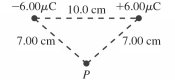
(Essay)
4.9/5 (82)
(82) Two tiny particles carrying like charges of the same magnitude are apart. If the electric force on one of them is what is the magnitude of the charge on each of these particles?(k = 1/4πε0 = 9.0 × 10⁹ N ∙ m2/C2)
(Multiple Choice)
4.9/5 (69)
(69) 
Filters
- Essay(0)
- Multiple Choice(0)
- Short Answer(0)
- True False(0)
- Matching(0)