



 Chat with AI
Exam 6: Gravity

Exam 1: Representing Motion113 Questions
Exam 2: Motion in One Dimension174 Questions
Exam 3: Vectors and Motion in Two Dimensions183 Questions
Exam 4: Forces and Newtons Laws of Motion64 Questions
Exam 5: Applying Newtons Laws82 Questions
Exam 6: Gravity96 Questions
Exam 7: Rotational Motion95 Questions
Exam 8: Equilibrium Ad Elasticity73 Questions
Exam 9: Momentum103 Questions
Exam 10: Energy and Work223 Questions
Exam 11: Using Energy106 Questions
Exam 12: Thermal Properties of Matter220 Questions
Exam 13: Fluids115 Questions
Exam 14: Oscillations105 Questions
Exam 15: Traveling Waves and Sound94 Questions
Exam 16: Superposition and Standing Waves66 Questions
Exam 17: Wave Optics129 Questions
Exam 18: Ray Optics155 Questions
Exam 19: Optical Instruments137 Questions
Exam 20: Electric Fields and Forces95 Questions
Exam 21: Electric Potential144 Questions
Exam 22: Current and Resistance125 Questions
Exam 23: Circuits157 Questions
Exam 24: Magnetic Fields and Forces168 Questions
Exam 25: EM Induction and Em Waves185 Questions
Exam 26: AC Electricity122 Questions
Exam 27: Relativity126 Questions
Exam 28: Quantum Physics86 Questions
Exam 29: Atoms and Molecules105 Questions
Exam 30: Nuclear Physics175 Questions
Select questions type


In order to simulate weightlessness for astronauts in training, they are flown in a vertical circle. If the passengers are to experience weightlessness, how fast should an airplane be moving at the top of a vertical circle with a radius of 2.5 km?
(Multiple Choice)
4.8/5  (68)
(68) The reason an astronaut in an earth satellite feels weightless is that
(Multiple Choice)
4.9/5 (73)
(73) A particularly scary roller coaster contains a loop-the-loop in which the car and rider are completely upside down. If the radius of the loop is with what minimum speed must the car traverse the loop so that the rider does not fall out while upside down at the top? Assume the rider is not strapped to the car.
(Multiple Choice)
4.9/5 (76)
(76) Two cars go around a banked curve at the proper speed for the banking angle. One car has tires with excellent traction, while the other car has bald slippery tires. Which of these cars is more likely to slide on the pavement as it goes around the curve?
(Multiple Choice)
4.7/5 (76)
(76) Pulling out of a dive, the pilot of an airplane guides his plane into a vertical circle. At the bottom of the dive, the speed of the airplane is 320 m/s. What is the smallest radius allowable for the vertical circle if the pilot's apparent weight is not to exceed 7.0 times his true weight?
(Multiple Choice)
4.8/5 (71)
(71) When an object moves in uniform circular motion, the direction of its acceleration is
(Multiple Choice)
4.8/5 (78)
(78) What would be the weight of a 59.1-kg astronaut on a planet with the same density as Earth and having twice Earth's radius?
(Multiple Choice)
4.8/5 (78)
(78) A 20-g bead is attached to a light 120-cm-long string as shown in the figure. This bead moves in a horizontal circle with a constant speed of 1.5 m/s. What is the tension in the string if the angle α is measured to be 25°? 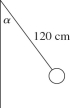
(Multiple Choice)
4.9/5 (94)
(94) A curved portion of highway has a radius of curvature of 65 m. As a highway engineer, you want to bank this curve at the proper angle for a steady speed of 22 m/s.
(a) What banking angle should you specify for this curve?
(b) At the proper banking angle, what normal force and what friction force does the highway exert on a 750-kg car going around the curve at the proper speed?
(Short Answer)
4.9/5 (74)
(74) The mass of Pluto is 1.31 × 10²² kg and its radius is 1.15 × 10⁶ m. What is the acceleration of a freely-falling object at the surface of Pluto if it has no atmosphere? (G = 6.67 × 10⁻¹¹ N ∙ m2/kg2)
(Multiple Choice)
4.8/5 (91)
(91) A very dense 1500-kg point mass (A) and a dense 1200-kg point mass (B) are held in place 1.00 m apart on a frictionless table. A third point mass is placed between the other two at a point that is 20.0 cm from B along the line connecting A and B. When the third mass is suddenly released, find the magnitude and direction
(toward A or toward B) of its initial acceleration. (G = 6.67 × 10⁻¹¹ N ∙ m2/kg2)
(Short Answer)
4.8/5 (85)
(85) As a 70-kg person stands at the seashore gazing at the tides (which are caused by the Moon), how large is the gravitational force on that person due to the Moon? The mass of the Moon is 7.35 × 10²² kg, the distance to the Moon is 3.82 × 10⁸ m, and G = 6.67 × 10⁻¹¹ N ∙ m2/kg2.
(Multiple Choice)
4.9/5 (81)
(81) The curved section of a horizontal highway is a circular unbanked arc of radius 740 m. If the coefficient of static friction between this roadway and typical tires is 0.40, what would be the maximum safe driving speed for this horizontal curved section of highway?
(Multiple Choice)
4.8/5 (83)
(83) What would be the weight of a 59.1-kg astronaut on a planet twice as massive as Earth and having twice Earth's radius?
(Multiple Choice)
4.7/5 (73)
(73) A 1000-kg car is moving at 30 m/s around a horizontal unbanked curve whose diameter is 0.20 km. What is the magnitude of the friction force required to keep the car from sliding?
(Multiple Choice)
4.8/5 (84)
(84) A satellite encircles Mars at a distance above its surface equal to 3 times the radius of Mars. If gm is the acceleration due to gravity at the surface of Mars, what is the acceleration due to gravity at the location of the satellite?
(Multiple Choice)
4.7/5 (81)
(81) 
Filters
- Essay(0)
- Multiple Choice(0)
- Short Answer(0)
- True False(0)
- Matching(0)