



 Chat with AI
Exam 15: Cost Allocation: Joint Products and Byproducts

Exam 1: The Accountants Vital Role in Decision Making171 Questions
Exam 2: An Introduction to Cost Terms and Purposes202 Questions
Exam 3: Cost-Volume-Profit Analysis165 Questions
Exam 4: Job Costing161 Questions
Exam 5: Activity-Based Costing and Management160 Questions
Exam 6: Master Budget and Responsibility Accounting179 Questions
Exam 7: Flexible Budgets, Variances, and Management Control: I190 Questions
Exam 8: Flexible Budgets, Variances, and Management Control: II156 Questions
Exam 9: Income Effects of Denominator Level on Inventory Valuation178 Questions
Exam 10: Analysis of Cost Behaviour251 Questions
Exam 11: Decision Making and Relevant Information194 Questions
Exam 12: Pricing Decisions, Product Profitability Decisions, and Cost Management160 Questions
Exam 13: Strategy, Balanced Scorecard, and Profitability Analysis152 Questions
Exam 14: Period Cost Allocation180 Questions
Exam 15: Cost Allocation: Joint Products and Byproducts192 Questions
Exam 16: Revenue and Customer Profitability Analysis165 Questions
Exam 17: Process Costing155 Questions
Exam 18: Spoilage, Rework, and Scrap155 Questions
Exam 19: Inventory Cost Management Strategies161 Questions
Exam 20: Capital Budgeting: Methods of Investment Analysis196 Questions
Exam 21: Transfer Pricing and Multinational Management Control Systems183 Questions
Exam 22: Multinational Performance Measurement and Compensation166 Questions
Select questions type


Favata Corporation processes a single material into three separate products A, B, and C .During September, the joint costs of processing were $600,000.Production and sales value information for the month were as follows:
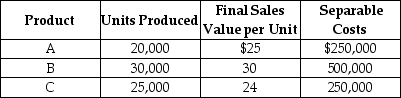 Required:
Determine the amount of joint cost allocated to each product if the constant gross margin percentage of NRV method is used.
Required:
Determine the amount of joint cost allocated to each product if the constant gross margin percentage of NRV method is used. (Essay)
4.8/5  (57)
(57) Helen Company processes 30,000 litres of direct materials to produce two products, Zander and Ifso.Zander, a byproduct, sells for $5 per litre, and Ifso, the main product, sells for $70 per litre.The following information is for July:
 The manufacturing costs totalled $145,000; beginning inventory $3,000.Required:
1.Prepare a July income statement assuming that Helen Company recognizes the byproduct net realizable value when production is completed.The company uses FIFO for the inventory flow assumption.2.Prepare the journal entry to record the byproduct sales.
The manufacturing costs totalled $145,000; beginning inventory $3,000.Required:
1.Prepare a July income statement assuming that Helen Company recognizes the byproduct net realizable value when production is completed.The company uses FIFO for the inventory flow assumption.2.Prepare the journal entry to record the byproduct sales. (Essay)
4.9/5 (75)
(75) What are the two methods to account for byproducts.Which is the more appropriate method to use and why?
(Essay)
4.9/5 (79)
(79) Salt Island Pottery Ltd.manufactures two products, bowls and plates, from a joint process.Bowls are allocated $5,000 of the total joint costs of $25,000.There are 1,500 bowls produced and 1,500 plates produced each year.Bowls can be sold at the split-off point for $12 per unit, or they can be processed further into a deluxe bowl for additional processing costs of $5,000 and sold for $16 for each deluxe bowl.By how much will operating income change if the company chooses to process deluxe bowls?
(Multiple Choice)
5.0/5 (85)
(85) Answer the following question(s)using the information below:
The Morton Company processes unprocessed goat milk up to the splitoff point where two products, condensed goat milk and skim goat milk result.The following information was collected for the month of October: 
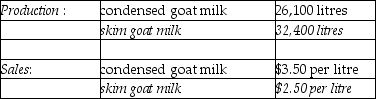 The costs of purchasing the 65,000 litres of unprocessed goat milk and processing it up to the splitoff point to yield a total of 58,500 litres of salable product was $72,240.There were no inventory balances of either product.Condensed goat milk may be processed further to yield 19,500 litres (the remainder is shrinkage)of a medicinal milk product, Xyla, for an additional processing cost of $3 per usable litre.Xyla can be sold for $18 per litre.Skim goat milk can be processed further to yield 28,100 litres of skim goat ice cream, for an additional processing cost per usable litre of $2.50.The product can be sold for $9 per litre.There are no beginning and ending inventory balances.
-Using estimated net realizable value, what amount of the $72,240 of joint costs would be allocated Xyla and the skim goat ice cream?
The costs of purchasing the 65,000 litres of unprocessed goat milk and processing it up to the splitoff point to yield a total of 58,500 litres of salable product was $72,240.There were no inventory balances of either product.Condensed goat milk may be processed further to yield 19,500 litres (the remainder is shrinkage)of a medicinal milk product, Xyla, for an additional processing cost of $3 per usable litre.Xyla can be sold for $18 per litre.Skim goat milk can be processed further to yield 28,100 litres of skim goat ice cream, for an additional processing cost per usable litre of $2.50.The product can be sold for $9 per litre.There are no beginning and ending inventory balances.
-Using estimated net realizable value, what amount of the $72,240 of joint costs would be allocated Xyla and the skim goat ice cream? (Multiple Choice)
4.9/5 (74)
(74) Match each of the following costs with the appropriate joint production process cost classification.
A)separable cost
B)joint cost
-Cost of moulding plastic for use in making different toys on an assembly line.
(Short Answer)
4.7/5 (75)
(75) Use the information below to answer the following question(s).Chem Manufacturing Company processes direct materials up to the splitoff point, where two products (X and Y)are obtained and sold.The following information was collected for the month of November.Direct materials processed:
10,000 litres (10,000 litres yield 9,500 litres of good product and 500 litres of shrinkage)
 The cost of purchasing 10,000 litres of direct materials and processing it up to the splitoff point to yield a total of 9,500 litres of good products was $975,000.The beginning inventories totalled 50 litres for X and 25 litres for Y.Ending inventory amounts reflected 300 litres of product X and 525 litres of product Y.October costs were per unit were the same as November.
-Advantages of the sales value at splitoff method include all of the following EXCEPT
The cost of purchasing 10,000 litres of direct materials and processing it up to the splitoff point to yield a total of 9,500 litres of good products was $975,000.The beginning inventories totalled 50 litres for X and 25 litres for Y.Ending inventory amounts reflected 300 litres of product X and 525 litres of product Y.October costs were per unit were the same as November.
-Advantages of the sales value at splitoff method include all of the following EXCEPT (Multiple Choice)
4.8/5 (96)
(96) Answer the following question(s)using the information below.The Oxnard Corporation processes a liquid component up to the splitoff point where two products, Mr.DirtOut and Mr.SinkClean, are produced and sold.There was no beginning inventory.The following material was collected for the month of January: 
 The cost of purchasing 250,000 litres of direct materials and processing it up to the splitoff point to yield a total of 242,500 litres of good product was $380,000.
-When using the physical measures method, what is Mr.DirtOut's approximate production cost per unit?
The cost of purchasing 250,000 litres of direct materials and processing it up to the splitoff point to yield a total of 242,500 litres of good product was $380,000.
-When using the physical measures method, what is Mr.DirtOut's approximate production cost per unit? (Multiple Choice)
4.9/5 (73)
(73) Use the information below to answer the following question(s).Cranbrook Chemical Ltd.manufactures two industrial compounds.In the month of May, 15,000 litres of direct material costing $160,000 were processed at a cost of $400,000.The joint process yielded 16,000 containers of a compound known as Jarlon and 4,000 containers of a compound known as Kharton.The respective selling prices of Jarlon and Kharton are $38 and $58.Both products may be processed further.Jarlon may be processed into Jaxton at an incremental cost of $8 per jar of the final product while Kharton may be processed into Kraxton at an additional cost of $32 per jar of the final product.The volume of jars of the final product are: 12,000 and 3,000 for Jaxton and Kraxton respectively.The selling price of Jaxton is $48 per jar.The selling price of Kraxton is $102 per jar.
-Using the sales value at splitoff method, the joint costs allocated to Jarlon would be
(Multiple Choice)
4.9/5 (69)
(69) Distinguish between the two principal methods of accounting for byproducts, the production byproduct method and the sale byproduct method.Briefly discuss the relative merits (or lack thereof)of each.
(Essay)
4.8/5 (82)
(82) Different joint cost allocation methods will result in different product margin percentages for the individual products.
(True/False)
4.8/5 (90)
(90) BC Lumber processes timber into four products.During January the joint costs of processing were $280,000.There was no beginning inventory at the beginning of the month.Production and sales value information for the month were as follows:
Sales Value at
 Required:
Determine the value of ending inventory if the physical measures method is used for product costing.Round to 3 decimal places when necessary.
Required:
Determine the value of ending inventory if the physical measures method is used for product costing.Round to 3 decimal places when necessary. (Essay)
4.8/5 (85)
(85) Use the information below to answer the following question(s).Chem Manufacturing Company processes direct materials up to the splitoff point, where two products (X and Y)are obtained and sold.The following information was collected for the month of November.Direct materials processed:
10,000 litres (10,000 litres yield 9,500 litres of good product and 500 litres of shrinkage)
The cost of purchasing 10,000 litres of direct materials and processing it up to the splitoff point to yield a total of 9,500 litres of good products was $975,000.The beginning inventories totalled 50 litres for X and 25 litres for Y.Ending inventory amounts reflected 300 litres of product X and 525 litres of product Y.October costs were per unit were the same as November.
-Product X is sold for $8 a unit and Product Y is sold for $12 a unit.Each product can also be sold at the splitoff point.Product X can be sold for $5 and Product Y for $4.Joint costs for the two products totaled $4,000 for January for 600 units of X and 500 units of Y.What are the respective joint costs assigned to each unit of products X and Y if the sales value at splitoff method is used?
The cost of purchasing 10,000 litres of direct materials and processing it up to the splitoff point to yield a total of 9,500 litres of good products was $975,000.The beginning inventories totalled 50 litres for X and 25 litres for Y.Ending inventory amounts reflected 300 litres of product X and 525 litres of product Y.October costs were per unit were the same as November.
-Product X is sold for $8 a unit and Product Y is sold for $12 a unit.Each product can also be sold at the splitoff point.Product X can be sold for $5 and Product Y for $4.Joint costs for the two products totaled $4,000 for January for 600 units of X and 500 units of Y.What are the respective joint costs assigned to each unit of products X and Y if the sales value at splitoff method is used? (Multiple Choice)
4.7/5 (98)
(98) All separable costs in joint cost allocations are always incremental costs.
(True/False)
4.9/5 (79)
(79) Trundle Ltd.produces two main products, J and K; and, a byproduct, L.There were no beginning inventories.During April, it incurred $275,000 of joint costs, which are allocated to main products using the physical output method.Additional information follows:
 Required:
Assuming Trundle recognizes byproduct revenue at the time of production, what is the total value of ending inventory?
Required:
Assuming Trundle recognizes byproduct revenue at the time of production, what is the total value of ending inventory? (Essay)
4.8/5 (72)
(72) In each of the following industries, identify possible joint (or severable)products at the splitoff point.a.Coal
b.Petroleum
c.Dairy
d.Lamb
e.Lumber
f.Cocoa Beans
g.Christmas Trees
h.Salt
i.Cowhide
(Essay)
4.9/5 (76)
(76) The sales value at splitoff method allocates joint costs according to each product's value, at the splitoff point, of the total production in the accounting period of each product.
(True/False)
4.7/5 (85)
(85) Answer the following question(s)using the information below:
The Morton Company processes unprocessed goat milk up to the splitoff point where two products, condensed goat milk and skim goat milk result.The following information was collected for the month of October: The costs of purchasing the 65,000 litres of unprocessed goat milk and processing it up to the splitoff point to yield a total of 58,500 litres of salable product was $72,240.There were no inventory balances of either product.Condensed goat milk may be processed further to yield 19,500 litres (the remainder is shrinkage)of a medicinal milk product, Xyla, for an additional processing cost of $3 per usable litre.Xyla can be sold for $18 per litre.Skim goat milk can be processed further to yield 28,100 litres of skim goat ice cream, for an additional processing cost per usable litre of $2.50.The product can be sold for $9 per litre.There are no beginning and ending inventory balances.
-What is the estimated net realizable value of the skim goat ice cream at the splitoff point?
The costs of purchasing the 65,000 litres of unprocessed goat milk and processing it up to the splitoff point to yield a total of 58,500 litres of salable product was $72,240.There were no inventory balances of either product.Condensed goat milk may be processed further to yield 19,500 litres (the remainder is shrinkage)of a medicinal milk product, Xyla, for an additional processing cost of $3 per usable litre.Xyla can be sold for $18 per litre.Skim goat milk can be processed further to yield 28,100 litres of skim goat ice cream, for an additional processing cost per usable litre of $2.50.The product can be sold for $9 per litre.There are no beginning and ending inventory balances.
-What is the estimated net realizable value of the skim goat ice cream at the splitoff point? (Multiple Choice)
5.0/5 (92)
(92) 
Filters
- Essay(0)
- Multiple Choice(0)
- Short Answer(0)
- True False(0)
- Matching(0)