



 Chat with AI
Exam 4: Job Costing

Exam 1: The Accountants Vital Role in Decision Making171 Questions
Exam 2: An Introduction to Cost Terms and Purposes202 Questions
Exam 3: Cost-Volume-Profit Analysis165 Questions
Exam 4: Job Costing161 Questions
Exam 5: Activity-Based Costing and Management160 Questions
Exam 6: Master Budget and Responsibility Accounting179 Questions
Exam 7: Flexible Budgets, Variances, and Management Control: I190 Questions
Exam 8: Flexible Budgets, Variances, and Management Control: II156 Questions
Exam 9: Income Effects of Denominator Level on Inventory Valuation178 Questions
Exam 10: Analysis of Cost Behaviour251 Questions
Exam 11: Decision Making and Relevant Information194 Questions
Exam 12: Pricing Decisions, Product Profitability Decisions, and Cost Management160 Questions
Exam 13: Strategy, Balanced Scorecard, and Profitability Analysis152 Questions
Exam 14: Period Cost Allocation180 Questions
Exam 15: Cost Allocation: Joint Products and Byproducts192 Questions
Exam 16: Revenue and Customer Profitability Analysis165 Questions
Exam 17: Process Costing155 Questions
Exam 18: Spoilage, Rework, and Scrap155 Questions
Exam 19: Inventory Cost Management Strategies161 Questions
Exam 20: Capital Budgeting: Methods of Investment Analysis196 Questions
Exam 21: Transfer Pricing and Multinational Management Control Systems183 Questions
Exam 22: Multinational Performance Measurement and Compensation166 Questions
Select questions type


Place the following steps in the order suggested by the seven steps used to assign costs to individual jobs: A.Select the cost-allocation bases to use for allocating indirect costs to the job
B.Compute the rate per unit of each cost-allocation base used to allocate indirect costs to the job
C.Compute the total cost of the job by adding all direct and indirect costs assigned to the job
D.Identify the direct costs of the job
E.Compute the indirect costs allocated to the job
F.Identify the indirect costs associated with each cost-allocation base
G.Identify the job that is the chosen cost object
(Multiple Choice)
4.9/5  (70)
(70) Use the information below to answer the following question(s).Capable Carts manufactures custom carts for a variety of uses.The following data have been recorded for Job 892, which was recently completed.Direct materials used cost $6,300, the budgeted direct materials were $5,900.There were 180 direct labour hours worked on this job at a direct labour wage rate of $20 per hour; the budgeted direct labour wage rate was $21 per hour.There were 75 machine hours used on this job.The budgeted and actual indirect cost allocation rates are $32 and $29 per machine hour used, respectively.
-What is the total manufacturing cost of Job 892 using actual costing?
(Multiple Choice)
4.7/5 (72)
(72) The manufacturing overhead control account and the manufacturing overhead allocated account both have zero balances at the end of each year after all adjustments are recorded.
(True/False)
4.9/5 (79)
(79) Cost assignment includes cost allocation for indirect costs and direct costs.
(True/False)
4.8/5 (69)
(69) A local attorney employs ten full-time professionals.The budgeted compensation per employee is $80,000.The maximum billable hours for each client are 400.Clients always receive their full amount of time.All professional labour costs are included in a single direct cost category and are traced to jobs on a per-hour basis.Any other costs are included in a single indirect cost pool, allocated according to professional labour-hours.Budgeted indirect costs for the year are $400,000 and the firm had 20 clients.Required:
a.What is the direct labour budgeted cost rate per hour?
b.What is the indirect cost pool budgeted cost rate per hour?
(Essay)
4.9/5 (66)
(66) A local financial consulting firm employs 30 full-time employees.The budgeted compensation per employee is $50,000.The annual maximum chargeable time to each client is 1,000 hours.Clients always receive their full amount of time.All labour costs are included in a single direct-cost category and are traced to jobs on a per-hour basis.Any other costs are included in a single indirect-cost pool, allocated according to professional labour-hours.Budgeted indirect costs for the year are $1,050,000, and the firm expects to have 60 clients during the coming year.What is the budgeted indirect-cost rate per hour?
(Multiple Choice)
4.8/5 (63)
(63) Correct the following journal entry, and explain your changes.  To record the cost of machinery repair labour.
 (Essay)
4.9/5 (78)
(78) Beacon Company does residential real estate appraisals.There are 40 professionals on its staff.Each professional is allotted the following number of hours per year:
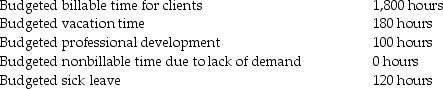 The company receives more jobs than it can handle and therefore rejects most out of town work.The budgeted salary for each professional is $44,000 per year with fringe benefits of $11,000.During the previous year, the actual salaries were $46,500, plus fringe benefits of $11,500.Required:
a.What was the total budgeted direct cost rate if the company believes that clients should be charged directly for its employees' salaries and benefits?
b.What was the budgeted direct cost rate if the company wants to charge clients for employee vacation, sick leave, and professional development as an indirect cost?
The company receives more jobs than it can handle and therefore rejects most out of town work.The budgeted salary for each professional is $44,000 per year with fringe benefits of $11,000.During the previous year, the actual salaries were $46,500, plus fringe benefits of $11,500.Required:
a.What was the total budgeted direct cost rate if the company believes that clients should be charged directly for its employees' salaries and benefits?
b.What was the budgeted direct cost rate if the company wants to charge clients for employee vacation, sick leave, and professional development as an indirect cost? (Essay)
4.8/5 (68)
(68) Actual costing systems are commonly found in practice because the indirect cost information is readily available.
(True/False)
5.0/5 (75)
(75) Budgeted fixed indirect costs remain constant at $150,000 per month.During high-output months variable indirect costs are budgeted at $120,000, and during low-output months budgeted variable costs are $60,000.What are the respective high and low indirect cost rates if budgeted professional labour-hours are 6,000 for high-output months and 2,000 for low-output months?
(Multiple Choice)
4.8/5 (78)
(78) The Work-in-Process Control account tracks job costs from the time jobs are started until they are completed.
(True/False)
4.9/5 (80)
(80) Which method for dealing with under/over allocated overhead provides the most accurate individual job cost records?
(Multiple Choice)
4.9/5 (76)
(76) What are three possible ways to dispose of underallocated or overallocated overhead costs at the end of a fiscal year? Briefly comment on the theoretical correctness or incorrectness of each method.
(Essay)
4.9/5 (79)
(79) A process costing system assigns costs to groups of similar units during a specified time period and then computes the average unit cost.
(True/False)
4.8/5 (73)
(73) Which of the following would be appropriately costed using a job costing system?
(Multiple Choice)
4.8/5 (83)
(83) Process costing is a useful system for tracking the costs of building a house.
(True/False)
4.9/5 (78)
(78) Use the information below to answer the following question(s).Because the Abernathy Company used a budgeted indirect cost allocation rate for its manufacturing operations, the amount allocated ($200,000)was different from the actual amount incurred ($225,000).These were the respective ending balances in the Manufacturing Overhead Allocated and Manufacturing Overhead control accounts.Before disposition of under/overallocated overhead, the following information was available:
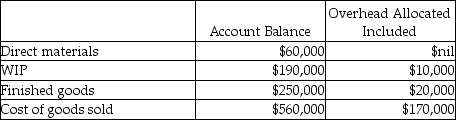 -What is the journal entry Abernathy Company should use to write-off the difference between allocated and actual overhead directly to cost of goods sold?
 (Multiple Choice)
4.9/5 (80)
(80) Manufacturing overhead costs incurred for the month are:  Which is the correct journal entry assuming utilities and repairs were on account?
 (Multiple Choice)
4.7/5 (90)
(90) 
Filters
- Essay(0)
- Multiple Choice(0)
- Short Answer(0)
- True False(0)
- Matching(0)