



 Chat with AI
Exam 3: Job Costing

Exam 1: Introduction to Managerial Accounting201 Questions
Exam 2: Building Blocks of Managerial Accounting318 Questions
Exam 3: Job Costing333 Questions
Exam 4: Activity-Based Costing, Lean Operations, and the Costs of Quality262 Questions
Exam 5: Process Costing271 Questions
Exam 6: Cost Behavior307 Questions
Exam 7: Cost-Volume-Profit Analysis276 Questions
Exam 8: Relevant Costs for Short-Term Decisions270 Questions
Exam 9: The Master Budget219 Questions
Exam 10: Performance Evalulation232 Questions
Exam 11: Standard Costs and Variances254 Questions
Exam 12: Capital Investment Decisions and the Time Value of Money213 Questions
Exam 13: Statement of Cash Flows193 Questions
Exam 14: Financial Statement Analysis196 Questions
Exam 15: Sustainability123 Questions
Select questions type


Denver Company uses a job costing system. The work in process inventory on December 31 consisted of Job No. 173 with a balance of $66,900. Job No. 173 has been charged with manufacturing overhead costs of $20,500. Denver allocates manufacturing overhead costs at a rate of 50% of direct labor cost. What was the amount of direct materials charged to Job No. 173?
(Multiple Choice)
4.8/5  (64)
(64) Barefoot Running Company's work in process inventory on June 1 has a balance of $22,700 representing Job No. 265. During June, $50,100 of direct materials were requisitioned for Job No. 265 and $35,900 of direct labor cost was incurred on Job No. 265. Manufacturing overhead is allocated at 115% of direct labor cost. Actual manufacturing overhead costs incurred in June amounted to $41,300. No new jobs were started during June. Job No. 265 is completed on June 28. What is the total cost assigned to Job No. 265?
(Multiple Choice)
4.9/5 (74)
(74) At a service company, the indirect costs of serving the client consists of operating expenses.
(True/False)
4.8/5 (72)
(72) Manufacturers follow four steps to implement a manufacturing overhead allocation system. In the first step, the company estimates its total manufacturing overhead costs for the coming year.
(True/False)
4.9/5 (82)
(82) In job costing, when raw materials are requisitioned for a job, the Raw Materials Inventory account is credited.
(True/False)
4.8/5 (69)
(69) Management can use job cost information to control costs on jobs produced in the future.
(True/False)
5.0/5 (84)
(84) Calico Corporation produced 2,000 units in Job 903. The following data is provided for Job 903 for the year: 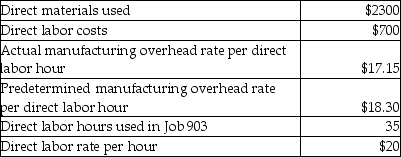 What is the unit cost for Job 903? (Round to two decimal places.)
 (Multiple Choice)
4.8/5 (82)
(82) Nadal Company is debating the use of direct labor cost or direct labor hours as the cost allocation base for allocating manufacturing overhead. The following information is available for the most recent year: 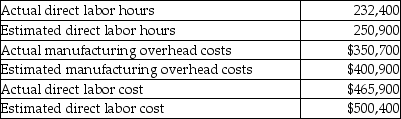 If Nadal Company uses direct labor hours as the allocation base, what would the allocated manufacturing overhead be for the year? (Round intermediary calculations to the nearest cent and the final answer to the nearest dollar.)
 (Multiple Choice)
4.8/5 (73)
(73) The following account balances at the beginning of January were selected from the general ledger of Fresh Bagel Manufacturing Company:  Additional data:
1) Actual manufacturing overhead for January amounted to $66,400.
2) Total direct labor cost for January was $63,400.
3) The predetermined manufacturing overhead rate is based on direct labor cost. The budget for the year called for $250,900 of direct labor cost and $350,200 of manufacturing overhead costs.
4) The only job unfinished on January 31 was Job No. 151, for which total direct labor charges were $6200 (800 direct labor hours)and total direct material charges were $14,100.
5) Cost of direct materials placed in production during January totaled $123,600. There were no indirect material requisitions during January.
6) January 31 balance in raw materials inventory was $36,000.
7) Finished goods inventory balance on January 31 was $35,300.
What is the predetermined manufacturing overhead rate?
Additional data:
1) Actual manufacturing overhead for January amounted to $66,400.
2) Total direct labor cost for January was $63,400.
3) The predetermined manufacturing overhead rate is based on direct labor cost. The budget for the year called for $250,900 of direct labor cost and $350,200 of manufacturing overhead costs.
4) The only job unfinished on January 31 was Job No. 151, for which total direct labor charges were $6200 (800 direct labor hours)and total direct material charges were $14,100.
5) Cost of direct materials placed in production during January totaled $123,600. There were no indirect material requisitions during January.
6) January 31 balance in raw materials inventory was $36,000.
7) Finished goods inventory balance on January 31 was $35,300.
What is the predetermined manufacturing overhead rate? (Multiple Choice)
4.7/5 (90)
(90) Which of the following types of costing is used for many similar products?
(Multiple Choice)
5.0/5 (72)
(72) Which of the following is an example of an industry that would use a process costing-rather than a job costing-system?
(Multiple Choice)
4.8/5 (69)
(69) The predetermined manufacturing overhead rate is calculated by multiplying the total estimated manufacturing overhead costs by the total estimated amount of the allocation base.
(True/False)
4.8/5 (81)
(81) Zanny Moldings has the following estimated costs for the upcoming year: 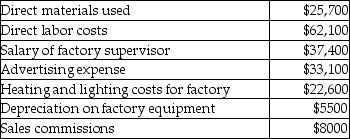 The company estimates that 1600 direct labor hours will be worked in the upcoming year, while 2100 machine hours will be used during the year. The predetermined manufacturing overhead rate per machine hour is closest to
 (Multiple Choice)
4.7/5 (84)
(84) Overallocated and underallocated manufacturing overhead is calculated by comparing estimated manufacturing overhead to actual manufacturing overhead.
(True/False)
4.8/5 (86)
(86) If manufacturing overhead has been underallocated during the year, it means the jobs have been undercosted.
(True/False)
4.8/5 (72)
(72) ________ laws , or "take-back" laws, create future costs associated with the production of electronic devices and require manufacturers of electronic devices to take back their products at the end of the products' useful lives.
(Multiple Choice)
4.9/5 (74)
(74) Serena Corporation uses estimated manufacturing overhead costs of $880,600 and estimated direct labor hours of 200,000 in establishing manufacturing overhead rates. Allocated manufacturing overhead was $1,012,100 and actual manufacturing overhead was $970,500. What were the number of actual direct hours worked? (Round intermediary calculations to the nearest cent and the final answer to the nearest dollar.)
(Multiple Choice)
4.8/5 (64)
(64) 
Filters
- Essay(0)
- Multiple Choice(0)
- Short Answer(0)
- True False(0)
- Matching(0)