



 Chat with AI
Exam 26: Capital Investment Decisions

Exam 1: Accounting and the Business Environment143 Questions
Exam 2: Recording Business Transactions156 Questions
Exam 3: The Adjusting Process152 Questions
Exam 4: Completing the Accounting Cycle156 Questions
Exam 5: Merchandising Operations160 Questions
Exam 6: Merchandise Inventory155 Questions
Exam 7: Accounting Information Systems137 Questions
Exam 8: Internal Control and Cash160 Questions
Exam 9: Receivables138 Questions
Exam 10: Plant Assets, Natural Resources, and Intangibles151 Questions
Exam 11: Current Liabilities and Payroll162 Questions
Exam 12: Partnerships161 Questions
Exam 13: Corporations158 Questions
Exam 14: Long-Term Liabilities151 Questions
Exam 15: Investments135 Questions
Exam 16: The Statement of Cash Flows154 Questions
Exam 17: Financial Statement Analysis112 Questions
Exam 18: Introduction to Managerial Accounting179 Questions
Exam 19: Job Order Costing152 Questions
Exam 20: Process Costing144 Questions
Exam 21: Cost-Volume-Profit Analysis172 Questions
Exam 22: Master Budgets114 Questions
Exam 23: Flexible Budgets and Standard Cost Systems173 Questions
Exam 24: Cost Allocation and Responsibility Accounting129 Questions
Exam 25: Short-Term Business Decisions161 Questions
Exam 26: Capital Investment Decisions122 Questions
Select questions type


John wins the lottery and has the following three payout options for after-tax prize money: 1. $50,000 per year at the end of each of the next six years
2. $300,000 (lump sum)now
3. $500,000 (lump sum)six years from now
The required rate of return is 9%. What is the present value if he selects the third option? Round to nearest whole dollar.
Present value of $1: 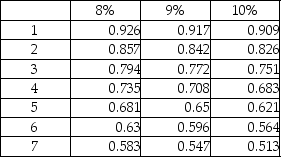
(Multiple Choice)
4.9/5  (97)
(97) Which of the following two methods are typically used for initial screening of investments, rather than for detailed, in-depth analysis?
(Multiple Choice)
4.8/5 (67)
(67) The following details are provided by Dopler Company: 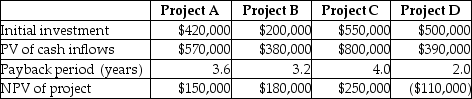 What is the profitability index for Project C?
 (Multiple Choice)
4.9/5 (73)
(73) Gamma Company is considering an investment proposal that would require an initial outlay of $800,000, and would yield yearly cash flows of $200,000 for 9 years. The company uses a discount rate of 10%. What is the NPV of the investment? Present value of annuity of $1: 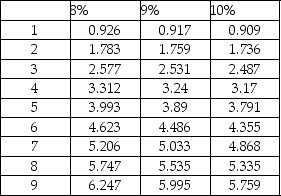
(Multiple Choice)
4.9/5 (59)
(59) Gamma Company is considering an investment opportunity with the following expected net cash inflows: Year 1, $250,000; Year 2, $350,000; Year 3, $395,000. Residual value of the investment would be $50,000. The company uses a discount rate of 12% and the initial investment is $400,000. Calculate the NPV of the investment.
Present value of $1: 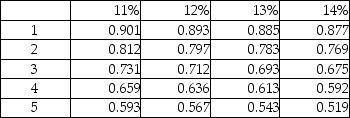
(Essay)
4.7/5 (74)
(74) The acquisition or construction of a capital asset is known as a capital investment.
(True/False)
4.8/5 (81)
(81) The internal rate of return (IRR)is the rate of return, based on discounted cash flows, that a company can expect to earn by investing in a capital asset.
(True/False)
4.9/5 (80)
(80) Logy Inc. is evaluating two possible investments in depreciable plant assets. The company uses the straight-line method of depreciation. The following information is available: 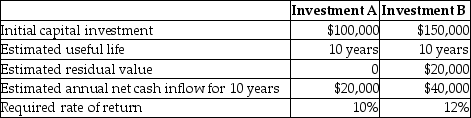 Calculate the payback period for Investment A.
 (Multiple Choice)
4.9/5 (86)
(86) Following details are provided by VPN Company. 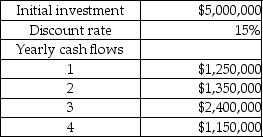 Refer to the following table for PV factors:
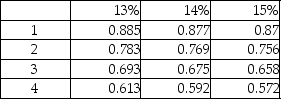 What is the NPV of the project?
Refer to the following table for PV factors: What is the NPV of the project? (Multiple Choice)
4.8/5 (70)
(70) All else being equal, the shorter the investment period, the higher the total amount of interest earned.
(True/False)
4.9/5 (83)
(83) Which of the following would be the best basis on whether to accept an investment opportunity or not?
(Multiple Choice)
4.7/5 (73)
(73) The accounting rate of return method of analyzing a potential capital investment considers the time value of money.
(True/False)
4.8/5 (74)
(74) A company is evaluating three possible investments. Each uses straight-line method of depreciation. Following information is provided by the company. 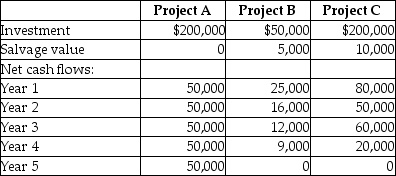 What is the accounting rate of return for Project B?
 (Multiple Choice)
4.9/5 (72)
(72) The accounting rate of return is also known as average rate of return or annual rate of return.
(True/False)
4.9/5 (82)
(82) Which of the following is a capital budgeting method that is used to screen potential investments?
(Multiple Choice)
4.9/5 (79)
(79) Following details are provided by Dopler Company. 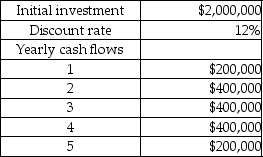 Refer to the following table for PV factors:
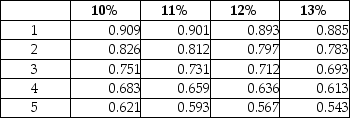 Calculate the NPV of the project.
Refer to the following table for PV factors: Calculate the NPV of the project. (Multiple Choice)
4.7/5 (75)
(75) Discounted cash flow methods consider the time value of money while evaluating an investment proposal.
(True/False)
4.9/5 (98)
(98) James has just won the lottery after purchasing one $10 lottery ticket. The state offers him the following three payout options for after-tax prize money:
1. $50,000 per year at the end of each of the next six years
2. $300,000 (lump sum)now
3. $400,000 (lump sum)six years from now
Calculate the present value of each scenario using an 8% discount rate. Round to nearest whole dollar.
Present value of annuity of $1: 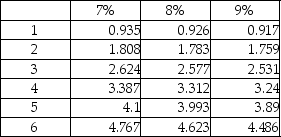 Present value of $1:
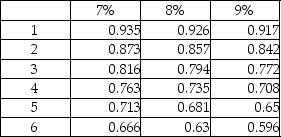
Present value of $1: (Essay)
4.7/5 (84)
(84) The residual value is discounted as a single lump sum because it will be received only once at the end of life of the asset.
(True/False)
4.9/5 (77)
(77) 
Filters
- Essay(0)
- Multiple Choice(0)
- Short Answer(0)
- True False(0)
- Matching(0)