



 Chat with AI
Exam 20: Process Costing

Exam 1: Accounting and the Business Environment143 Questions
Exam 2: Recording Business Transactions156 Questions
Exam 3: The Adjusting Process152 Questions
Exam 4: Completing the Accounting Cycle156 Questions
Exam 5: Merchandising Operations160 Questions
Exam 6: Merchandise Inventory155 Questions
Exam 7: Accounting Information Systems137 Questions
Exam 8: Internal Control and Cash160 Questions
Exam 9: Receivables138 Questions
Exam 10: Plant Assets, Natural Resources, and Intangibles151 Questions
Exam 11: Current Liabilities and Payroll162 Questions
Exam 12: Partnerships161 Questions
Exam 13: Corporations158 Questions
Exam 14: Long-Term Liabilities151 Questions
Exam 15: Investments135 Questions
Exam 16: The Statement of Cash Flows154 Questions
Exam 17: Financial Statement Analysis112 Questions
Exam 18: Introduction to Managerial Accounting179 Questions
Exam 19: Job Order Costing152 Questions
Exam 20: Process Costing144 Questions
Exam 21: Cost-Volume-Profit Analysis172 Questions
Exam 22: Master Budgets114 Questions
Exam 23: Flexible Budgets and Standard Cost Systems173 Questions
Exam 24: Cost Allocation and Responsibility Accounting129 Questions
Exam 25: Short-Term Business Decisions161 Questions
Exam 26: Capital Investment Decisions122 Questions
Select questions type


LDR Manufacturing produces a pesticide chemical and uses process costing. There are three processing departments-Mixing, Refining, and Packaging. On January 1, 2012, the first department, Mixing, had a zero beginning balance. During January, 40,000 gallons of chemicals were started into production. During the month, 32,000 gallons were completed, and 8,000 remained in process, partially completed. In the Mixing Department, all direct materials are added at the beginning of the production process, and conversion costs are applied evenly through the process. During January, the Mixing Department incurred $60,000 in direct materials costs and $230,000 in conversion costs. At the end of the month, the ending inventory in the Mixing Department was 60% complete with respect to conversion costs. First, calculate the equivalent units, then calculate the cost per equivalent unit, and then calculate the total cost of the product that was completed and transferred out during January.
The total cost of product transferred out was:
(Multiple Choice)
4.7/5  (94)
(94) Which of the following is used to calculate the number of units to account for under the first-in, first-out (FIFO)method of inventory valuation of process costing?
(Multiple Choice)
4.7/5 (75)
(75) A production cost report aids in preparing an income statement by:
(Multiple Choice)
4.9/5 (81)
(81) Nevada Manufacturing has two processing departments, Department I and Department II. During 2014, direct materials worth $38,000 purchased on account were assigned to Department I. At the end of 2014, when the production cost report for Department 1 was prepared, Nevada assigned $46,000 to the units transferred from Department 1 to Department II. The journal entry to record the transfer of units to Department II will:
(Multiple Choice)
4.7/5 (61)
(61) Which of the following best describes the term equivalent units?
(Multiple Choice)
4.8/5 (68)
(68) Nevada Manufacturing has two processing departments, Department I and Department II. During 2015, direct materials were assigned to the two production departments: $280,000 to Department I and $300,000 to Department II. During the period, $8,000 of indirect materials were used in production. Provide the journal entry to record this transaction.
(Essay)
4.9/5 (85)
(85) Which of the following statements correctly describes the term conversion costs?
(Multiple Choice)
4.8/5 (85)
(85) The Polishing Department of Wood Shiners had 15,000 units in process on June 1 and received 25,000 units from the Machining Department. During the month, it completed 32,000 units and transferred them to the Packaging Department and had 8,000 units in ending Work-in-Process Inventory. Calculate the number of units accounted for by the Polishing Department for June.
(Multiple Choice)
4.8/5 (85)
(85) The weighted average method determines the cost of equivalent units of production by accounting for beginning inventory costs separately from current period costs.
(True/False)
5.0/5 (78)
(78) The combined production costs from all departments for completed products are transferred to the Cost of Goods Sold account immediately after the completion of all production processes.
(True/False)
4.8/5 (74)
(74) Organic Sugar Company at Ohio has six processing departments for refining sugar: Affination, Carbonatation, Decolorization, Boiling, Recovery, and Packaging. Conversion costs are added evenly throughout each process. Data from the month of August for the Recovery Department are as follows: 
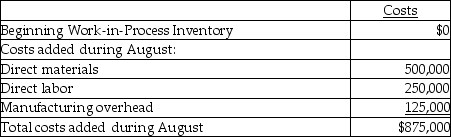 The ending Work-in-Process Inventory is 100% and 95% complete with respect to direct materials and conversion costs respectively. How many metric tons of sugar were refined and transferred to the Packaging Department in August?
 (Multiple Choice)
4.9/5 (73)
(73) The Refining Department of Sweet Sugar Inc. had 80,000 tons of sugar to account for in July. Of the 80,000 tons, 45,000 tons were completed and transferred to the Boiling Department, and the remaining 35,000 tons were 75% complete. The materials required for production are added at the beginning of the process. Conversion costs are added equally throughout the refining process. Calculate the total equivalent units of production for direct materials.
(Multiple Choice)
4.7/5 (72)
(72) The journal entry to record indirect labor costs incurred includes a debit to Manufacturing Overhead and credit to Wages Payable.
(True/False)
4.9/5 (65)
(65) A process costing system is generally used by companies that produce homogeneous products.
(True/False)
4.9/5 (73)
(73) On September 30, the Mixing Department of Tea Works had Work-in-Process Inventory that was 25% complete for materials and 20% complete for conversion costs. This means that for the ending inventory, ________ % of materials and ________ % of the conversion costs were added during September.
(Multiple Choice)
4.7/5 (79)
(79) In a production cost report, the number of units to account for must always be greater than the number of units accounted for.
(True/False)
4.8/5 (79)
(79) In a production cost report, ________ includes the number of units completed and transferred out of a process and the number of units remaining in ending work-in-process.
(Multiple Choice)
5.0/5 (76)
(76) Organic Sugar Company at Ohio has six processing departments for refining sugar: Affination, Carbonatation, Decolorization, Boiling, Recovery, and Packaging. Conversion costs are added evenly throughout each process. Data from the month of August for the Decolorization Department are as follows: 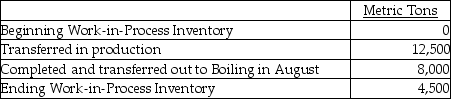
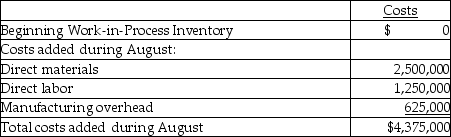 The ending Work-in-Process Inventory is 100% and 65% complete with respect to direct materials and conversion costs, respectively. Compute the equivalent units of production (EUP)for direct materials and for conversion costs for the month of August.
 (Multiple Choice)
4.9/5 (79)
(79) Under the first-in, first-out (FIFO)method, the cost of equivalent units of production are calculated by:
(Multiple Choice)
4.9/5 (79)
(79) Bubbly Inc. produces and sells candies. Bubbly purchases raw materials, stores them in warehouse, and then runs them through two processes: production and packaging. During September, the production process incurred the following costs in processing 20,000 candies:  Use the FIFO method to compute the September conversion costs in the Production Department.
 (Multiple Choice)
4.9/5 (80)
(80) 
Filters
- Essay(0)
- Multiple Choice(0)
- Short Answer(0)
- True False(0)
- Matching(0)