



 Chat with AI
Exam 9: Receivables

Exam 1: Accounting and the Business Environment143 Questions
Exam 2: Recording Business Transactions156 Questions
Exam 3: The Adjusting Process152 Questions
Exam 4: Completing the Accounting Cycle156 Questions
Exam 5: Merchandising Operations160 Questions
Exam 6: Merchandise Inventory155 Questions
Exam 7: Accounting Information Systems137 Questions
Exam 8: Internal Control and Cash160 Questions
Exam 9: Receivables138 Questions
Exam 10: Plant Assets, Natural Resources, and Intangibles151 Questions
Exam 11: Current Liabilities and Payroll162 Questions
Exam 12: Partnerships161 Questions
Exam 13: Corporations158 Questions
Exam 14: Long-Term Liabilities151 Questions
Exam 15: Investments135 Questions
Exam 16: The Statement of Cash Flows154 Questions
Exam 17: Financial Statement Analysis112 Questions
Exam 18: Introduction to Managerial Accounting179 Questions
Exam 19: Job Order Costing152 Questions
Exam 20: Process Costing144 Questions
Exam 21: Cost-Volume-Profit Analysis172 Questions
Exam 22: Master Budgets114 Questions
Exam 23: Flexible Budgets and Standard Cost Systems173 Questions
Exam 24: Cost Allocation and Responsibility Accounting129 Questions
Exam 25: Short-Term Business Decisions161 Questions
Exam 26: Capital Investment Decisions122 Questions
Select questions type


On April 1, 2015, Banne Services has received a 6-month note for $10,000 at 8%. Calculate the amount of interest receivable on maturity.
(Multiple Choice)
5.0/5  (82)
(82) On December 1, 2015, Parsons Inc. sold machinery to a customer for $20,000. The customer could not pay at the time of sale, but agreed to pay 9 months later, and signed a 9-month note at 9% interest. What was the total amount of cash collected by Parsons on the maturity of the note?
(Multiple Choice)
4.8/5 (84)
(84) On October 1, 2015, Android Inc. made a loan to one of its customers. The customer signed a 4-month note for $100,000 at 15%. How much interest revenue did the company record in the year 2016 for this note?
(Multiple Choice)
4.9/5 (86)
(86) Smart Art is a new establishment. During the first year, there were credit sales of $40,000 and collections of credit sales of $36,000. One account for $650 was written off. The company decided to use the percent-of-sales method to account for bad debts expense, and decided to use a factor of 2% for their year-end adjustment of bad debts expense. At the end of the year, the balance of bad debts expense would be:
(Multiple Choice)
4.9/5 (80)
(80) Martin Sales provides the following information: Net credit sales: $750,000
Beginning net accounts receivable: $40,000
Ending net accounts receivable: $20,000
Calculate the accounts receivable turnover ratio. (Round to the nearest whole number.)
(Multiple Choice)
4.8/5 (73)
(73) What is the maturity value of a 3-month, 10% note for $40,000?
(Multiple Choice)
4.7/5 (76)
(76) Which of the following are the two methods of accounting for uncollectible receivables?
(Multiple Choice)
4.7/5 (76)
(76) Sales through credit cards and debit cards are journalized in the same way as credit sales are journalized.
(True/False)
4.8/5 (79)
(79) A receivable can be described as a monetary claim against a business or an individual.
(True/False)
4.8/5 (90)
(90) Which of the following is an example of exercise of internal control over receivables?
(Multiple Choice)
4.8/5 (75)
(75) At the beginning of 2015, Peter Dots has the following ledger balances:  During the year, credit sales amounted to $800,000. Cash collected on credit sales amounted to $760,000 and $18,000 has been written off. At the end of the year, company adjusted for bad debts expense using the aging method. The amount estimated as uncollectible was $25,000. The ending balance in Bad Debts Expense would be:
 (Multiple Choice)
4.9/5 (74)
(74) In order to exercise effective internal control over receivables the credit department must have access cash.
(True/False)
4.7/5 (80)
(80) At the beginning of 2015, Peter Dots has the following ledger balances:  During the year, credit sales amounted to $800,000. Cash collected on credit sales amounted to $760,000 and $18,000 has been written off. At the end of the year, company adjusted for bad debts expense using the aging method. The amount estimated as uncollectible was $25,000. The ending balance in the Allowance for Bad Debts would be:
 (Multiple Choice)
4.9/5 (82)
(82) Days' sales in receivables is also known as the collection period.
(True/False)
4.8/5 (93)
(93) The amount of Accounts Receivable is generally reported at its gross amount on the balance sheet.
(True/False)
4.8/5 (79)
(79) The following information is from the 2015 records of Armand Camera Shop: 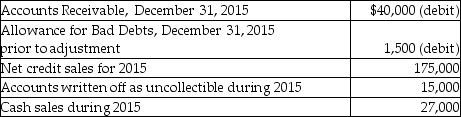 Bad debts expense is estimated by the aging-of-receivables method. Management estimates that $5,000 of accounts receivable will be uncollectible. Calculate the amount of bad debts expense for 2015.
 (Multiple Choice)
4.8/5 (84)
(84) Which of the following is included in the category of other receivables?
(Multiple Choice)
4.9/5 (72)
(72) 
Filters
- Essay(0)
- Multiple Choice(0)
- Short Answer(0)
- True False(0)
- Matching(0)