



 Chat with AI
Exam 4: Completing the Accounting Cycle

Exam 1: Accounting and the Business Environment143 Questions
Exam 2: Recording Business Transactions156 Questions
Exam 3: The Adjusting Process152 Questions
Exam 4: Completing the Accounting Cycle156 Questions
Exam 5: Merchandising Operations160 Questions
Exam 6: Merchandise Inventory155 Questions
Exam 7: Accounting Information Systems137 Questions
Exam 8: Internal Control and Cash160 Questions
Exam 9: Receivables138 Questions
Exam 10: Plant Assets, Natural Resources, and Intangibles151 Questions
Exam 11: Current Liabilities and Payroll162 Questions
Exam 12: Partnerships161 Questions
Exam 13: Corporations158 Questions
Exam 14: Long-Term Liabilities151 Questions
Exam 15: Investments135 Questions
Exam 16: The Statement of Cash Flows154 Questions
Exam 17: Financial Statement Analysis112 Questions
Exam 18: Introduction to Managerial Accounting179 Questions
Exam 19: Job Order Costing152 Questions
Exam 20: Process Costing144 Questions
Exam 21: Cost-Volume-Profit Analysis172 Questions
Exam 22: Master Budgets114 Questions
Exam 23: Flexible Budgets and Standard Cost Systems173 Questions
Exam 24: Cost Allocation and Responsibility Accounting129 Questions
Exam 25: Short-Term Business Decisions161 Questions
Exam 26: Capital Investment Decisions122 Questions
Select questions type


Permanent accounts are not closed at the end of the accounting period.
(True/False)
4.8/5  (85)
(85) The beginning balance in the Capital account of a company was $10,000. The revenues and expenses were $200,000 and $120,000, respectively. The owner withdrew $4,000 during the year. The ending balance in the Capital was $90,000.
(True/False)
4.8/5 (71)
(71) Which of the following accounts would appear in the income statement credit column?
(Multiple Choice)
4.8/5 (87)
(87) Which of the following is an example of an intangible asset?
(Multiple Choice)
5.0/5 (78)
(78) Under which of the following categories would Accounts Payable appear?
(Multiple Choice)
4.9/5 (72)
(72) In an accounting cycle, an analysis of transactions is performed at the end of each accounting period.
(True/False)
4.8/5 (67)
(67) Which of the following accounts will be closed by debiting the Income Summary account?
(Multiple Choice)
4.8/5 (90)
(90) Asset and liability accounts are closed to the Income Summary account.
(True/False)
4.8/5 (79)
(79) The Net Income of Sarah for the year is $25,000. The withdrawals Sarah made during the year amounted to $30,000. Which of the following statements is true of effect of these transactions on Sarah, Capital?
(Multiple Choice)
4.7/5 (71)
(71) Salaries Payable, Interest Payable, and Unearned Revenue are examples of:
(Multiple Choice)
4.8/5 (87)
(87) The current ratio is calculated using the values from the income statement.
(True/False)
4.9/5 (82)
(82) Calculate the current ratio using the following information: 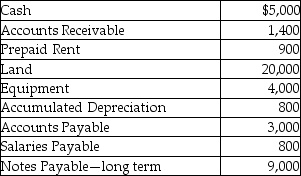
(Multiple Choice)
4.9/5 (83)
(83) Which of the following entries will be necessary to close the Insurance Expense account at the end of the year?
(Multiple Choice)
4.9/5 (90)
(90) Net income is entered as the balancing amount on the debit side of the income statement columns and the credit side of the balance sheet columns of the worksheet.
(True/False)
4.8/5 (80)
(80) The beginning balance in the Capital account of a company was $10,000. The revenues and expenses were $200,000 and $120,000, respectively. The owner withdrew $4,000 during the year. The ending balance in the Capital account was $86,000.
(True/False)
4.9/5 (75)
(75) In an accounting cycle, which of the following steps takes place only at the end of the accounting period?
(Multiple Choice)
4.8/5 (85)
(85) In which of the columns of the worksheet would Net Income be found?
(Multiple Choice)
4.8/5 (78)
(78) 
Filters
- Essay(0)
- Multiple Choice(0)
- Short Answer(0)
- True False(0)
- Matching(0)