



 Chat with AI
Exam 10: Risk and Return in Capital Markets

Exam 1: Corporate Finance and the Financial Manager93 Questions
Exam 2: Introduction to Financial Statement Analysis122 Questions
Exam 3: The Valuation Principle: the Foundation of Financial Decision Making120 Questions
Exam 4: The Time Value of Money101 Questions
Exam 5: Interest Rates118 Questions
Exam 6: Bonds122 Questions
Exam 7: Valuing Stocks122 Questions
Exam 8: Investment Decision Rules136 Questions
Exam 9: Fundamentals of Capital Budgeting108 Questions
Exam 10: Risk and Return in Capital Markets101 Questions
Exam 11: Systematic Risk and the Equity Risk Premium102 Questions
Exam 12: Determining the Cost of Capital107 Questions
Exam 13: Risk and the Pricing of Options112 Questions
Exam 14: Raising Equity Capital106 Questions
Exam 15: Debt Financing112 Questions
Exam 16: Capital Structure114 Questions
Exam 17: Payout Policy101 Questions
Exam 18: Financial Modelling and Pro Forma Analysis124 Questions
Exam 19: Working Capital Management122 Questions
Exam 20: Short-Term Financial Planning105 Questions
Exam 21: Risk Management111 Questions
Exam 22: International Corporate Finance113 Questions
Exam 23: Leasing88 Questions
Exam 24: Mergers and Acquisitions80 Questions
Exam 25: Corporate Governance53 Questions
Select questions type


Suppose you invested $45 in TD Bank one month ago.It paid a dividend of $0.60,and you sold it right after the dividend was paid for $44.90.What was your dividend yield and capital gains yield on the investment?
(Multiple Choice)
4.9/5  (79)
(79) Rational investors may be willing to choose an investment that has additional risk but does not offer additional reward.
(True/False)
4.7/5 (75)
(75) The geometric average annual return for a large capitalization stock portfolio is 12% for ten years and 5% per year for the next five years.The geometric average annual return for the entire 15-year period is:
(Multiple Choice)
4.7/5 (70)
(70) Stocks have both diversifiable risk and undiversifiable risk,but only diversifiable risk is rewarded with higher expected returns.
(True/False)
4.7/5 (74)
(74) Use the table for the question(s)below.
Consider the following average annual returns:
 -What is the risk premium for corporate bonds?
 (Multiple Choice)
4.8/5 (87)
(87) You purchased Enron stock at a price of $30 per share.Its price was $20 after six months and the company declared bankruptcy at the end of the next six months.The realized return over the last year is:
(Multiple Choice)
4.9/5 (81)
(81) When looking at investment portfolios historically,was there a pattern between returns and volatility?
(Essay)
4.9/5 (69)
(69) Explain why investors do not receive a risk premium for exposure to unsystematic risk.
(Essay)
4.7/5 (71)
(71) The S&P TSX Composite index delivered annual returns of 10.55%,-8.32%,21.08% and 9.10% from 2014 to 2017.What is the standard deviation of the index returns over these four years?
(Multiple Choice)
4.9/5 (82)
(82) The S&P TSX Composite index delivered annual returns of 10.55%,-8.32%,21.08% and 9.10% from 2014 to 2017.What was the average compound annual return per year?
(Multiple Choice)
4.8/5 (93)
(93) Use the table for the question(s)below.
Consider the following average annual returns:
-What is the risk premium for the portfolio of small stocks?
-What is the risk premium for the portfolio of small stocks? (Multiple Choice)
4.8/5 (83)
(83) Use the table for the question(s)below.
Consider the following realized annual returns:
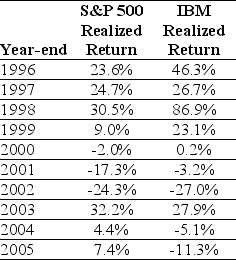 -The average annual return over the period 1926-2009 for small stocks is 22.1%,and the standard deviation of returns is 22.1%.Based on these numbers,what is a 95% confidence interval for 2010 returns?
 (Multiple Choice)
4.9/5 (63)
(63) Use the table for the question(s)below.
Consider the following realized annual returns:
-The average annual return over the period 1926-2009 for the S&P 500 is 11.7%,and the standard deviation of returns is 20.5%.Based on these numbers,what is a 67% confidence interval for 2010 returns?
-The average annual return over the period 1926-2009 for the S&P 500 is 11.7%,and the standard deviation of returns is 20.5%.Based on these numbers,what is a 67% confidence interval for 2010 returns? (Multiple Choice)
4.9/5 (87)
(87) Use the table for the question(s)below.
Consider the following price and dividend data for Ford Motor Company:
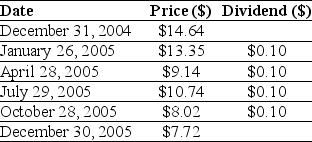 -Assume that you purchased Ford Motor Company stock at the closing price on December 31,2004 and sold it after the dividend had been paid at the closing price on January 26,2005.Your dividend yield for this period is closest to:
 (Multiple Choice)
4.8/5 (81)
(81) Treasury bill returns are 5%,4%,3%,and 6% over four years.The standard deviation of returns of Treasury bills is:
(Multiple Choice)
4.9/5 (80)
(80) The probability mass between two standard deviations around the mean for a normal distribution is:
(Multiple Choice)
4.9/5 (64)
(64) Independent risks can be diversified by holding a large number of uncorrelated assets with independent risks.
(True/False)
4.9/5 (83)
(83) 
Filters
- Essay(0)
- Multiple Choice(0)
- Short Answer(0)
- True False(0)
- Matching(0)