



 Chat with AI
Exam 14: Raising Equity Capital

Exam 1: Corporate Finance and the Financial Manager93 Questions
Exam 2: Introduction to Financial Statement Analysis122 Questions
Exam 3: The Valuation Principle: the Foundation of Financial Decision Making120 Questions
Exam 4: The Time Value of Money101 Questions
Exam 5: Interest Rates118 Questions
Exam 6: Bonds122 Questions
Exam 7: Valuing Stocks122 Questions
Exam 8: Investment Decision Rules136 Questions
Exam 9: Fundamentals of Capital Budgeting108 Questions
Exam 10: Risk and Return in Capital Markets101 Questions
Exam 11: Systematic Risk and the Equity Risk Premium102 Questions
Exam 12: Determining the Cost of Capital107 Questions
Exam 13: Risk and the Pricing of Options112 Questions
Exam 14: Raising Equity Capital106 Questions
Exam 15: Debt Financing112 Questions
Exam 16: Capital Structure114 Questions
Exam 17: Payout Policy101 Questions
Exam 18: Financial Modelling and Pro Forma Analysis124 Questions
Exam 19: Working Capital Management122 Questions
Exam 20: Short-Term Financial Planning105 Questions
Exam 21: Risk Management111 Questions
Exam 22: International Corporate Finance113 Questions
Exam 23: Leasing88 Questions
Exam 24: Mergers and Acquisitions80 Questions
Exam 25: Corporate Governance53 Questions
Select questions type


Which of the following is a reason why an investor would choose to invest in new and growing firms as a limited partner in a venture capital firm rather than making those investments directly by themselves?
(Multiple Choice)
4.9/5  (88)
(88) The main advantages for a firm in going public are greater liquidity,better access to capital,and greater ability of investors to monitor the management of the firm.
(True/False)
4.9/5 (76)
(76) Waterloo Waste Management sells 5 million shares of stock in an SEO,with 3 million being primary shares issued by the company and 2 million being secondary shares sold by investors in the company.At the time of the sale,the firm's stock was selling at $12.50 per share.If the underwriter charges 7% of the gross proceeds as a fee,how much money was raised in the sale?
(Multiple Choice)
4.9/5 (71)
(71) The founder of a company currently holds 12 million of the 15 million shares in that company.She considers an IPO where she sells a mix of primary shares and 2 million of her own secondary shares for $18 per share.If she wants to retain a 60% ownership of the company,how much money can she raise in this IPO?
(Multiple Choice)
4.9/5 (74)
(74) Melissa founded her company using $100,000 of her own money,issuing herself 50,000 shares of stock.An angel investor bought an additional 30,000 shares for $75,000.She now sells another 30,000 shares to a venture capitalist for $450,000.What is the post-money valuation for the company?
(Multiple Choice)
4.8/5 (74)
(74) Which of the following statements regarding best efforts IPOs is most accurate?
(Multiple Choice)
4.8/5 (84)
(84) Which of the following best describes a limited partnership that specializes in raising money to invest in the private equity of young firms?
(Multiple Choice)
4.8/5 (63)
(63) Use the table for the question(s)below.
The founder of a company issues 100,000 shares of series A stock for his own $250,000 investment.He then goes through three further rounds of investment,as shown below:
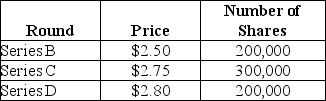 -What is the post-money valuation for the series D funding round?
 (Multiple Choice)
4.7/5 (81)
(81) Use the table for the question(s)below.
David founds a company and goes through the investment rounds shown below:
 He decides to take the company public through an IPO,issuing 2 million new shares.Assuming that he successfully completes the IPO,the net income for the next year is estimated to be $8 million.His banker informs him that the price of shares should be set using average price-earnings ratios for similar businesses,which is 15.0.
-An IPO is offered at $6.75 per share for 2 million shares.The IPO underwriters had a spread of 9%.What was the total fee paid to the underwriters?
He decides to take the company public through an IPO,issuing 2 million new shares.Assuming that he successfully completes the IPO,the net income for the next year is estimated to be $8 million.His banker informs him that the price of shares should be set using average price-earnings ratios for similar businesses,which is 15.0.
-An IPO is offered at $6.75 per share for 2 million shares.The IPO underwriters had a spread of 9%.What was the total fee paid to the underwriters? (Multiple Choice)
4.9/5 (93)
(93) In a best-efforts IPO,the underwriter guarantees that all stock will be sold.
(True/False)
4.8/5 (76)
(76) Use the table for the question(s)below.
David founds a company and goes through the investment rounds shown below:
He decides to take the company public through an IPO,issuing 2 million new shares.Assuming that he successfully completes the IPO,the net income for the next year is estimated to be $8 million.His banker informs him that the price of shares should be set using average price-earnings ratios for similar businesses,which is 15.0.
-What will be the IPO price per share?
He decides to take the company public through an IPO,issuing 2 million new shares.Assuming that he successfully completes the IPO,the net income for the next year is estimated to be $8 million.His banker informs him that the price of shares should be set using average price-earnings ratios for similar businesses,which is 15.0.
-What will be the IPO price per share? (Multiple Choice)
4.9/5 (89)
(89) The Ontario Teachers' Pension Plan is a pension fund for public school teachers in the province of Ontario.It has a large and diverse portfolio of investments,both in Canada and internationally,and had net assets in December 2012 of $108.5 billion.Which of the following best describes the Ontario Teachers' Pension Plan?
(Multiple Choice)
4.8/5 (74)
(74) Which of the following statements regarding venture capitalists is most accurate?
(Multiple Choice)
4.9/5 (84)
(84) Which of the following is an advantage of a cash offer over a rights offer?
(Multiple Choice)
4.9/5 (70)
(70) Chambers Industries has a market capitalization of $800 million and 250 million shares outstanding.The management of this firm plans to raise further capital through a rights issue.Which of the following rights schemes will raise the most money,if all shareholders exercise their rights?
(Multiple Choice)
4.9/5 (78)
(78) Tangible Technologies has a market capitalization of $150 million and 8 million shares outstanding.In order to finance its growth,the firm's management plans to raise further capital through a rights issue.All shareholders will be issued one right per share.For every 4 rights held by a stockholder,they can purchase one share at a price of $15 per share.How much money will this raise,if all shareholders exercise their rights?
(Multiple Choice)
4.9/5 (76)
(76) Use the table for the question(s)below.
David founds a company and goes through the investment rounds shown below:
He decides to take the company public through an IPO,issuing 2 million new shares.Assuming that he successfully completes the IPO,the net income for the next year is estimated to be $8 million.His banker informs him that the price of shares should be set using average price-earnings ratios for similar businesses,which is 15.0.
-What share of the company will David own after the IPO?
He decides to take the company public through an IPO,issuing 2 million new shares.Assuming that he successfully completes the IPO,the net income for the next year is estimated to be $8 million.His banker informs him that the price of shares should be set using average price-earnings ratios for similar businesses,which is 15.0.
-What share of the company will David own after the IPO? (Multiple Choice)
4.7/5 (80)
(80) 
Filters
- Essay(0)
- Multiple Choice(0)
- Short Answer(0)
- True False(0)
- Matching(0)