



 Chat with AI
Exam 6: Bonds

Exam 1: Corporate Finance and the Financial Manager93 Questions
Exam 2: Introduction to Financial Statement Analysis122 Questions
Exam 3: The Valuation Principle: the Foundation of Financial Decision Making120 Questions
Exam 4: The Time Value of Money101 Questions
Exam 5: Interest Rates118 Questions
Exam 6: Bonds122 Questions
Exam 7: Valuing Stocks122 Questions
Exam 8: Investment Decision Rules136 Questions
Exam 9: Fundamentals of Capital Budgeting108 Questions
Exam 10: Risk and Return in Capital Markets101 Questions
Exam 11: Systematic Risk and the Equity Risk Premium102 Questions
Exam 12: Determining the Cost of Capital107 Questions
Exam 13: Risk and the Pricing of Options112 Questions
Exam 14: Raising Equity Capital106 Questions
Exam 15: Debt Financing112 Questions
Exam 16: Capital Structure114 Questions
Exam 17: Payout Policy101 Questions
Exam 18: Financial Modelling and Pro Forma Analysis124 Questions
Exam 19: Working Capital Management122 Questions
Exam 20: Short-Term Financial Planning105 Questions
Exam 21: Risk Management111 Questions
Exam 22: International Corporate Finance113 Questions
Exam 23: Leasing88 Questions
Exam 24: Mergers and Acquisitions80 Questions
Exam 25: Corporate Governance53 Questions
Select questions type


What rating must Luther receive on these bonds if they want the bonds to be issued at par?
(Multiple Choice)
4.9/5  (90)
(90) Which of the following bonds will be most sensitive to a change in interest rates?
(Multiple Choice)
4.9/5 (76)
(76) A bond will trade at a discount if its coupon rate is less than its yield to maturity.
(True/False)
4.8/5 (93)
(93) A company issues a ten-year $1000 bond at par with a coupon rate of 6% paid semi-annually.The YTM at the beginning of the third year of the bond (8 years left to maturity)is 7.8%.What was the percentage change in the price of the bond over the past two years?
(Multiple Choice)
4.8/5 (78)
(78) Use the figure for the question(s)below. 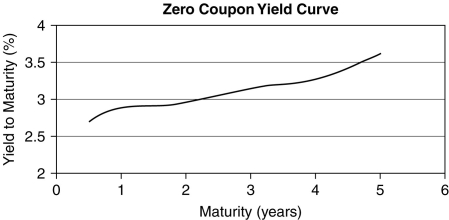 -The current zero-coupon yield curve for risk-free bonds is shown above.What is the price per $100 face value of a four-year,zero-coupon,risk-free bond?
 (Multiple Choice)
4.9/5 (81)
(81) Suppose that when these bonds were issued,Luther received a price of $972.42 for each bond.What is the likely rating that Luther's bonds received?
(Multiple Choice)
5.0/5 (70)
(70) 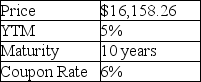 The above table provides information on a coupon bond that has annual coupon payments.What is the face value of this bond?
 (Multiple Choice)
4.9/5 (88)
(88) A bond is said to mature on the date when the issuer repays its notional value.
(True/False)
4.8/5 (80)
(80) What is the coupon rate of a 10-year $4,000 bond with annual coupon payments of $100?
(Multiple Choice)
5.0/5 (82)
(82) How are the cash flows of a coupon bond different from an amortizing loan?
(Essay)
4.8/5 (75)
(75) Under what situation can a zero-coupon bond be selling at par to its face value?
(Essay)
4.8/5 (87)
(87) Which of the following best shows the timeline for cash flows from a five-year bond with a face value of $2,000,a coupon rate of 4.2%,and semi-annual payments?
(Multiple Choice)
4.8/5 (79)
(79) Use the information for the question(s)below.
 -The above table shows the yields to maturity on a number of one-year,zero-coupon securities.What is the credit spread on a one-year,zero-coupon corporate bond with a B rating?
 (Multiple Choice)
4.8/5 (88)
(88) How are investors in zero-coupon bonds compensated for making such an investment?
(Multiple Choice)
4.8/5 (77)
(77) Which of the following best describes a bond rated by Standard and Poor's,Moody's,and DBRS as B?
(Multiple Choice)
4.9/5 (70)
(70) Use the table for the question(s)below.
The following table summarizes prices of various default-free zero-coupon bonds (expressed as a percentage of face value):
 -The yield to maturity for the two-year zero-coupon bond is closest to:
 (Multiple Choice)
5.0/5 (71)
(71) What is the yield to maturity of a ten-year,$1000 bond with a 5.2% coupon rate and semi-annual coupons if this bond is currently trading for a price of $884?
(Multiple Choice)
4.8/5 (81)
(81) 
Filters
- Essay(0)
- Multiple Choice(0)
- Short Answer(0)
- True False(0)
- Matching(0)