



 Chat with AI
Exam 11: Capital Budgeting

Exam 1: Managerial Accounting, the Business Organization129 Questions
Exam 2: Introduction to Cost Behavior and Cost-Volume Relationships152 Questions
Exam 3: Measurement of Cost Behavior141 Questions
Exam 4: Cost Management Systems and Activity-Based Costing129 Questions
Exam 5: Relevant Information for Decision Making With a Focus128 Questions
Exam 6: Relevant Information for Decision Making With a Focus148 Questions
Exam 7: Introduction to Budgets and Preparing the Master Budget144 Questions
Exam 8: Flexible Budgets and Variance Analysis143 Questions
Exam 9: Management Control Systems and Responsibility Accounting147 Questions
Exam 10: Management Control in Decentralized Organizations160 Questions
Exam 11: Capital Budgeting141 Questions
Exam 12: Cost Allocation125 Questions
Exam 13: Accounting for Overhead Costs127 Questions
Exam 14: Job-Order Costing and Process-Costing Systems157 Questions
Exam 15: Basic Accounting: Concepts, techniques, and Conventions154 Questions
Exam 16: Understanding Corporate Annual Reports: Basic Financial Statements149 Questions
Exam 17: Understanding and Analyzing Consolidated Financial Statements122 Questions
Select questions type


Sunrise Company has a tax rate of 40% and a required rate of return of 12%.The company has new equipment that saves $100,000 per year in labor costs.What is the annual after-tax cash flow from the labor cost savings?
(Multiple Choice)
4.8/5  (94)
(94) Discounted-cash-flow models focus on a project's cash inflows and cash outflows without regard to the time value of money.
(True/False)
4.9/5 (66)
(66) If a project has a positive net present value that will become negative with a ________,it can be considered to be a risky project.
(Multiple Choice)
4.9/5 (84)
(84) The internal rate of return model determines the ________ at which the net present value of an investment project equals ________.
(Multiple Choice)
4.8/5 (71)
(71) When comparing projects using the total project approach,a manager should choose the project with the ________.
(Multiple Choice)
5.0/5 (78)
(78) An investment of $270,000 is expected to generate $140,000 in cost savings annually over the asset's three year life.Assume straight-line depreciation is used.Ignore income taxes.What is the payback period?
(Multiple Choice)
4.8/5 (88)
(88) Bryant Company has obtained the following data about a possible planned investment:
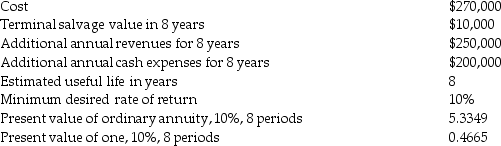 The company uses straight-line depreciation method.Ignore income taxes.
Required:
A)Compute the net present value of the investment.
B)Compute the payback period.
C)Compute the accounting rate of return using the initial required investment.
The company uses straight-line depreciation method.Ignore income taxes.
Required:
A)Compute the net present value of the investment.
B)Compute the payback period.
C)Compute the accounting rate of return using the initial required investment. (Essay)
4.9/5 (74)
(74) Which is NOT a relevant cash inflow or cash outflow when using the net present value method? (Ignore income taxes.)
(Multiple Choice)
5.0/5 (69)
(69) When using the NPV model,it is assumed that the capital markets are perfect.
(True/False)
4.9/5 (76)
(76) An asset with a book value of $200,000 is sold for $160,000.The applicable tax rate is 40%.What is the tax effect of the loss?
(Multiple Choice)
4.9/5 (90)
(90) An investment of $42,000 is expected to generate the following annual cash flows:  Assume straight-line depreciation is used.Ignore income taxes.What is the payback period?
 (Multiple Choice)
5.0/5 (80)
(80) Reasons for the post-audit of an investment project do NOT include ________.
(Multiple Choice)
4.8/5 (79)
(79) If the IRR on a project is greater than the required rate of return,then the net present value of the project is ________.
(Multiple Choice)
4.8/5 (65)
(65) ________ is the decline in the general purchasing power of the monetary unit.
(Multiple Choice)
4.9/5 (74)
(74) When evaluating an investment project,the higher the minimum desired rate of return,the ________ the present value of each ________ cash inflow.
(Multiple Choice)
4.9/5 (77)
(77) The use of accelerated depreciation for tax purposes will generally produce a present value of tax savings that is ________.
(Multiple Choice)
4.9/5 (75)
(75) The more sensitive a project is to changes in cash flows,the riskier it is.
(True/False)
4.9/5 (84)
(84) The ________ approach compares two alternative projects by computing the total cash flows of each alternative and then converting these total cash flows to their present values.
(Multiple Choice)
4.9/5 (72)
(72) The minimum desired rate of return for an investment under the NPV method is based on the cost of capital.
(True/False)
4.8/5 (76)
(76) 
Filters
- Essay(0)
- Multiple Choice(0)
- Short Answer(0)
- True False(0)
- Matching(0)