



 Chat with AI
Exam 2: Financial Reporting Theory

Exam 1: The Financial Reporting Environment63 Questions
Exam 2: Financial Reporting Theory178 Questions
Exam 3: Judgment and Applied Financial Accounting Research127 Questions
Exam 4: Review of the Accounting Cycle154 Questions
Exam 5: Statements of Net Income and Comprehensive Net Income125 Questions
Exam 6: Statements of Financial Position and Cash Flows and the Annual Report158 Questions
Exam 7: Accounting and the Time Value of Money120 Questions
Exam 8: Revenue Recognition159 Questions
Exam 9: OL: Revenue Recognition110 Questions
Exam 10: Short-Term Operating Assets: Cash and Receivables125 Questions
Exam 11: Short-Term Operating Assets: Inventory134 Questions
Exam 12: Long-Term Operating Assets: Acquisition, cost Allocation, and Derecognition156 Questions
Exam 13: Long-Term Operating Assets: Departures From Historical Cost126 Questions
Exam 14: Operating Liabilities and Contingencies95 Questions
Exam 15: OL: Operating Liabilities and Contingencies12 Questions
Exam 16: Financing Liabilities167 Questions
Exam 17: Accounting for Stockholders Equity114 Questions
Exam 18: Investing Assets189 Questions
Exam 19: Accounting for Income Taxes121 Questions
Exam 20: Accounting for Employee Compensation and Benefits106 Questions
Exam 21: Earnings Per Share99 Questions
Exam 22: Accounting Corrections and Error Analysis394 Questions
Select questions type


Identify the element,and whether it is point-in-time or period-of-time.
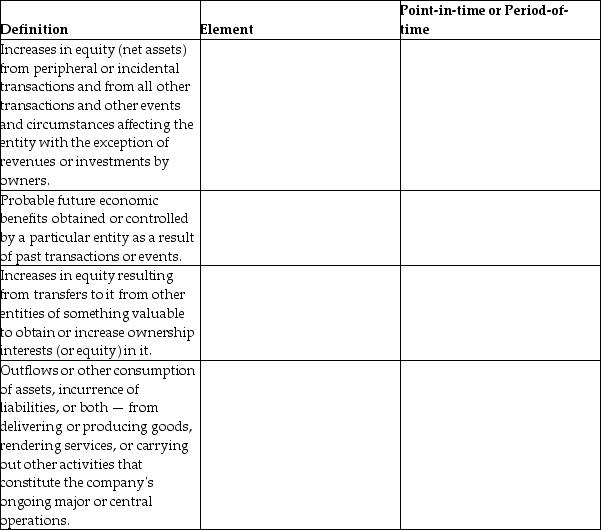
(Essay)
4.7/5  (74)
(74) IFRS includes all of the following bases of measurement except ________.
(Multiple Choice)
4.9/5 (97)
(97) The IASB and FASB share the goal that standards will be based on an agreed set of fundamental ________.
(Multiple Choice)
4.9/5 (84)
(84) Identify the three main approaches to expense recognition under U.S.GAAP - provide examples of each.How does IFRS expense recognition principles differ?
(Essay)
4.9/5 (81)
(81) Poseidon Corp is aware that a large portion of receivables may become uncollectible because the customer is in talks for bankruptcy.By choosing not to disclose this information,the information provided in the statements ________.
(Multiple Choice)
4.8/5 (75)
(75) Unobservable values cannot be used to report fair value in the financial statements.
(True/False)
4.7/5 (75)
(75) The major difference between cash and accrual accounting is the timing of revenue and expense recognition.
(True/False)
4.9/5 (82)
(82) Which of the following is not considered to be a primary user of financial information for which financial reporting standards are designed?
(Multiple Choice)
4.9/5 (81)
(81) The primary distinction between expenses and losses is ________.
(Multiple Choice)
4.8/5 (87)
(87) Changes in equity that result from the company's central business operations are ________.
(Multiple Choice)
4.9/5 (87)
(87) The going concern concept is explicitly stated in the IFRS conceptual framework but not in the U.S.GAAP conceptual framework.
(True/False)
4.9/5 (76)
(76) Dr.Flu uses the cash basis to keep his accounting records.During 2014,he collected $350,000 from clients.At December 31,2013 he had accounts receivable of $100,000.At December 31,2014 he had accounts receivable of $125,000 and unearned revenue of $25,000.What did Dr.Flu earn in service revenue for 2014 using the accrual basis of accounting?
(Multiple Choice)
4.8/5 (72)
(72) A purpose of FASB's conceptual framework is to assist preparers,auditors,and users of financial statements.
(True/False)
4.7/5 (71)
(71) TLR Studio reported earnings per share of $2.11.This surpassed the average analyst forecast of $2.06.This information has ________ to users of financial information.
(Multiple Choice)
4.9/5 (77)
(77) Elements are categorized by whether they are relevant or faithfully representative.
(True/False)
4.9/5 (76)
(76) The ________ justifies the use of depreciation on buildings.
(Multiple Choice)
4.8/5 (87)
(87) The conceptual framework indicates that the primary users of financial information are the investors,lenders,and managers.
(True/False)
4.8/5 (81)
(81) 
Filters
- Essay(0)
- Multiple Choice(0)
- Short Answer(0)
- True False(0)
- Matching(0)