



 Chat with AI
Exam 10: Capital Budgeting Decisions

Exam 1: Management Accounting and Management Decisions90 Questions
Exam 2: Cost Behaviour and Cost-Volume Relationships96 Questions
Exam 3: Measurement of Cost Behaviour97 Questions
Exam 4: Cost Management Systems134 Questions
Exam 5: Cost Allocation and Activity-Based Costing Systems128 Questions
Exam 6: Job-Costing Systems88 Questions
Exam 7: Process-Costing Systems82 Questions
Exam 8: Relevant Information and Decision Making: Marketing Decisions100 Questions
Exam 9: Relevant Information and Decision Making: Production Decisions111 Questions
Exam 10: Capital Budgeting Decisions116 Questions
Exam 11: The Master Budget112 Questions
Exam 12: Flexible Budgets and Variance Analysis106 Questions
Exam 13: Management Control Systems, the Balanced Scorecard, and Responsibility Accounting94 Questions
Exam 14: Management Control in Decentralized Organizations103 Questions
Select questions type


A capital investment project requires an investment of $200,000. It has an expected life of 5 years with annual cash flows of $50,000 received at the end of each year.
a. Compute the payback period for the project.
b. Determine the accounting rate of return for the project based on the initial capital investment.
c. Compute the internal rate of return for the project.
d. Compute the net present value of the project using a 6% discount rate.
(Essay)
4.8/5  (94)
(94) Any capital budgeting model that explicitly considers the time value of money in identifying criteria for accepting or rejecting proposed projects.
(Short Answer)
4.9/5 (81)
(81) The present value of $10,000 to be received 5 years from now and earning an annual return of 8 percent is
(Multiple Choice)
4.8/5 (78)
(78) Which of the following statements about depreciation is TRUE?
(Multiple Choice)
4.8/5 (82)
(82) Below are two potential investment alternatives:
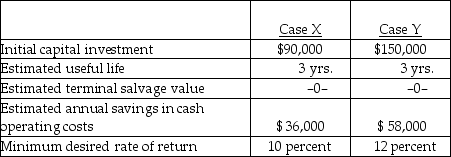
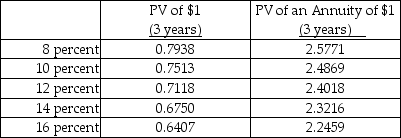 -Assume straight-line amortization in all computations, and ignore income taxes. The net present value in case B is
 (Multiple Choice)
4.8/5 (76)
(76) Below are two potential investment alternatives:
 Assume straight-line amortization in all computations, and ignore income taxes.
-The payback period in case A is
Assume straight-line amortization in all computations, and ignore income taxes.
-The payback period in case A is (Multiple Choice)
4.8/5 (78)
(78) The difference between the present value of a project's cash inflows and the present value of its cash outflows.
(Short Answer)
5.0/5 (75)
(75) A capital investment project requires an investment of $50,000 and has an expected life of four years. Annual cash flows at the end of each year are expected to be as follows:  a. Compute the payback period assuming that the cash flows occur evenly throughout the year.
b. Determine the accounting rate of return for the project based on the initial investment.
c. Compute the net present value of the project using a 10% discount rate. (Round amounts to dollars.)
a. Compute the payback period assuming that the cash flows occur evenly throughout the year.
b. Determine the accounting rate of return for the project based on the initial investment.
c. Compute the net present value of the project using a 10% discount rate. (Round amounts to dollars.) (Essay)
4.8/5 (91)
(91) Which of the following statements about depreciation is TRUE?
(Multiple Choice)
5.0/5 (64)
(64)  -What is (c)?
The annual income statement of ZAP Inc. shows the following items:  Required:
Compute the following amounts (ignore present value considerations):
a. Net after-tax accounting income
b. Total net after-tax cash inflow from operations
Required:
Compute the following amounts (ignore present value considerations):
a. Net after-tax accounting income
b. Total net after-tax cash inflow from operations (Essay)
4.8/5 (82)
(82) Which of the following methods determines the interest rate which equates the present value of the future cash flows with the investment outlay?
(Multiple Choice)
4.9/5 (71)
(71) Below are two potential investment alternatives:
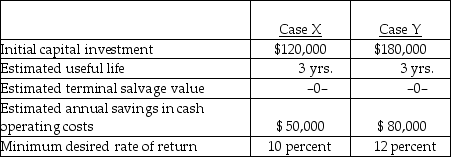
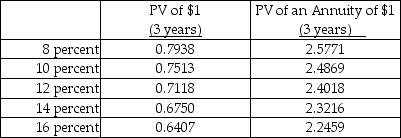 -Assume straight-line amortization in all computations, and ignore income taxes. The internal rate of return in case Y is approximately
 (Multiple Choice)
4.9/5 (72)
(72) Below are two potential investment alternatives:
Assume straight-line amortization in all computations, and ignore income taxes.
-The marginal tax rate is
Assume straight-line amortization in all computations, and ignore income taxes.
-The marginal tax rate is (Multiple Choice)
4.8/5 (97)
(97) Use the following information regarding a production asset to answer the next question(s).
 -The tax savings from the capital cost allowance in the second year would be
 (Multiple Choice)
4.9/5 (90)
(90) Projects that, if accepted, preclude the acceptance of competing projects.
(Short Answer)
4.8/5 (72)
(72) Which of the following is NOT usually considered when a company establishes its minimum desired rate of return?
(Multiple Choice)
4.8/5 (67)
(67) 
Filters
- Essay(0)
- Multiple Choice(0)
- Short Answer(0)
- True False(0)
- Matching(0)