



 Chat with AI
Exam 15: Distributions to Shareholders-Dividends and Repurchases

Exam 1: An Overview of Financial Management and the Financial Environment41 Questions
Exam 2: Risk and Return-Part I147 Questions
Exam 3: Risk and Return-Part II35 Questions
Exam 4: Bond Valuation101 Questions
Exam 5: Financial Options28 Questions
Exam 6: Accounting for Financial Management77 Questions
Exam 7: Analysis of Financial Statements104 Questions
Exam 8: Basic Stock Valuation91 Questions
Exam 9: Corporate Valuation and Financial Planning46 Questions
Exam 10: Corporate Governance51 Questions
Exam 11: Determining the Cost of Capital92 Questions
Exam 12: Capital Budgeting: Decision Criteria108 Questions
Exam 13: Capital Budgeting-Estimating Cash Flows and Analyzing Risk78 Questions
Exam 14: Real Options19 Questions
Exam 15: Distributions to Shareholders-Dividends and Repurchases58 Questions
Exam 16: Capital Structure Decisions87 Questions
Exam 17: Dynamic Capital Structures and Corporate Valuation50 Questions
Exam 18: Initial Public Offerings-Investment Banking: and Financial Restructuring13 Questions
Exam 19: Lease Financing23 Questions
Exam 20: Hybrid Financing Preferred Stock-Warrants and Convertibles30 Questions
Exam 21: Supply Chains and Working Capital Management131 Questions
Exam 22: Providing and Obtaining Credit38 Questions
Exam 23: Other Topics in Working Capital Management29 Questions
Exam 24: Enterprise Risk Management14 Questions
Exam 25: Bankruptcy-Reorganization and Liquidation12 Questions
Exam 26: Mergers and Corporate Control42 Questions
Exam 27: Multinational Financial Management49 Questions
Exam 28: Time Value of Money168 Questions
Exam 29: Basic Financial Tools: A review249 Questions
Exam 30: Pension Plan Management10 Questions
Exam 31: Financial Management in Not for Profit Businesses10 Questions
Select questions type


Consider two very different firms, M and N. Firm M is a mature firm in a mature industry. Its annual net income and net cash flows are both consistently high and stable. However, M's growth prospects are quite limited, so its capital budget is small relative to its net income. Firm N is a relatively new firm in a new and growing industry. Its markets and products have not stabilized, so its annual operating income fluctuates considerably. However, N has substantial growth opportunities, and its capital budget is expected to be large relative to its net income for the foreseeable future. Which of the following statements is correct?
(Multiple Choice)
4.8/5  (67)
(67) Reynolds Paper Products Corporation follows a strict residual dividend policy. All else equal, which of the following factors would be most likely to lead to an increase in the firm's dividend per share?
(Multiple Choice)
5.0/5 (82)
(82) Poff Industries' stock currently sells for $120 a share. You own 100 shares of the stock. The company is contemplating a 2-for-1 stock split. Which of the following best describes what your position will be after such a split takes place?
(Multiple Choice)
4.9/5 (74)
(74) Which of the following statements about dividend policies is correct?
(Multiple Choice)
4.8/5 (90)
(90) Last week, Weschler Paint Corp. completed a 3-for-1 stock split. Immediately prior to the split, its stock sold for $150 per share. The firm's total market value was unchanged by the split. Other things held constant, what is the best estimate of the stock's post-split price?
(Multiple Choice)
4.7/5 (86)
(86) One implication of the bird-in-the-hand theory of dividends is that a given reduction in dividend yield must be offset by a more than proportionate increase in growth in order to keep a firm's required return constant, other things held constant.
(True/False)
5.0/5 (81)
(81) Harvey's Industrial Plumbing Supply's target capital structure consists of 40% debt and 60% equity. Its capital budget this year is forecast to be $650,000. It also wants to pay a dividend of $225,000. If the company follows the residual dividend policy, how much net income must it earn to meet its capital requirements, pay the dividend, and keep the capital structure in balance?
(Multiple Choice)
4.9/5 (75)
(75) Grandin Inc. is evaluating its dividend policy. It has a capital budget of $625,000, and it wants to maintain a target capital structure of 60% debt and 40% equity. The company forecasts a net income of $475,000. If it follows the residual dividend policy, what is its forecasted dividend payout ratio?
(Multiple Choice)
4.8/5 (78)
(78) Underlying the dividend irrelevance theory proposed by Miller and Modigliani is their argument that the value of the firm is determined only by its basic earning power and its business risk.
(True/False)
5.0/5 (91)
(91) The capital budget of Creative Ventures Inc. is $1,000,000. The company wants to maintain a target capital structure that is 30% debt and 70% equity. The company forecasts that its net income this year will be $800,000. If the company follows a residual dividend policy, what will be its total dividend payment?
(Multiple Choice)
4.8/5 (87)
(87) If the signaling, hypothesis (which is also called the information content hypothesis) is correct, then changes in dividend policy can have an important effect on the firm's value and capital costs.
(True/False)
4.9/5 (77)
(77) Downie Foods recently completed a 4-for-1 stock split. Prior to the split, its stock sold for $120 per share. If the firm's total market value increased by 5% as a result of increased liquidity caused by the split, what was the stock price following the split?
(Multiple Choice)
4.9/5 (81)
(81) If a firm adopts a residual distribution policy, distributions are determined as a residual after funding the capital budget. Therefore, the better the firm's investment opportunities, the lower its payout ratio should be.
(True/False)
4.8/5 (80)
(80) Getler Inc.'s projected capital budget is $2,000,000, its target capital structure is 40% debt and 60% equity, and its forecasted net income is $1,000,000. If the company follows a residual dividend policy, how much dividends will it pay or, alternatively, how much new stock must it issue?
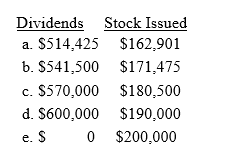
(Short Answer)
4.8/5 (66)
(66) 
Filters
- Essay(0)
- Multiple Choice(0)
- Short Answer(0)
- True False(0)
- Matching(0)