



 Chat with AI
Exam 23: The Respiratory System

Exam 1: An Introduction to the Human Body74 Questions
Exam 2: The Chemical Level of Organization75 Questions
Exam 3: The Cellular Level of Organization76 Questions
Exam 4: The Tissue Level of Organization75 Questions
Exam 5: The Integumentary System Unit Ii: Principles of Support and Movement74 Questions
Exam 6: The Skeletal System: Bone Tissue75 Questions
Exam 7: The Skeletal System: the Axial Skeleton75 Questions
Exam 8: The Skeletal System: the Appendicular Skeleton75 Questions
Exam 9: Joints75 Questions
Exam 10: Muscle Tissue75 Questions
Exam 11: The Muscular System Unit Iii: Control Systems of the Human Body75 Questions
Exam 12: Nervous Tissue75 Questions
Exam 13: The Spinal Cord and Spinal Nerves75 Questions
Exam 14: The Brain and Cranial Nerves75 Questions
Exam 15: The Autonomic Nervous System75 Questions
Exam 16: Sensory, Motor and Integrative Systems75 Questions
Exam 17: The Special Senses75 Questions
Exam 18: The Endocrine System Unit Iv: Maintenance of the Human Body75 Questions
Exam 19: The Cardiovascular System: the Blood74 Questions
Exam 20: The Cardiovascular System: the Heart74 Questions
Exam 21: The Cardiovascular System: Blood Vessels and Hemodynamics75 Questions
Exam 22: The Lymphatic System, Nonspecific Resistance to Disease, and Immunity75 Questions
Exam 23: The Respiratory System75 Questions
Exam 24: The Digestive System75 Questions
Exam 25: Metabolism73 Questions
Exam 26: The Urinary System73 Questions
Exam 27: Fluid, Electrolyte, and Acid-Base Homeostasis Unit V: Continuity48 Questions
Exam 28: The Reproductive Systems74 Questions
Exam 29: Development and Inheritance75 Questions
Select questions type


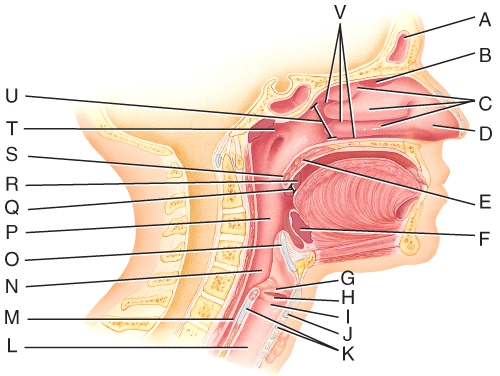
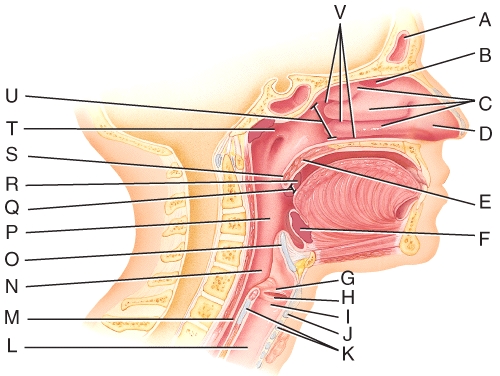
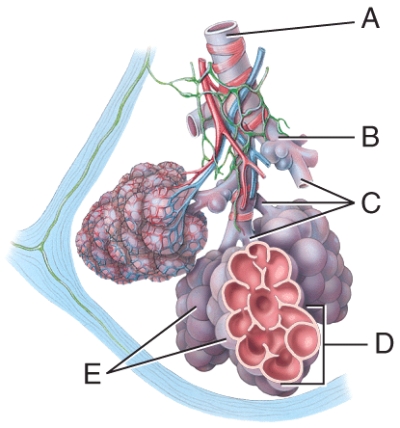

Which of the following is a forced exhalation against the closed rima glottidis as may occur during periods of straining while defecating?
(Multiple Choice)
4.8/5  (78)
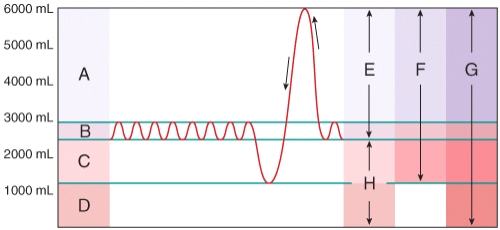
(78) What area in the figure represents a very deep inhalation,much greater than the tidal volume?
(Multiple Choice)
4.9/5 (94)
(94) Which of the following is a long drawn and deep inhalation immediately followed by a shorter but forceful exhalation?
(Multiple Choice)
4.7/5 (80)
(80) 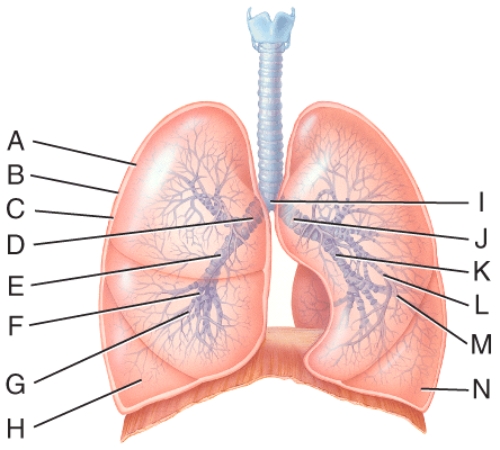
Which of the below tissues provides the functions of the inner layer of the conducting organs?
(Multiple Choice)
4.8/5 (90)
(90) Which of the following is a spasmodic contraction of the diaphragm followed by spasmodic closure of the rima glottidis,which produces a sharp sound on inhalation?
(Multiple Choice)
4.7/5 (86)
(86) Describe the inward forces of elastic recoil,and explain why the lungs do not normally collapse during expiration.
(Essay)
4.9/5 (71)
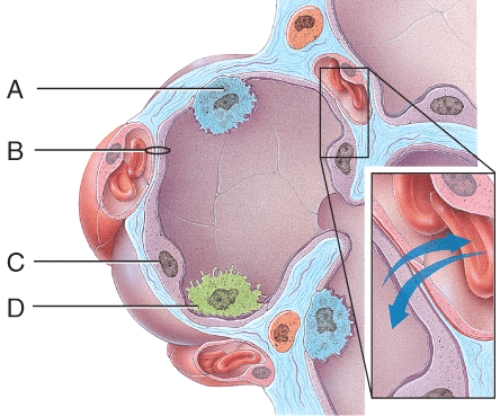
(71) Which of the following indicates the direction of diffusion of gases at the alveoli of the lungs?
(Multiple Choice)
4.8/5 (67)
(67) What area in the figure represents the volume of a normal breath?
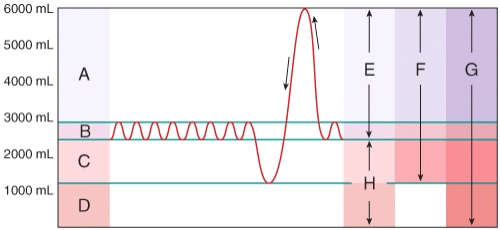
(Multiple Choice)
4.9/5 (67)
(67) 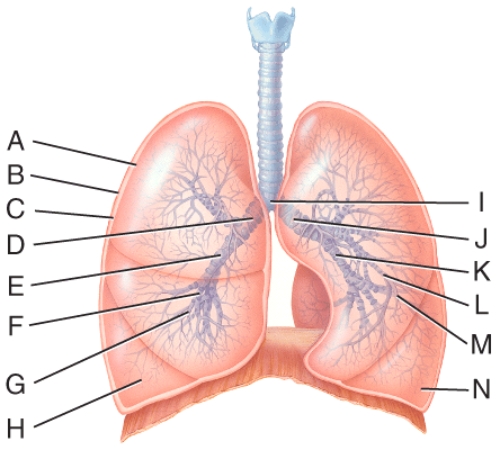
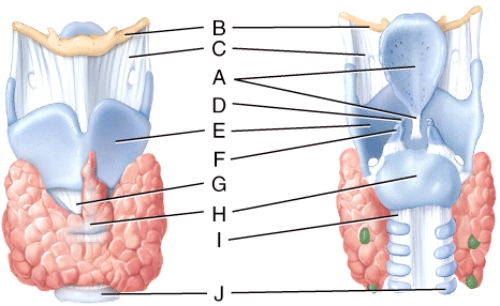
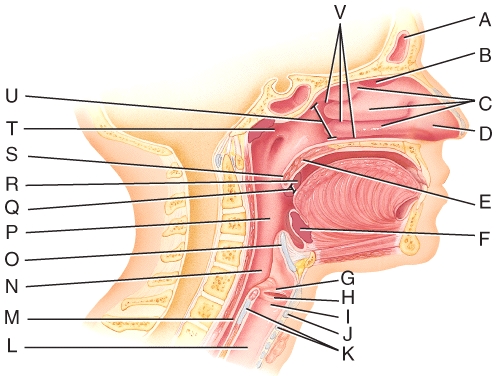
Describe the neural,chemical,and physical changes that increase the rate and depth of ventilation during exercise.
(Essay)
4.7/5 (79)
(79) 
Which of the following is NOT a factor that the rate of pulmonary and systemic gas exchange depends on?
(Multiple Choice)
5.0/5 (88)
(88) 
Filters
- Essay(0)
- Multiple Choice(0)
- Short Answer(0)
- True False(0)
- Matching(0)