



 Chat with AI
Exam 21: The Cardiovascular System: Blood Vessels and Hemodynamics

Exam 1: An Introduction to the Human Body74 Questions
Exam 2: The Chemical Level of Organization75 Questions
Exam 3: The Cellular Level of Organization76 Questions
Exam 4: The Tissue Level of Organization75 Questions
Exam 5: The Integumentary System Unit Ii: Principles of Support and Movement74 Questions
Exam 6: The Skeletal System: Bone Tissue75 Questions
Exam 7: The Skeletal System: the Axial Skeleton75 Questions
Exam 8: The Skeletal System: the Appendicular Skeleton75 Questions
Exam 9: Joints75 Questions
Exam 10: Muscle Tissue75 Questions
Exam 11: The Muscular System Unit Iii: Control Systems of the Human Body75 Questions
Exam 12: Nervous Tissue75 Questions
Exam 13: The Spinal Cord and Spinal Nerves75 Questions
Exam 14: The Brain and Cranial Nerves75 Questions
Exam 15: The Autonomic Nervous System75 Questions
Exam 16: Sensory, Motor and Integrative Systems75 Questions
Exam 17: The Special Senses75 Questions
Exam 18: The Endocrine System Unit Iv: Maintenance of the Human Body75 Questions
Exam 19: The Cardiovascular System: the Blood74 Questions
Exam 20: The Cardiovascular System: the Heart74 Questions
Exam 21: The Cardiovascular System: Blood Vessels and Hemodynamics75 Questions
Exam 22: The Lymphatic System, Nonspecific Resistance to Disease, and Immunity75 Questions
Exam 23: The Respiratory System75 Questions
Exam 24: The Digestive System75 Questions
Exam 25: Metabolism73 Questions
Exam 26: The Urinary System73 Questions
Exam 27: Fluid, Electrolyte, and Acid-Base Homeostasis Unit V: Continuity48 Questions
Exam 28: The Reproductive Systems74 Questions
Exam 29: Development and Inheritance75 Questions
Select questions type


In fetal circulation,what is the opening between the right and left atria called?
(Multiple Choice)
4.9/5  (64)
(64) Which of the following types of blood vessels have high pulsing blood pressure?
(Multiple Choice)
4.7/5 (71)
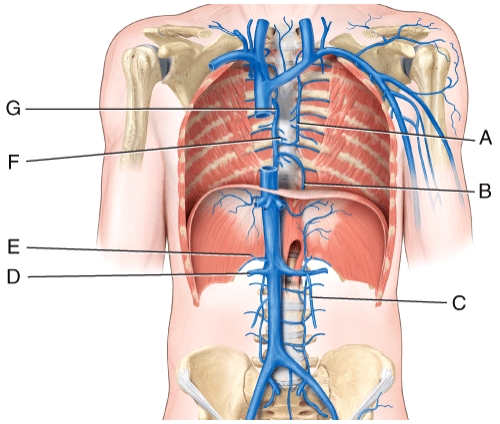
(71) 
When chemoreceptors in blood vessels detect high levels of carbon dioxide in the blood,they stimulate all of the following changes EXCEPT
(Multiple Choice)
4.8/5 (75)
(75) The alternate route of blood flow to a body part through an anastomosis is called
(Multiple Choice)
4.8/5 (81)
(81) All of the following changes are commonly observed in the cardiovascular system in response to aging EXCEPT
(Multiple Choice)
4.9/5 (84)
(84) Which of the following blood vessels carries blood from the tissues back to the heart?
(Multiple Choice)
4.9/5 (78)
(78) Which of the following vessels is a pulse point found at the wrist?
(Multiple Choice)
4.9/5 (81)
(81) Which type of blood vessel plays a key role in regulating blood flow into capillaries?
(Multiple Choice)
4.8/5 (77)
(77) Describe the route of an RBC traveling from the heart to the left elbow and back to the heart.
(Essay)
4.8/5 (72)
(72) Describe the vessel wall characteristics of the five main types of blood vessels that blood travels through from the time it leaves the left ventricle until it returns to the right atrium.
(Essay)
4.9/5 (74)
(74) Which of the following structures are found in veins but NOT in arteries?
(Multiple Choice)
4.8/5 (63)
(63) What is the main difference between the pulmonary and systemic circulations with respect to their autoregulatory response to changes in blood O2 level?
(Essay)
4.9/5 (78)
(78) Which of the following would be a normal response of the cardiovascular system to a decreased frequency of action potentials arising from the baroreceptors?
(Multiple Choice)
4.8/5 (84)
(84) Which of the following characteristics of blood depends mostly on the ratio of RBCs to plasma volume?
(Multiple Choice)
4.7/5 (72)
(72) When an artery or arteriole is damaged,its smooth muscle layer contracts producing
(Multiple Choice)
4.8/5 (86)
(86) Which of the capillaries shown in the figure has an incomplete or absent basement membrane?
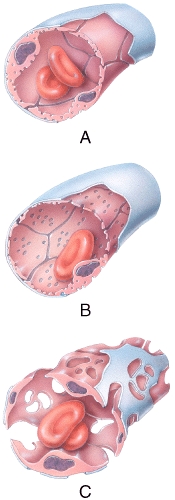
(Multiple Choice)
4.9/5 (81)
(81) The volume of blood that circulates through the systemic (or pulmonary)blood vessels per minute is called
(Multiple Choice)
4.9/5 (91)
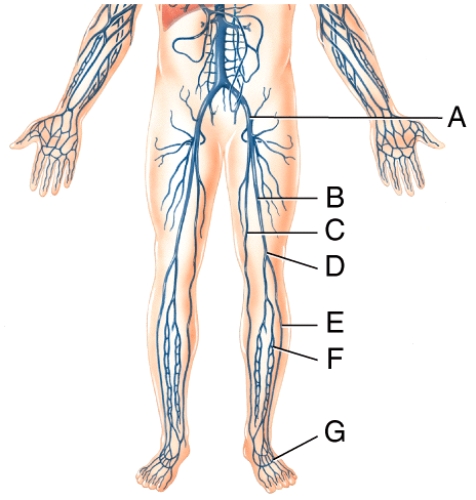
(91) 

Filters
- Essay(0)
- Multiple Choice(0)
- Short Answer(0)
- True False(0)
- Matching(0)