



 Chat with AI
Exam 18: The Endocrine System Unit Iv: Maintenance of the Human Body

Exam 1: An Introduction to the Human Body74 Questions
Exam 2: The Chemical Level of Organization75 Questions
Exam 3: The Cellular Level of Organization76 Questions
Exam 4: The Tissue Level of Organization75 Questions
Exam 5: The Integumentary System Unit Ii: Principles of Support and Movement74 Questions
Exam 6: The Skeletal System: Bone Tissue75 Questions
Exam 7: The Skeletal System: the Axial Skeleton75 Questions
Exam 8: The Skeletal System: the Appendicular Skeleton75 Questions
Exam 9: Joints75 Questions
Exam 10: Muscle Tissue75 Questions
Exam 11: The Muscular System Unit Iii: Control Systems of the Human Body75 Questions
Exam 12: Nervous Tissue75 Questions
Exam 13: The Spinal Cord and Spinal Nerves75 Questions
Exam 14: The Brain and Cranial Nerves75 Questions
Exam 15: The Autonomic Nervous System75 Questions
Exam 16: Sensory, Motor and Integrative Systems75 Questions
Exam 17: The Special Senses75 Questions
Exam 18: The Endocrine System Unit Iv: Maintenance of the Human Body75 Questions
Exam 19: The Cardiovascular System: the Blood74 Questions
Exam 20: The Cardiovascular System: the Heart74 Questions
Exam 21: The Cardiovascular System: Blood Vessels and Hemodynamics75 Questions
Exam 22: The Lymphatic System, Nonspecific Resistance to Disease, and Immunity75 Questions
Exam 23: The Respiratory System75 Questions
Exam 24: The Digestive System75 Questions
Exam 25: Metabolism73 Questions
Exam 26: The Urinary System73 Questions
Exam 27: Fluid, Electrolyte, and Acid-Base Homeostasis Unit V: Continuity48 Questions
Exam 28: The Reproductive Systems74 Questions
Exam 29: Development and Inheritance75 Questions
Select questions type


Compare and contrast the mechanisms of action of lipid-soluble versus water-soluble hormones.
(Essay)
4.9/5  (90)
(90) The anterior pituitary develops from which of the following germ layers during embryonic development?
(Multiple Choice)
4.7/5 (77)
(77) Which of the following statements does NOT describe a step in the synthesis and secretion of T3 and T4?
(Multiple Choice)
4.9/5 (73)
(73) Which of the following hormones promotes increases in the basal metabolic rate (BMR)?
(Multiple Choice)
4.9/5 (60)
(60) Which of the following hormones play key regulatory roles in the body's long-term response to stress?
(Multiple Choice)
4.9/5 (90)
(90) Which of the following statements correctly compares water-soluble hormones with lipid-soluble hormones?
(Multiple Choice)
5.0/5 (87)
(87) Which of the following is NOT a common characteristic of an exocrine gland?
(Multiple Choice)
4.8/5 (64)
(64) Which of the following is an abnormal condition of excess androgen secretion,observed primarily in women,that is characterized by the presence of excessive body and facial hair in a male pattern?
(Multiple Choice)
4.8/5 (78)
(78) Which of the following conditions could potentially result from hyposecretion of a hormone released by the portion of the marked gland in the diagram?
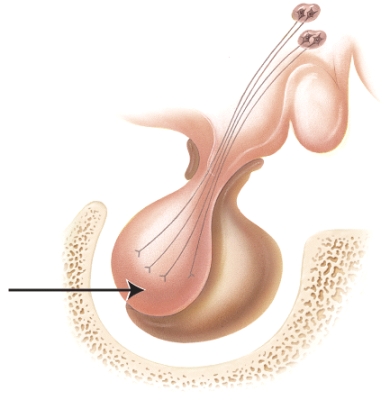
(Multiple Choice)
4.8/5 (79)
(79) Which of the following anterior pituitary hormones stimulates the adrenal cortex to secrete cortisol?
(Multiple Choice)
4.9/5 (74)
(74) Hypersecretion of a hormone by the endocrine gland marked in the diagram results in a type of depression that affects some people during the winter months,when the day length is short,known as
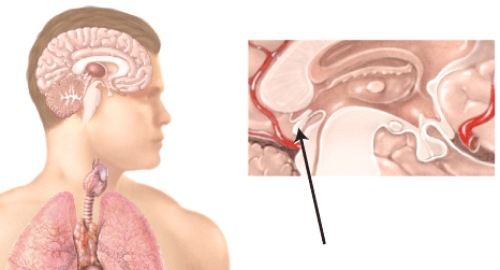
(Multiple Choice)
4.7/5 (71)
(71) Which of the following bones (marked in the diagram)contains a depression which houses the endocrine gland shown in the diagram?
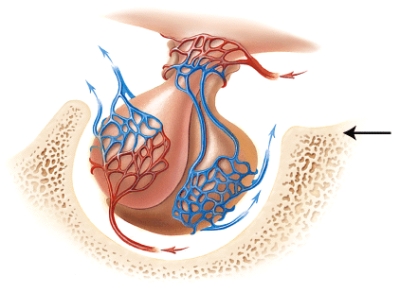
(Multiple Choice)
5.0/5 (83)
(83) When one hormone opposes the action of another hormone,it is called a(n)
(Multiple Choice)
4.7/5 (78)
(78) The disorder shown in one of the identical twins seen in this figure is due to a hypersecretion of hormones by which endocrine gland?
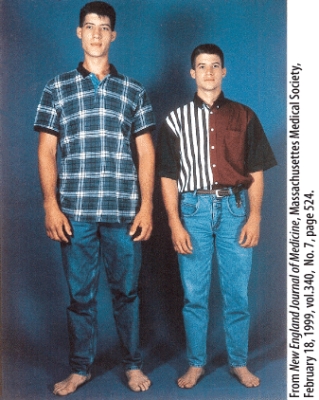
(Multiple Choice)
5.0/5 (76)
(76) Which of the labeled endocrine glands secretes hGH,TSH,FSH and other hormones?
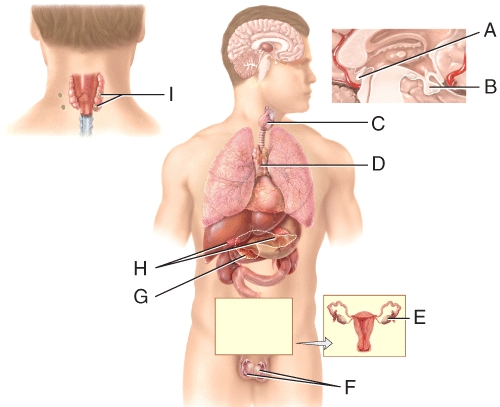
(Multiple Choice)
4.8/5 (85)
(85) 
Filters
- Essay(0)
- Multiple Choice(0)
- Short Answer(0)
- True False(0)
- Matching(0)