



 Chat with AI
Exam 16: Sensory, Motor and Integrative Systems

Exam 1: An Introduction to the Human Body74 Questions
Exam 2: The Chemical Level of Organization75 Questions
Exam 3: The Cellular Level of Organization76 Questions
Exam 4: The Tissue Level of Organization75 Questions
Exam 5: The Integumentary System Unit Ii: Principles of Support and Movement74 Questions
Exam 6: The Skeletal System: Bone Tissue75 Questions
Exam 7: The Skeletal System: the Axial Skeleton75 Questions
Exam 8: The Skeletal System: the Appendicular Skeleton75 Questions
Exam 9: Joints75 Questions
Exam 10: Muscle Tissue75 Questions
Exam 11: The Muscular System Unit Iii: Control Systems of the Human Body75 Questions
Exam 12: Nervous Tissue75 Questions
Exam 13: The Spinal Cord and Spinal Nerves75 Questions
Exam 14: The Brain and Cranial Nerves75 Questions
Exam 15: The Autonomic Nervous System75 Questions
Exam 16: Sensory, Motor and Integrative Systems75 Questions
Exam 17: The Special Senses75 Questions
Exam 18: The Endocrine System Unit Iv: Maintenance of the Human Body75 Questions
Exam 19: The Cardiovascular System: the Blood74 Questions
Exam 20: The Cardiovascular System: the Heart74 Questions
Exam 21: The Cardiovascular System: Blood Vessels and Hemodynamics75 Questions
Exam 22: The Lymphatic System, Nonspecific Resistance to Disease, and Immunity75 Questions
Exam 23: The Respiratory System75 Questions
Exam 24: The Digestive System75 Questions
Exam 25: Metabolism73 Questions
Exam 26: The Urinary System73 Questions
Exam 27: Fluid, Electrolyte, and Acid-Base Homeostasis Unit V: Continuity48 Questions
Exam 28: The Reproductive Systems74 Questions
Exam 29: Development and Inheritance75 Questions
Select questions type


Which type of sensory receptor responds to stimuli resulting from physical or chemical damage to tissue?
(Multiple Choice)
5.0/5  (82)
(82) What category of receptor cell is used to sense changes in the osmotic pressure of body fluids?
(Multiple Choice)
4.7/5 (72)
(72) What category of receptor cell is used to sense changes in the concentration of chemicals in body fluids?
(Multiple Choice)
4.8/5 (89)
(89) Which condition is characterized by a lack of memory for events occurring after the trauma or disease that caused the condition?
(Multiple Choice)
4.7/5 (96)
(96) Which of the labeled structures in the diagram senses touch,pressure and slow vibrations?
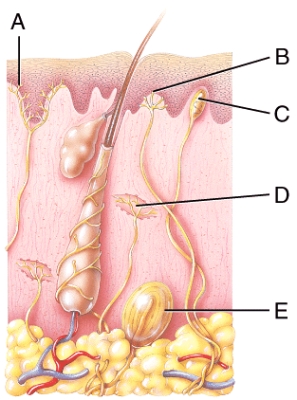
(Multiple Choice)
4.9/5 (79)
(79) Which of the labeled structures in the diagram of the trigeminothalamic pathway is the first-order neuron?
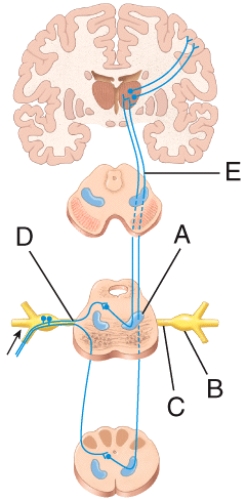
(Multiple Choice)
4.7/5 (70)
(70) Visceral pain coming from the urinary bladder is referred to which location(s)in the diagram?
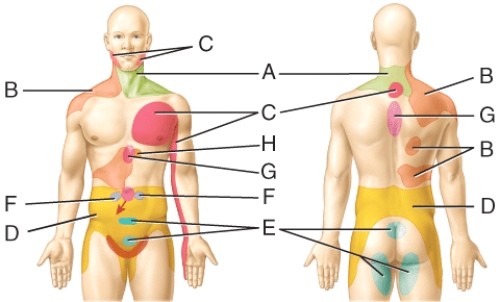
(Multiple Choice)
4.9/5 (82)
(82) List the six types of sensory receptors categorized based on the type of stimulus they detect and describe the types of stimuli that each type can detect.
(Essay)
4.9/5 (80)
(80) Which of the following stages of non-rapid eye movement (NREM)sleep is considered the deepest level of sleep?
(Multiple Choice)
4.8/5 (94)
(94) Which of the neurons in the diagram is modified in a manner that helps enhance the sensitivity of the receptor?
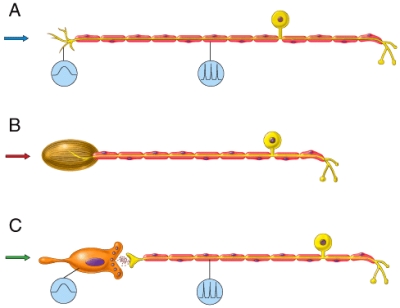
(Multiple Choice)
4.9/5 (84)
(84) Which of the following types of neurons conduct impulses from the thalamus to the primary somatosensory area of the cerebral cortex?
(Multiple Choice)
4.8/5 (63)
(63) Which of the labeled structures in the diagram of the trigeminothalamic pathway is the trigeminal nerve?
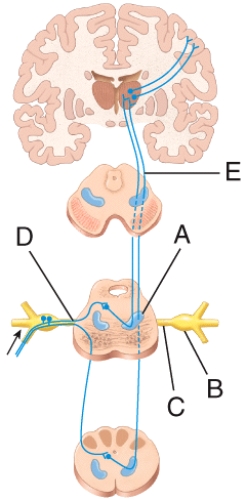
(Multiple Choice)
4.9/5 (80)
(80) Sensory receptors that are located in blood vessels and visceral organs and whose signals are not usually consciously perceived are the
(Multiple Choice)
4.8/5 (83)
(83) 
Filters
- Essay(0)
- Multiple Choice(0)
- Short Answer(0)
- True False(0)
- Matching(0)