



 Chat with AI
Exam 15: The Autonomic Nervous System

Exam 1: An Introduction to the Human Body74 Questions
Exam 2: The Chemical Level of Organization75 Questions
Exam 3: The Cellular Level of Organization76 Questions
Exam 4: The Tissue Level of Organization75 Questions
Exam 5: The Integumentary System Unit Ii: Principles of Support and Movement74 Questions
Exam 6: The Skeletal System: Bone Tissue75 Questions
Exam 7: The Skeletal System: the Axial Skeleton75 Questions
Exam 8: The Skeletal System: the Appendicular Skeleton75 Questions
Exam 9: Joints75 Questions
Exam 10: Muscle Tissue75 Questions
Exam 11: The Muscular System Unit Iii: Control Systems of the Human Body75 Questions
Exam 12: Nervous Tissue75 Questions
Exam 13: The Spinal Cord and Spinal Nerves75 Questions
Exam 14: The Brain and Cranial Nerves75 Questions
Exam 15: The Autonomic Nervous System75 Questions
Exam 16: Sensory, Motor and Integrative Systems75 Questions
Exam 17: The Special Senses75 Questions
Exam 18: The Endocrine System Unit Iv: Maintenance of the Human Body75 Questions
Exam 19: The Cardiovascular System: the Blood74 Questions
Exam 20: The Cardiovascular System: the Heart74 Questions
Exam 21: The Cardiovascular System: Blood Vessels and Hemodynamics75 Questions
Exam 22: The Lymphatic System, Nonspecific Resistance to Disease, and Immunity75 Questions
Exam 23: The Respiratory System75 Questions
Exam 24: The Digestive System75 Questions
Exam 25: Metabolism73 Questions
Exam 26: The Urinary System73 Questions
Exam 27: Fluid, Electrolyte, and Acid-Base Homeostasis Unit V: Continuity48 Questions
Exam 28: The Reproductive Systems74 Questions
Exam 29: Development and Inheritance75 Questions
Select questions type


Which disorder is characterized by an exaggerated response of the sympathetic division of the ANS that occurs in most individuals with spinal cord injury at or above T6?
(Multiple Choice)
4.9/5  (78)
(78) What type of neurotransmitter is used by the pathway shown in the figure?
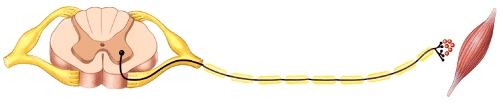
(Multiple Choice)
4.8/5 (82)
(82) Which of the following types of adrenergic receptors are found on cardiac muscle fibers where their activation stimulates increased force and rate of contraction of the heart?
(Multiple Choice)
4.8/5 (75)
(75) Which of the following is NOT a parasympathetic terminal ganglion?
(Multiple Choice)
4.8/5 (86)
(86) 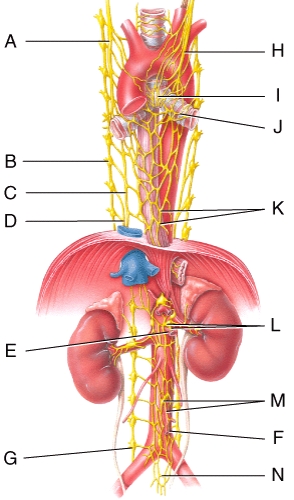
Which endocrine gland is directly innervated by sympathetic preganglionic axons?
(Multiple Choice)
4.7/5 (89)
(89) Where is the renal ganglion and renal plexus in the diagram?
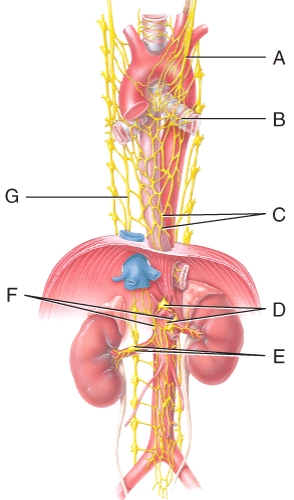
(Multiple Choice)
5.0/5 (70)
(70) Which disorder involves the loss of sympathetic innervation to one side of the face due to inherited mutation,injury or disease?
(Multiple Choice)
4.8/5 (84)
(84) Based on your knowledge of ANS receptors,explain how beta blockers are able to manage conditions such as hypertension (high blood pressure)?
(Essay)
4.8/5 (74)
(74) Which of the following does NOT describe the parasympathetic division of the ANS?
(Multiple Choice)
4.9/5 (72)
(72) 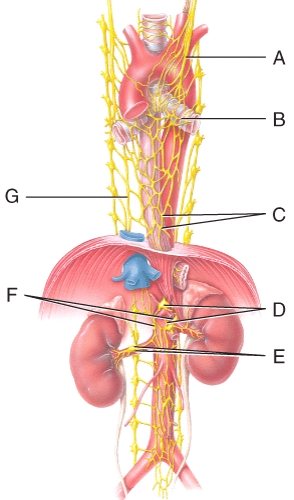
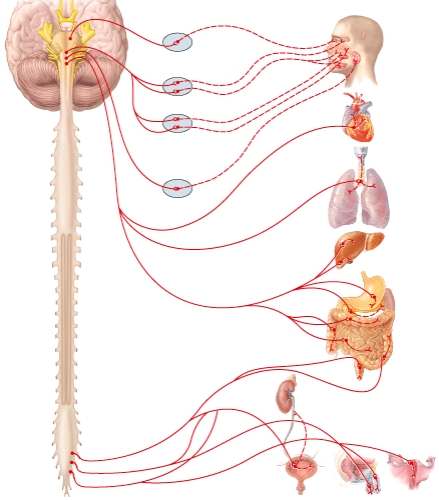
The chromaffin cells of the adrenal medulla possess what type of receptor that makes them responsive to the ACh released by preganglionic sympathetic neurons?
(Multiple Choice)
4.7/5 (74)
(74) Which of the following are structures containing sympathetic preganglionic axons that connect the anterior ramus of the spinal nerve with the ganglia of the sympathetic trunk?
(Multiple Choice)
4.9/5 (69)
(69) Which of the following is NOT a sympathetic prevertebral ganglion?
(Multiple Choice)
4.8/5 (76)
(76) Explain how blood flow to tissues changes during the fight-or-flight response.
(Essay)
4.9/5 (83)
(83) 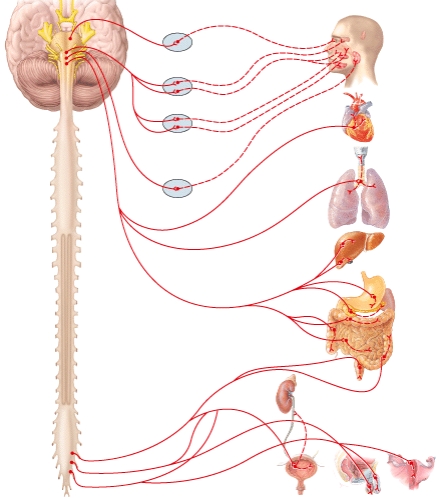
Which of the following types of adrenergic receptors are only found in brown adipose tissue where their activation stimulates heat production?
(Multiple Choice)
4.9/5 (81)
(81) 
Filters
- Essay(0)
- Multiple Choice(0)
- Short Answer(0)
- True False(0)
- Matching(0)